01Facts
The petitioner purchased CUET (UG) books published by Oswaal Books and Learning Pvt. Ltd. (R-3) on 10.02.2025.
¶ 2The books were marketed as "For 2025 Exam," "Strictly as per the latest examination pattern and syllabus," and "Bestseller," although the NTA had not yet released the CUET (UG) 2025 syllabus and pattern.
¶ 2After a legal notice dated 01.05.2025, the petitioner filed a complaint before the CCPA on 05.05.2025 under Sections 17 and 19 of the Consumer Protection Act, 2019 ("the Act") alleging misleading advertisements and unfair trade practices.
¶ 2R-3 denied liability on 02.06.2025.
¶ 2The petitioner then filed W.P.(C) 12267/2025 seeking a direction to decide the complaint.
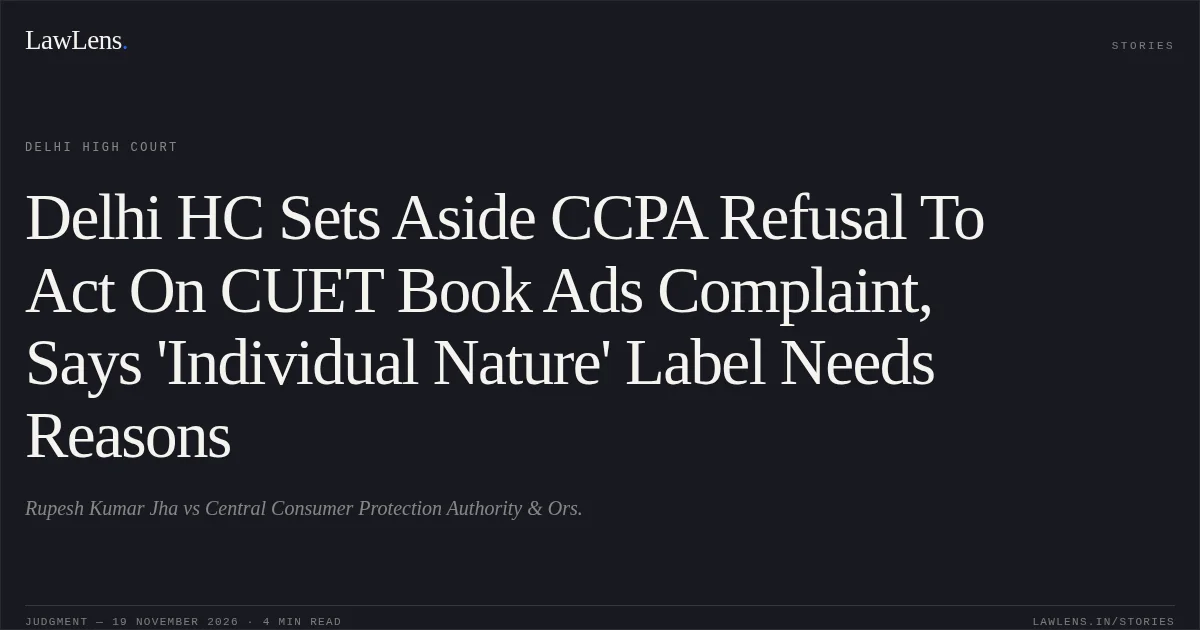
¶ 2During the pendency of that writ petition, the Under Secretary, CCPA, issued a communication dated 24.09.2025 declaring the grievance "of individual nature," referring it to the National Consumer Helpline, and stating that "no action lies on the part of CCPA."
¶ 2–3On 25.03.2026, the High Court disposed of the writ petition, left the petitioner's rights open, and granted liberty to approach the NCDRC.
¶ 5The NCDRC, by order dated 08.05.2026, held that the communication was an action under Section 19, not an order under Sections 20 or 21, so no appeal lay under Section 24. It did not examine the merits.
¶ 7The petitioner then filed the present writ petition under Article 226.
¶ 802Issues
i.1. Whether the CCPA's communication dated 24.09.2025, which disposed of the complaint by labelling the grievance "of individual nature" and referring it to the National Consumer Helpline without recording any reasons, can be sustained in law.
¶ 13–15, 18ii.2. Whether the complaint must be reconsidered by the CCPA, including the petitioner's objection that the Under Secretary lacked competence to decide it.
¶ 14, 1903Law Applied
The Court relied on the statutory framework of the Act, under which the CCPA is established by Section 10(1) to regulate consumer rights violations, unfair trade practices, and misleading advertisements affecting the public and consumers "as a class."
¶ 3The Court treated the distinction between an individual consumer grievance and a matter concerning consumers as a class as material to the CCPA's statutory functions under Sections 18 and 19.
¶ 16The Court applied the principle that an authority exercising statutory powers must give at least brief reasons showing that it considered the substance of the complaint and the statutory scheme before concluding that no action is warranted.
¶ 16–17The Court did not decide, and left open, the petitioner's competence challenge based on Section 14 (delegation) and Bombay Municipal Corporation v. Dhondu Narayan Chowdhary.
¶ 9, 19The Court did not rule on the respondents' contention that Section 19 does not mandate investigation.
¶ 10Kranti Associates (P) Ltd. v. Masood Ahmed Khan, (2010) 9 SCC 496, was cited by the petitioner for the duty to give reasons, but the Court's reasons-based holding is stated without express reliance on it.
¶ 9, 16–18Provisions in the judgment · 8 · Linked ones open on LawLens
Consumer Protection Act, 2019 Section 17Section 19Section 10Section 24Section 20Section 21Section 18Section 14
04Reasoning
The impugned communication did not engage with the complaint. It recorded that the grievance was "of individual nature" but gave no reason for that view.
¶ 3, 15The fact that an individual initiated the complaint could not, by itself, make the underlying grievance individual.
¶ 16The petitioner had alleged that the books were marketed for a national-level examination and could affect students beyond himself. The communication did not address these allegations, the manner of marketing, or the national scope of the examination.
¶ 9, 12, 15Because the petitioner had invoked the CCPA's jurisdiction on consumer rights, unfair trade practices, and misleading advertisements, a reasoned decision was especially necessary.
¶ 16The Court accepted that the CCPA could lawfully conclude that no proceedings were warranted, but held that such a conclusion must follow from consideration of the complaint and the statutory scheme and be supported by reasons, even if brief.
¶ 17The NCDRC's dismissal on maintainability did not examine the merits, so the legality of the CCPA's decision remained unreviewed.
¶ 7, 9The Court addressed the reasoning defect and did not decide the competence question, leaving it for the competent authority on remand.
¶ 1905Holding
The Court held that the communication dated 24.09.2025 "cannot be sustained in its present form" for want of reasons.
¶ 18The communication dated 24.09.2025 was set aside, and the complaint dated 05.05.2025 was remitted to the CCPA for fresh consideration in accordance with law.
¶ 18The CCPA must consider the petitioner's objection to the competence of the officer who dealt with the complaint, and the complaint must be decided by an authority competent in law.
¶ 19The CCPA was directed to pass a fresh reasoned order within two months of receiving the judgment, with liberty to the petitioner to seek remedies against that order.
¶ 20The Court expressed no opinion on the merits, on whether the representations amount to misleading advertisements or unfair trade practices, or on whether investigation is warranted.
¶ 21The petition and pending application were disposed of accordingly.
¶ 22Original Court PDF
Rupesh Kumar JhavsCentral Consumer Protection Authority & Ors.
Click to open original judgment
Original judgment, available to read, download and summarize on LawLens.in