Facts
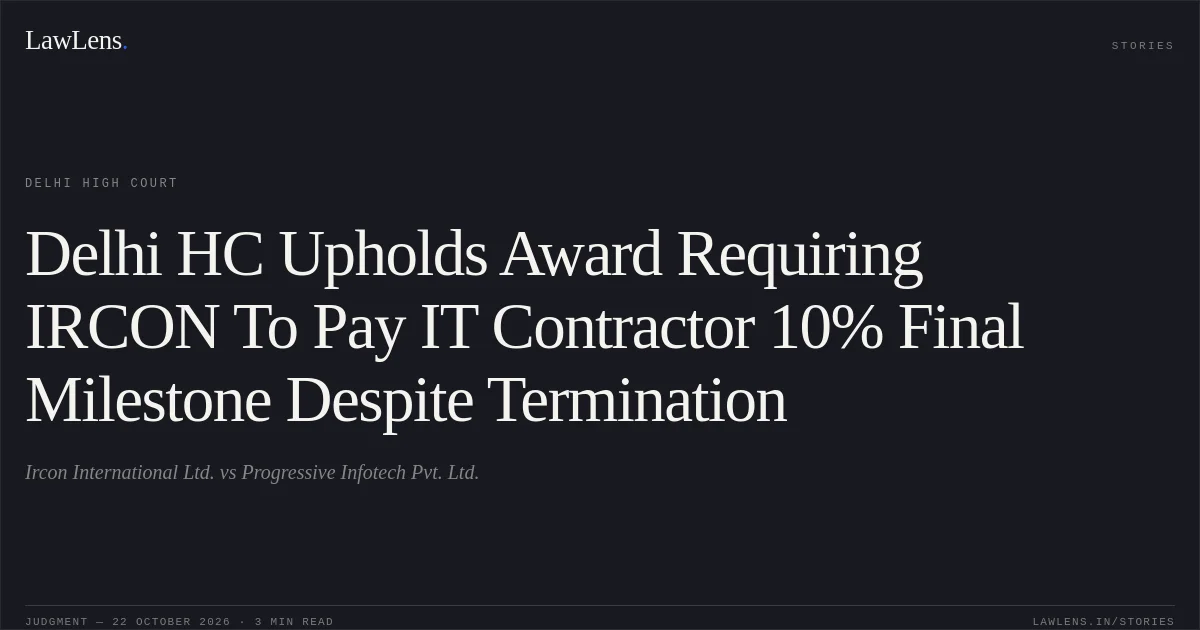
The dispute arose from a 2007 contract for the supply, installation and maintenance of a thin-client IT system.
Source reference: pp. 1–5The contract provided for milestone payments, including a final 10% payment after successful operation of the system for one year.
Source reference: pp. 1–5Ircon paid the first two milestones but withheld the final payment, later terminated the contract and invoked Progressive Infotech’s performance bank guarantee.
Source reference: pp. 1–5In arbitration, the tribunal awarded Progressive the balance payment, the bank-guarantee amount, the earnest-money deposit, interest and costs, while rejecting Ircon’s counterclaims.
Source reference: pp. 1–5Ircon challenged the award under Section 34 of the Arbitration and Conciliation Act, 1996, disputing the tribunal’s consideration of the termination, its award of the final milestone payment, and its rejection of the counterclaims.
Source reference: pp. 1–5Issues
1. Whether the tribunal exceeded its jurisdiction by considering the legality of the termination when no separate declaratory relief was sought.
Source reference: pp. 8–112. Whether the award of the Stage-III payment was patently illegal or perverse because the tribunal did not expressly find that the system had successfully operated for one year.
Source reference: pp. 11–163. Whether the tribunal’s rejection of Ircon’s counterclaims, including on the basis of insufficient proof of loss, warranted interference under Section 34.
Source reference: pp. 17–194. Whether the tribunal decided ex aequo et bono or as an amiable compositeur, contrary to Section 28(2), by referring to “justice, fairness and equity”.
Source reference: p. 19Law Applied
Section 34 limits judicial review of arbitral awards; the court does not sit in appeal or reappreciate evidence, and may interfere only on the statutory grounds.
Source reference: pp. 5–8Under Section 34(2A), patent illegality must go to the root of the matter; a perverse finding may include one based on no evidence, reached by ignoring vital evidence, or resting on an irrational view, but a possible view on the evidence is not open to correction [pp. 5–8, relying on OPG Power Generation (P) Ltd. v. Enexio Power Cooling Solutions (India) (P) Ltd., (2025) 2 SCC 417].
Source reference: pp. 5–8An award is read as a whole: discernible underlying reasons are not invalid merely because they are inadequately or imperfectly expressed [pp. 11–12, OPG Power Generation].
Source reference: pp. 11–12Pleadings identify the matters in dispute, and a tribunal may consider an issue expressly pleaded as the basis for substantive relief even without a separately worded prayer for a declaration [pp. 9–11].
Source reference: pp. 9–11Section 28(2) prohibits an arbitral tribunal from deciding ex aequo et bono or as an amiable compositeur without the parties’ express authorisation; Section 28(3) requires the tribunal to decide in accordance with the contract [pp. 6–7, 19–20].
Source reference: pp. 6–7, 19–20Reasoning
The termination’s legality was expressly pleaded as a basis for Progressive’s claims, so the tribunal could examine it while deciding the monetary relief, notwithstanding the absence of a separate declaratory prayer.
Source reference: pp. 8–11On the Stage-III payment, the award identified the one-year operating requirement and considered the parties’ correspondence, the absence of complaints during the warranty period, Ircon’s inconsistent positions on payment, and its subsequent additional order for computers.
Source reference: pp. 11–16Read as a whole, the award disclosed the tribunal’s reasoning and a plausible basis for its finding that Ircon had breached the contract; the absence of a finding in the precise words urged by Ircon did not establish patent illegality.
Source reference: pp. 11–16The counterclaims were not rejected solely because they were raised in the Statement of Defence: the tribunal also found no evidence of actual monetary or operational loss.
Source reference: pp. 17–19The alleged admission of payments for the first two stages established payment, not Ircon’s entitlement to a refund; the tribunal’s finding that Ircon was responsible for the fundamental breach further undermined that claim.
Source reference: pp. 17–19Finally, the reference to “justice, fairness and equity” appeared in the award’s concluding language; the relief was otherwise based on the pleadings, evidence and contractual terms, and the isolated expression did not show that the tribunal had decided ex aequo et bono.
Source reference: p. 19Holding
The Court held that Ircon had established no ground for interference under Section 34.
It dismissed the petition, leaving the arbitral award undisturbed.
Source reference: p. 20Acts & Sections Cited
4 provisions across 1 statute referred to in this judgment. Each provision opens on LawLens.
Arbitration and Conciliation Act, 19964
Original Court PDF
Ircon International Ltd.vsProgressive Infotech Pvt. Ltd.
Click to open original judgment
Original judgment, available to read, download and summarize on LawLens.in