01Facts
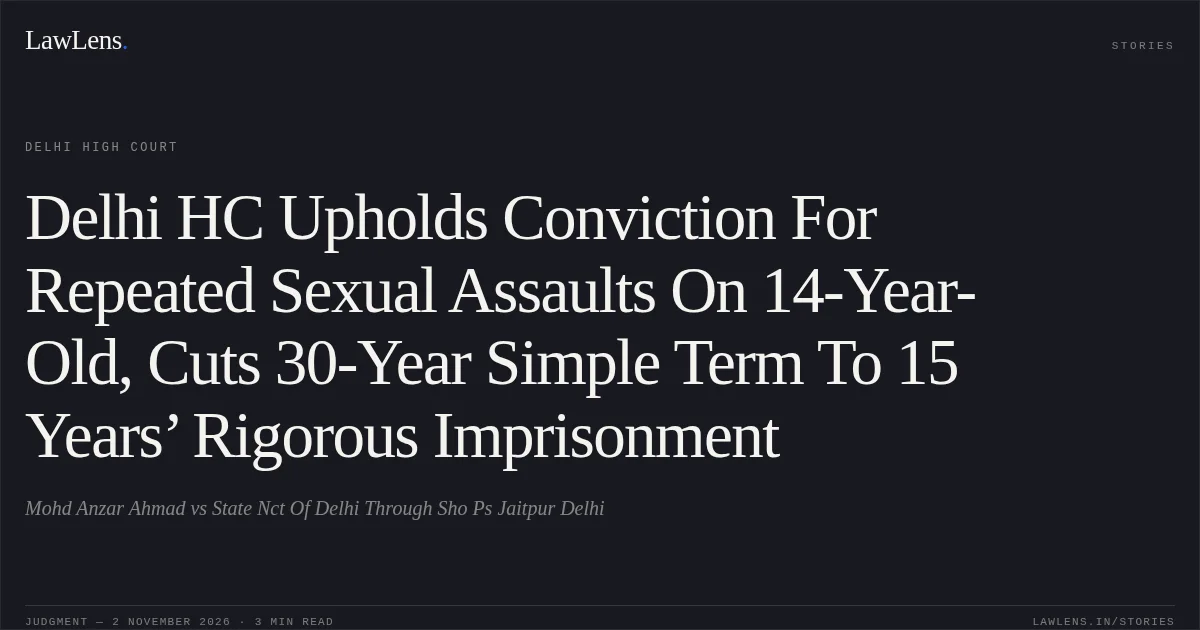
The victim went missing on 5 December 2014, aged below eighteen according to the prosecution, and was recovered from Akbarpur, Uttar Pradesh, on 13 February 2015.
pp. 2–10 · ¶ 3–9She testified that the appellant, a family acquaintance, had taken her away and repeatedly sexually assaulted her.
pp. 2–10 · ¶ 3–9At recovery, she was found to be pregnant; the pregnancy was subsequently terminated.
pp. 2–10 · ¶ 3–9The Trial Court convicted the appellant under Sections 363 and 506 IPC and Section 6 of the POCSO Act, sentencing him to five years’ simple imprisonment under Section 363, two years’ simple imprisonment under Section 506, and thirty years’ simple imprisonment under Section 6, with the sentences to run concurrently.
pp. 2–10 · ¶ 3–9The appellant appealed against the conviction and sentence under Section 415(2) BNSS.
p. 1 · ¶ 202Issues
i.1. Whether the prosecution established that the victim was below eighteen on the date of the incident and that the appellant took her away and subjected her to penetrative sexual assault.
p. 13 · ¶ 22ii.2. Whether the convictions under Sections 363 and 506 IPC and Section 6 of the POCSO Act were supported by the evidence, notwithstanding the alleged inconsistencies and investigative lapses.
pp. 21–25 · ¶ 37–46iii.3. Whether the thirty-year sentence of simple imprisonment under Section 6 of the POCSO Act should be modified, including to conform to the punishment prescribed when the offences occurred.
pp. 25–29 · ¶ 47–5803Law Applied
A sexual-offence conviction may rest on the victim’s sole testimony where it is cogent, consistent on material particulars and inspires confidence; corroboration is not invariably required (Rai Sandeep v. State (NCT of Delhi), (2012) 8 SCC 21, and Nirmal Premkumar v. State, 2024 SCC OnLine SC 260).
p. 15 · ¶ 26Under the POCSO Act, the presumptions in Sections 29 and 30 arise only after the prosecution establishes the requisite foundational facts, and a child’s consent to sexual intercourse is immaterial.
p. 21 · ¶ 37Section 6, as applicable to offences committed in 2014–15, prescribed rigorous imprisonment of at least ten years, extendable to life; the 2019 enhancement could not apply retrospectively under Article 20(1) of the Constitution (Satauram Mandavi v. State of Chhattisgarh, MANU/SC/0983/2025).
pp. 25–26 · ¶ 48–49Sentencing must be proportionate and account for the offence, the offender and the possibility of reformation (Gopal Singh v. State of Uttarakhand, (2013) 7 SCC 545).
pp. 26–27 · ¶ 50The appellate court may alter the nature or extent of sentence under Section 386(b)(iii) CrPC.
p. 27 · ¶ 53Provisions in the judgment · 14 · Linked ones open on LawLens
Bharatiya Nagarik Suraksha Sanhita, 2023 Section 415
Indian Penal Code, 1860 Section 363Section 506Section 376Section 53
Protection of Children from Sexual Offences Act, 2012 Section 6Section 29Section 30
Code of Criminal Procedure, 1973 Section 207Section 164Section 161Section 313Section 315Section 386
04Reasoning
The Court accepted the school record and affidavit proved through PW-4, together with the parents’ evidence, as establishing that the victim was under eighteen; the defence produced no reliable evidence supporting its assertion that she was born in 1997.
pp. 14–15 · ¶ 23–25It found her account consistent on the appellant’s identity, the taking and confinement, and the repeated assaults.
pp. 17–21 · ¶ 28–36The pregnancy and ultrasound findings corroborated sexual intercourse during the relevant period, though the inconclusive DNA report did not identify the appellant as the biological father.
pp. 17–21 · ¶ 28–36The Court held that discrepancies and omissions in the recovery investigation did not displace the victim’s testimony or the evidence corroborating her recovery.
pp. 22–24 · ¶ 38–42It therefore upheld the convictions.
pp. 25–29 · ¶ 47–58On sentence, it found that thirty years’ simple imprisonment was not adequately justified and, in any event, did not conform to Section 6’s requirement of rigorous imprisonment.
pp. 25–29 · ¶ 47–58Considering the offence’s gravity alongside the appellant’s age, antecedents and period in custody, it substituted fifteen years’ rigorous imprisonment.
pp. 25–29 · ¶ 47–5805Holding
The appeal was partly allowed: the convictions under Sections 363 and 506 IPC and Section 6 of the POCSO Act were affirmed, but the thirty-year sentence of simple imprisonment under Section 6 was modified to fifteen years’ rigorous imprisonment.
pp. 29–30 · ¶ 59–61The fine and default sentence under Section 6, the sentences under Sections 363 and 506 IPC, and the direction that all substantive sentences run concurrently remained unchanged.
pp. 29–30 · ¶ 59–61The appellant was entitled to set-off for detention already undergone in accordance with law.
pp. 29–30 · ¶ 59–61Original Court PDF
Mohd Anzar AhmadvsState Nct Of Delhi Through Sho Ps Jaitpur Delhi
Click to open original judgment
Original judgment, available to read, download and summarize on LawLens.in