Facts
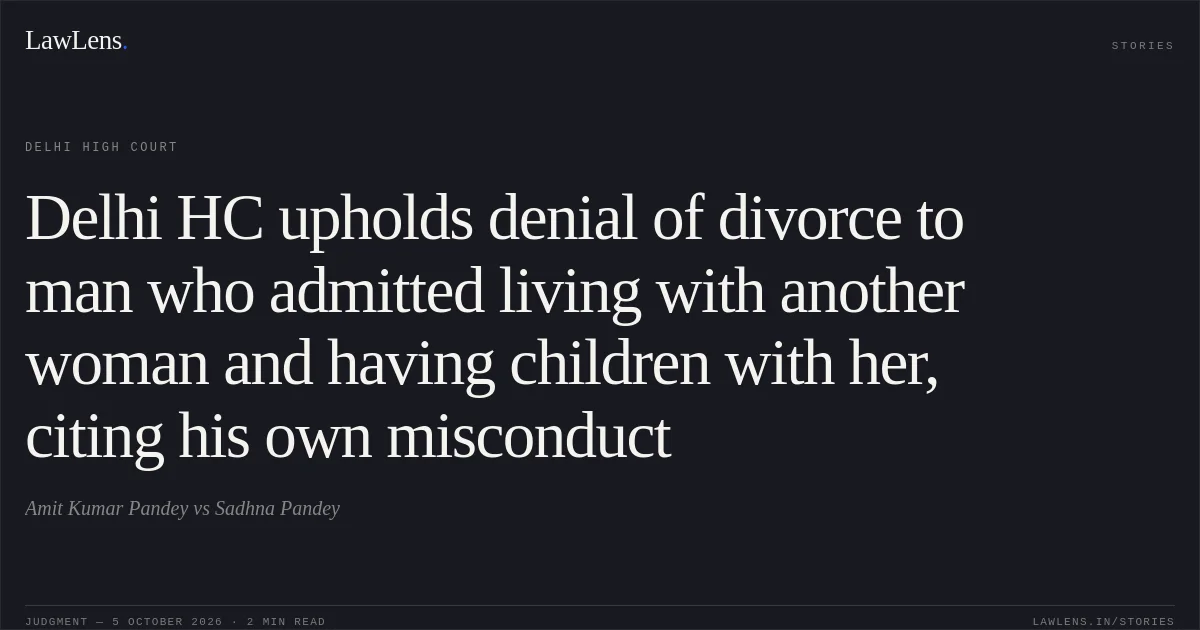
The parties married on 10 June 2015 and began living separately on 17 July 2017. The appellant issued a notice referring to desertion but later petitioned for divorce on the ground of cruelty.
Source reference: pp. 1–2, para. 2During the divorce proceedings, the respondent produced school and bank records indicating that the appellant was in a relationship with another woman and had children with her. When recalled for examination, the appellant admitted the documents; the Family Court dismissed his petition under Section 23(1)(a) of the Hindu Marriage Act, 1955, finding that he was taking advantage of his own wrong, and imposed costs of ₹2 lakh.
Source reference: pp. 2–4, paras. 3–5The appellant appealed that decision.
Source reference: p. 1, para. 1Issues
1. Whether the appellant’s admitted relationship with another woman and children from that relationship constituted his own wrong, disentitling him to divorce under Section 23(1)(a) of the Hindu Marriage Act, 1955.
Source reference: pp. 5–8, paras. 6–132. Whether the Family Court’s dismissal of the divorce petition and award of costs warranted appellate interference.
Source reference: pp. 4–5, 8, paras. 5–6, 13–14Law Applied
Section 23(1)(a) of the Hindu Marriage Act, 1955 requires a court, before granting matrimonial relief, to be satisfied that the petitioner is not taking advantage of his or her own wrong.
Source reference: p. 5, paras. 7–8In Hirachand Srinivas Mangaonkar v. Sunanda, (2001) 4 SCC 125, the Supreme Court held that continuing adulterous conduct may constitute a continuing wrong and that a petitioner cannot rely on illegality or immorality to obtain matrimonial relief.
Source reference: pp. 6–8, para. 12The Court distinguished Sushila v. Joginder, MAT.APP.(F.C.) 236/2018, observing that the effect of Section 23(1)(a) had not been considered there.
Source reference: pp. 5–6, paras. 9–10Reasoning
The appellant’s relationship and children with another woman were supported by the school and bank records and were not denied; the appellant admitted the documents.
Source reference: pp. 2–5, paras. 3–6, 11The Court concluded that, in seeking divorce while his own conduct amounted to a wrong under Section 23(1)(a), the appellant could not obtain relief by relying on that conduct.
Source reference: pp. 5–8, paras. 8, 11–13Applying Hirachand, the Court found no basis to fault the Family Court’s reliance on Section 23(1)(a), and also considered the burden further proceedings in Delhi would place on the respondent.
Source reference: pp. 6–8, paras. 11–13Holding
The High Court dismissed the appeal and pending application(s), declining to issue notice to the respondent.
It left the respondent at liberty to apply for release of the ₹2 lakh deposited by the appellant with the Registrar General.
Source reference: p. 8, para. 15Acts & Sections Cited
3 provisions across 2 statutes referred to in this judgment. Each provision opens on LawLens.
Family Courts Act, 19841
Hindu Marriage Act, 19552
Original Court PDF
Amit Kumar PandeyvsSadhna Pandey
Click to open original judgment
Original judgment, available to read, download and summarize on LawLens.in