Facts
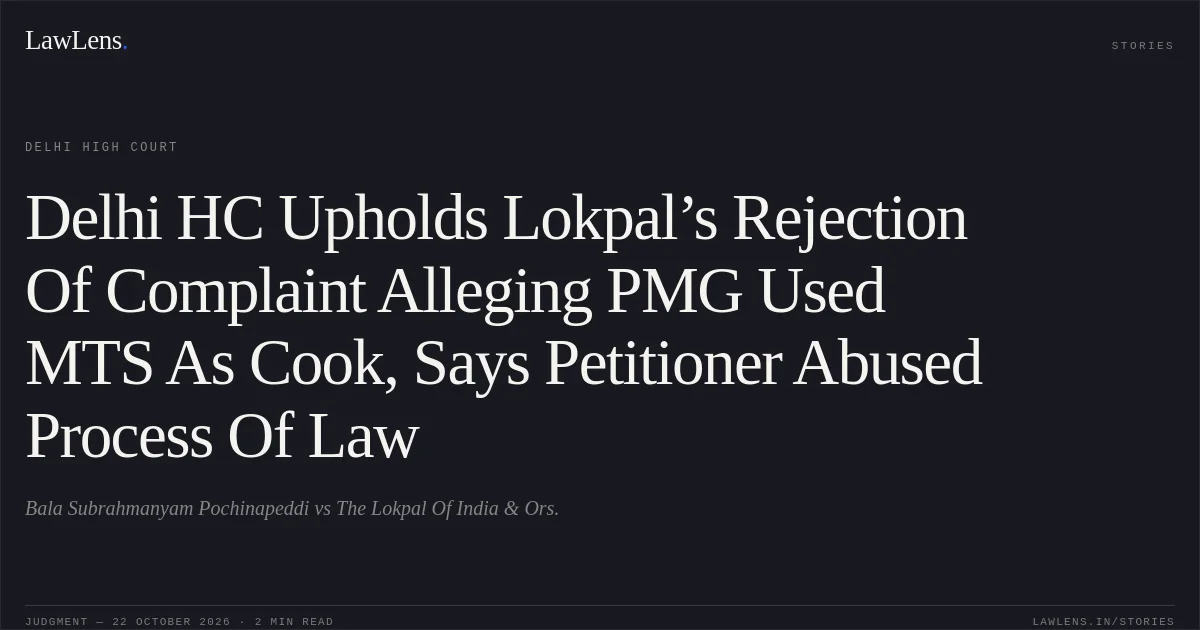
The petitioner challenged the Lokpal’s order dated 19 August 2026 rejecting his complaint against a Senior Superintendent of Railways and the then Postmaster General, Southern Region.
Source reference: pp. 1–5, paras. 1–2The complaint alleged that a Multi-Tasking Staff employee had been deployed as a cook and watchman at the Postmaster General’s residence, causing financial loss to the Department and attracting offences under the Prevention of Corruption Act, 1988.
Source reference: pp. 1–5, paras. 1–2The Lokpal relied on prior CVC-related proceedings in which the CVO, Department of Posts, had found the allegations unsubstantiated and recommended closure.
Source reference: pp. 5–6, paras. 3–4, 17–18After the Madras High Court declined territorial jurisdiction, the petitioner brought this writ petition under Articles 226 and 227, contending that the Lokpal had failed to follow Section 20 of the Lokpal and Lokayuktas Act, 2013, and had not independently examined the complaint.
Source reference: p. 6, paras. 5, 7–8Issues
Whether the Lokpal was required to conduct an independent preliminary inquiry under Section 20 before rejecting the complaint
Source reference: pp. 6, 8–9, paras. 7–8, 13–16Whether the Lokpal could rely on the prior CVC/CVO examination and its findings when deciding not to proceed with the complaint
Source reference: pp. 8–10, paras. 16–22Law Applied
Section 2(e) of the Lokpal and Lokayuktas Act, 2013 defines a complaint as an allegation that a public servant has committed an offence punishable under the Prevention of Corruption Act, 1988.
Source reference: p. 6, para. 10Section 20(1) provides that, on receiving a complaint, the Lokpal may decide whether to proceed and, if it does, may order a preliminary inquiry or investigation; where it decides to proceed with a preliminary inquiry, the statutory provisos prescribe referral to the CVC for specified categories of public servants.
Source reference: pp. 7–8, para. 14The Court held that the Lokpal must consider the material before it when deciding whether to initiate an inquiry, and that an inquiry is not required for every complaint.
Source reference: pp. 8–10, paras. 15–16, 22The Court also observed that the alleged conduct’s fit within Section 7 of the Prevention of Corruption Act, concerning offences relating to public servants being bribed, was doubtful.
Source reference: p. 7, paras. 11–12Reasoning
The Court read Section 20 as requiring the Lokpal first to decide whether to proceed, rather than mandating an inquiry upon every complaint.
Source reference: pp. 8–9, paras. 15–18In making that decision, the Lokpal could consider the prior examination of the identical complaints by the CVO and the resulting conclusion that the allegations were unsubstantiated.
Source reference: pp. 8–9, paras. 15–18The Court also noted the CVO’s finding that the MTS was not under the petitioner’s administrative control and that the petitioner was not authorised to obtain the employee’s statement.
Source reference: pp. 9–10, paras. 19–20In these circumstances, the Court found that the Lokpal had considered the relevant material and that its decision-making process disclosed no procedural infirmity.
Source reference: p. 10, paras. 21–22Holding
The Court held that Section 20 did not require the Lokpal to initiate an inquiry into the petitioner’s complaint and found no infirmity in the Lokpal’s consideration of the CVC/CVO material before declining to proceed.
The writ petition and all pending applications were dismissed.
Source reference: p. 10, para. 23Acts & Sections Cited
4 provisions across 3 statutes referred to in this judgment. Each provision opens on LawLens.
Prevention of Corruption Act, 19881
Lokpal and Lokayuktas Act, 20132
Central Vigilance Commission Act, 20031
Original Court PDF
Bala Subrahmanyam PochinapeddivsThe Lokpal Of India & Ors.
Click to open original judgment
Original judgment, available to read, download and summarize on LawLens.in