Facts
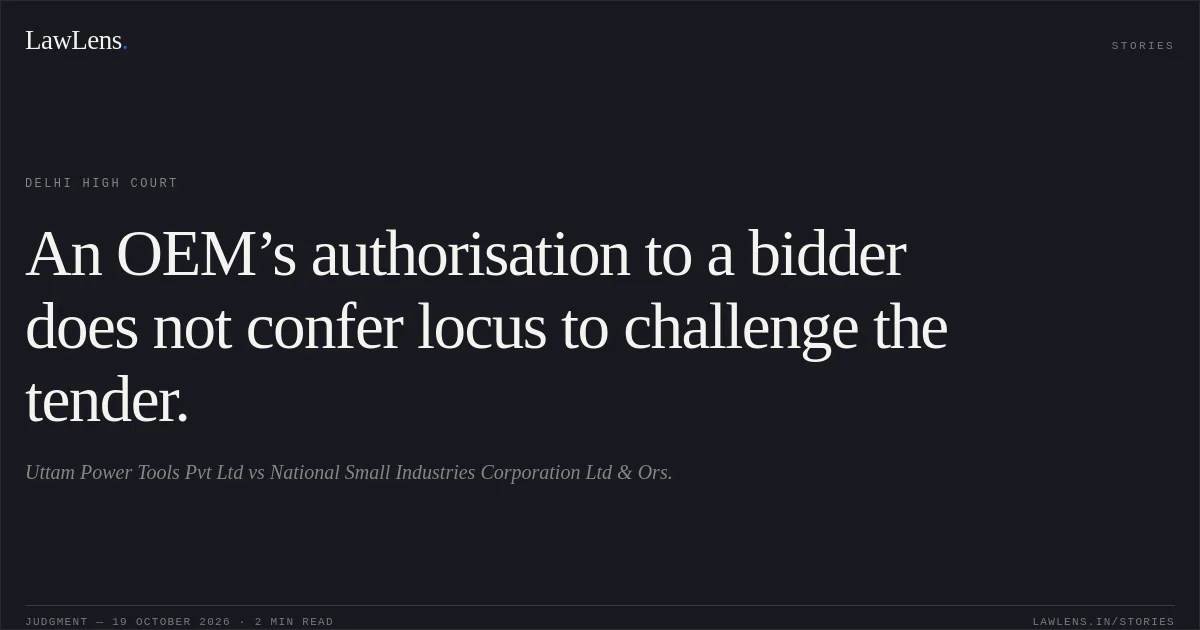
The petitioner, an Original Equipment Manufacturer (OEM), issued a Manufacturer’s Authorization Form (MAF) to a bidder who did not succeed in the tender process.
Source reference: paras. 1–3The petitioner challenged the tender process, alleging that the tender conditions had not been strictly followed and that bidders had not been provided an equal opportunity.
Source reference: paras. 1–3The respondents objected that the petitioner had not itself submitted a bid and lacked standing to maintain the petition.
Source reference: paras. 1–3The petitioner relied on Jasbhai Motibhai Desai v. Roshan Kumar and Suresh Kumar Jain v. Lt. Governor to assert that its commercial interest in supplying equipment gave it sufficient locus.
Source reference: paras. 4–5The respondents relied on NHAI v. Gwalior-Jhansi Expressway Ltd. and the Division Bench decision in Primatel Fibcom Ltd. v. Indian Oil Corporation Ltd.
Source reference: paras. 6–7Issues
Whether an OEM that did not participate in the tender, but issued an MAF to a bidder, has locus to challenge the tender process
Source reference: paras. 3–4, 8Whether the authorities relied on by the petitioner support standing in these circumstances
Source reference: paras. 10–13Law Applied
Under the principles governing writ standing under Article 226, a petitioner must establish a sufficient legal interest in the challenged action; a commercial or economic interest, without more, does not necessarily confer standing.
Source reference: no citationIn NHAI v. Gwalior-Jhansi Expressway Ltd., the Supreme Court held that an entity that did not participate in a tender generally cannot challenge the tender outcome or assert rights under its terms, particularly where the tender conditions remain unchallenged.
Source reference: para. 6The Court also relied on the Division Bench’s application of that principle in Primatel Fibcom Ltd., which held that an OEM’s intention to supply equipment to a bidder does not, by itself, confer locus to challenge the tender.
Source reference: paras. 7, 13Jasbhai Motibhai Desai requires strict scrutiny of standing in writ proceedings, while Suresh Kumar Jain was distinguished as not governing a third party’s challenge to a tender process.
Source reference: paras. 10–12Reasoning
The petitioner had issued an MAF but had neither submitted a bid nor entered into a contract with the tender-inviting authority.
Source reference: paras. 8–9The MAF was a document required for a third party’s tender submission; it did not make the petitioner a tenderer or give it rights under the tender.
Source reference: paras. 8–9Any arrangement between the petitioner and the bidder could not bind the respondents, and any dispute arising from that arrangement had to be pursued through other remedies.
Source reference: para. 9The bidder to whom the MAF was issued was not before the Court and had not challenged the tender outcome; the petitioner could not assert that bidder’s rights as its own.
Source reference: paras. 11, 14Applying NHAI and Primatel Fibcom, the Court held that the petitioner’s status as an OEM and its anticipated commercial interest were insufficient to establish locus.
Source reference: paras. 12–13Holding
The Court held that the petitioner lacked locus standi to challenge the tender process and that the petition was not maintainable.
The writ petition was dismissed, and any pending applications were disposed of accordingly.
Source reference: paras. 16–17Original Court PDF
Uttam Power Tools Pvt LtdvsNational Small Industries Corporation Ltd & Ors.
Click to open original judgment
Original judgment, available to read, download and summarize on LawLens.in