Facts
The trial court passed a judgment and decree against the petitioners on 10 July 2019.
Source reference: no citationThe petitioners stated that they learned of it in February 2020, but applied for certified copies only in September 2022 and filed a regular civil appeal that month, 712 days late.
Source reference: para. 3.1–3.2, 4They attributed the delay in part to the COVID-19 situation.
Source reference: para. 3.1–3.2, 4The appellate court’s order dated 13 October 2025 refused to condone the delay.
Source reference: para. 3.1–3.2In a separate order dated 17 July 2025, the appellate court had recorded that respondent No. 1.3 had died and that the appeal stood abated against him.
Source reference: para. 8Issues
Whether the petitioners established sufficient cause under Section 5 of the Limitation Act to condone the 712-day delay in filing their appeal.
Source reference: para. 3–7Whether the appeal had abated against all respondents because a deceased respondent and the other respondents had a common interest in the subject matter.
Source reference: para. 8Law Applied
Section 5 of the Limitation Act permits a court to condone delay where sufficient cause is established, but the discretion must be exercised judiciously; negligence, inaction, want of bona fides, or lack of due diligence may justify refusing condonation.
Source reference: para. 6.1–6.3The Court relied on Rajneesh Kumar v. Ved Prakash for the principle that a litigant must remain vigilant and cannot ordinarily shift responsibility for delay entirely to counsel.
Source reference: para. 6The Court relied on K.B. Lal v. Gyanendra Pratap and Esha Bhattacharjee v. Managing Committee of Raghunathpur Nafar Academy for the principles governing a liberal but reasoned approach to “sufficient cause”.
Source reference: para. 6.1The Court relied on Pathapati Subba Reddy v. Special Deputy Collector (LA) for the propositions that limitation serves public policy and that a liberal approach cannot defeat limitation law.
Source reference: para. 6.2The Court relied on Basawaraj v. Special Land Acquisition Officer for the rule that delay cannot be condoned where the party was negligent, inactive, or lacked bona fides.
Source reference: para. 6.3The Court considered the petition under its supervisory jurisdiction under Article 227 of the Constitution.
Source reference: para. 2Reasoning
The petitioners knew of the decree by February 2020 but did not seek certified copies until September 2022.
Source reference: para. 4–5, 7The Court found that the COVID-19 circumstances did not adequately explain this period: the petitioners could have applied for copies when they learned of the decree, and time remained after the first phase of the pandemic for them to pursue the appeal.
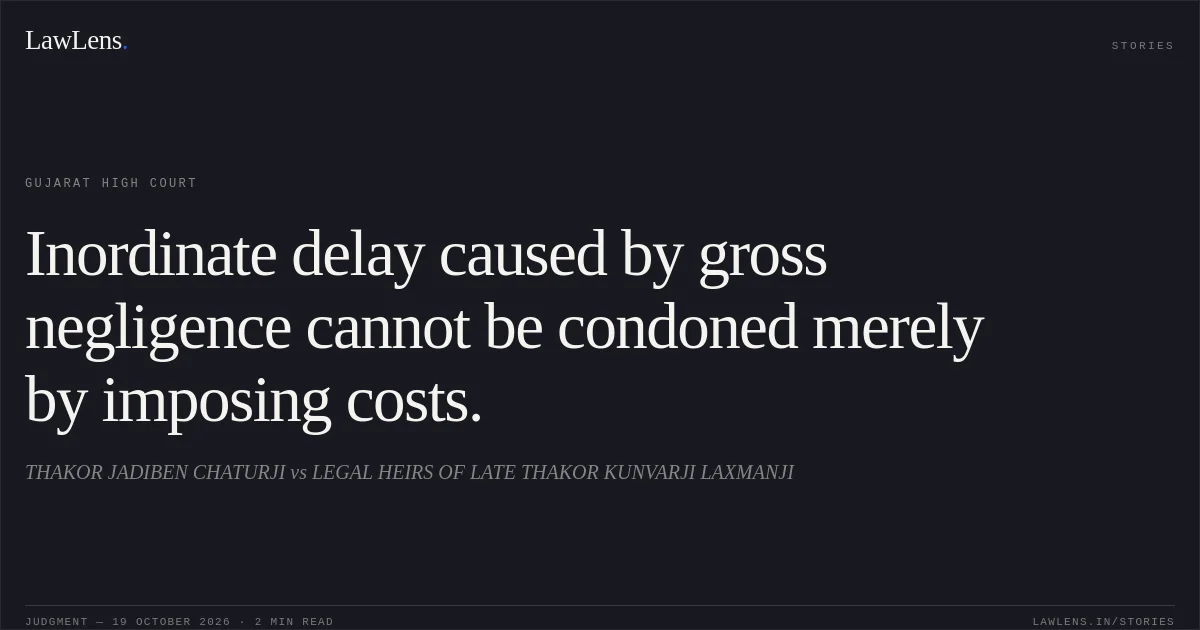
Source reference: para. 4–5, 7Applying the cited principles, the Court characterized the delay as gross negligence and a lackadaisical approach, and held that imposing costs would not cure the absence of sufficient cause.
Source reference: para. 7, 9It also noted that the deceased respondent and the other respondents were legal heirs and representatives with a common interest in the suit, and concluded that the appeal had abated against all respondents.
Source reference: para. 8Holding
The Court held that the petitioners had not shown sufficient cause for the 712-day delay and found no error in the appellate court’s refusal to condone it.
It further held that the appeal had abated against all respondents.
Source reference: para. 8The petition was dismissed in limine, with no order as to costs.
Source reference: para. 9–10Acts & Sections Cited
2 provisions across 1 statute referred to in this judgment. Each provision opens on LawLens.
Original Court PDF
THAKOR JADIBEN CHATURJIvsLEGAL HEIRS OF LATE THAKOR KUNVARJI LAXMANJI
Click to open original judgment
Original judgment, available to read, download and summarize on LawLens.in