Facts
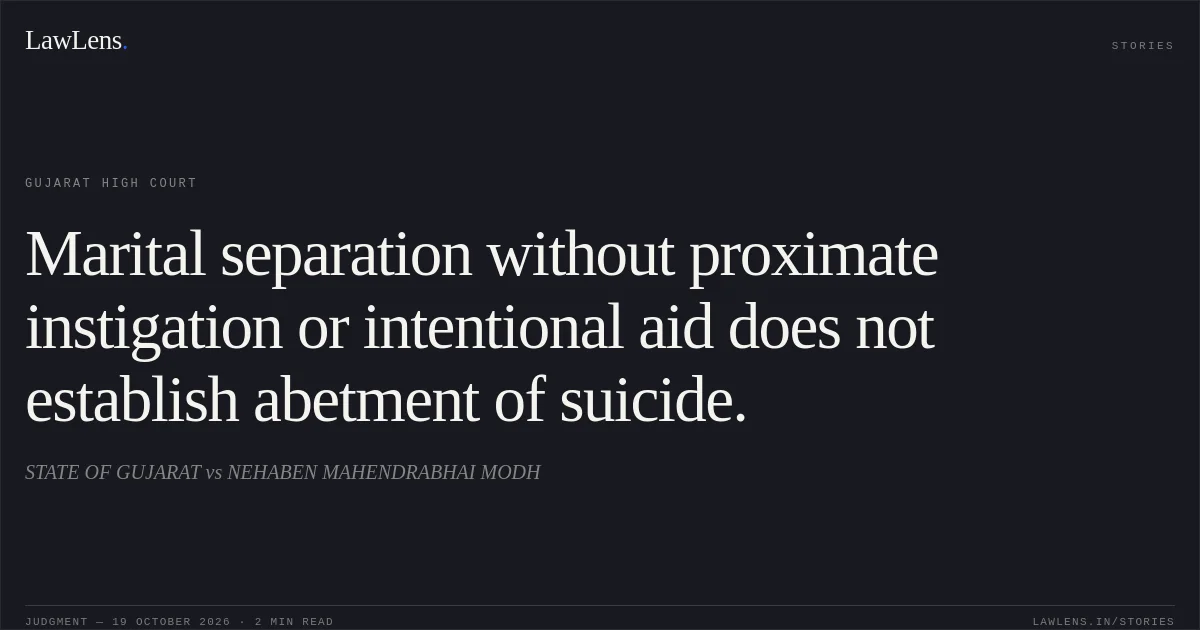
Dr. Deven Oza married respondent No. 1, Dr. Nehaben Modh, in 2000. After pursuing postgraduate studies and joining government service, they separated in 2005 under a notarised agreement.
Source reference: paras. 2.1–2.5Deven later died by suicide in his government quarters, leaving a note and a recorded mobile-phone message expressing distress over the separation.
Source reference: paras. 2.1–2.5His father alleged that Nehaben’s relationship with respondent No. 2 and the respondents’ conduct had led to the separation and abetted the suicide.
Source reference: para. 2.6The Sessions Court acquitted the respondents of charges under Sections 306 and 114 IPC; the State appealed under Section 378 CrPC.
Source reference: paras. 1, 2.8–2.10Issues
Whether the Trial Court erred in acquitting the respondents of the charges under Sections 306 and 114 IPC
Source reference: para. 4Whether the acquittal was vitiated by an error of law or fact, or was illegal or perverse so as to warrant appellate interference
Source reference: para. 4Law Applied
Section 306 IPC penalises abetment of suicide, while Section 107 IPC defines abetment as instigation, participation in a conspiracy accompanied by an act or illegal omission, or intentional aid.
Source reference: paras. 22–23The Court, relying on Gangula Mohan Reddy v. State of Andhra Pradesh, (2010) 1 SCC 750, stated that Section 306 requires proof of a clear and proximate act of instigation, incitement or intentional aid.
Source reference: para. 17On appeals against acquittal, an appellate court may review and reappreciate the evidence, but must account for the reinforced presumption of innocence; where two reasonable conclusions are possible, the acquittal should not be disturbed.
Source reference: paras. 28–31Reasoning
The suicide note and recorded message showed that Deven was distressed by the separation, but the Court found no cogent evidence that the respondents had instigated, conspired in, or intentionally aided his suicide.
Source reference: paras. 13–16, 18–21The allegations concerning an extramarital relationship were weakened by omissions in the complainant’s earlier statements and evidence that respondent No. 2 was no longer regularly travelling between the cities or in regular contact with respondent No. 1.
Source reference: paras. 9–12The Court therefore found no basis to conclude that the Trial Court’s acquittal was perverse or otherwise warranted interference.
Source reference: paras. 28–33Holding
The High Court held that the prosecution had failed to prove the essential ingredients of abetment under Sections 306 and 107 IPC, and found no illegality, perversity or other error in the acquittal.
The State’s appeal was dismissed and the acquittal confirmed; the bail bond was cancelled and the record and proceedings were directed to be returned to the Trial Court.
Source reference: para. 34Acts & Sections Cited
5 provisions across 2 statutes referred to in this judgment. Each provision opens on LawLens.
Code of Criminal Procedure, 19732
Indian Penal Code, 18603
Original Court PDF
STATE OF GUJARATvsNEHABEN MAHENDRABHAI MODH
Click to open original judgment
Original judgment, available to read, download and summarize on LawLens.in