Facts
The petitioner has Mayer-Rokitansky-Küster-Hauser Syndrome Type-II (MRKH Type-II), including congenital absence of the uterus and upper vagina, with right renal agenesis.
Source reference: para. 2–7A Kerala Government order classified congenital absence of the uterus as a 50% disability, and a medical board certified the petitioner as having 50% disability.
Source reference: para. 2–7Her claim for admission to an MBBS course under the disability quota was rejected because her condition was not a specified disability under the Rights of Persons with Disabilities Act, 2016 (RPwD Act).
Source reference: para. 2–7Following earlier proceedings in Kerala, she sought inclusion of MRKH Syndrome as a specified disability.
Source reference: para. 2–7A Central Government committee declined to recommend inclusion, reasoning that the condition did not affect daily functioning and that any resulting specified impairment would already be covered by the Act.
Source reference: para. 2–7The petitioner challenged that decision and sought a direction requiring inclusion.
Source reference: para. 2–7, 15Issues
1. Whether the Court could direct the Central Government to include MRKH Syndrome Type-II as a specified disability under the RPwD Act
Source reference: para. 15–212. Whether the committee’s decision, communicated on 20 February and 10 October 2023, refusing to recommend inclusion of MRKH Syndrome was arbitrary or otherwise unlawful
Source reference: para. 15–16, 33–35Law Applied
Under Sections 2(c) and 2(s) of the RPwD Act, a person with disability must have a long-term physical, mental, intellectual or sensory impairment which, in interaction with barriers, hinders full and effective participation in society; the existence of a medical condition or impairment alone is insufficient.
Source reference: para. 23–25A “specified disability” is one listed in the Schedule or notified by the Central Government under clause 6 of the Schedule, while a “benchmark disability” requires at least 40% of a specified disability; reservation benefits therefore cannot be claimed solely on the basis of a certified percentage.
Source reference: Sections 2(r), 2(zc), 32; para. 26–30The Court relied on Supreme Court Employees’ Welfare Assn. v. Union of India, (1989) 4 SCC 187; Mallikarjuna Rao v. State of A.P., (1990) 2 SCC 707; and State of H.P. v. Satpal Saini, (2017) 11 SCC 42, for the rule that a court cannot direct the legislature or the executive exercising delegated legislative power to enact or amend law in a particular manner.
Source reference: para. 17–20It also applied Vikash Kumar v. Union Public Service Commission, (2021) 5 SCC 370, distinguishing disability under Section 2(s) from benchmark disability under Section 2(r).
Source reference: para. 28Reasoning
Because inclusion in the Schedule requires notification by the Central Government under clause 6, the Court held that it could not issue a mandamus compelling that policy or delegated-legislative action.
Source reference: para. 21Its review was therefore limited to whether the refusal was arbitrary or contrary to law.
Source reference: para. 20The committee considered MRKH Syndrome alongside other medical conditions and concluded that the condition, as presented, did not affect daily functioning; the Court found that approach consistent with Section 2(s) and found no evidence that the committee had overlooked any hindrance to the petitioner’s daily life.
Source reference: para. 31–33The petitioner’s 50% certification under Kerala’s order did not itself establish eligibility as a person with benchmark disability under the RPwD Act, because the condition first had to qualify as a specified disability.
Source reference: para. 27–30The Court also found no hostile discrimination, noting that the committee applied the same approach to other conditions.
Source reference: para. 33Holding
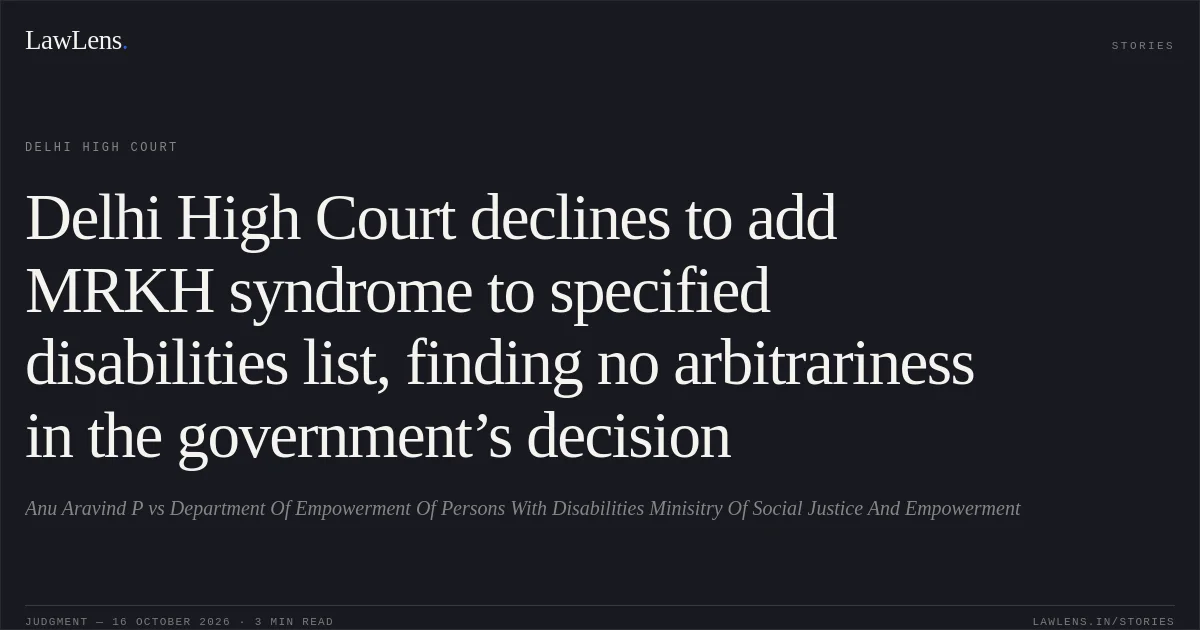
The Court held that it could not direct the Central Government to include MRKH Syndrome Type-II as a specified disability and found no illegality, arbitrariness or perversity in the impugned communications.
The petition was dismissed, without precluding the petitioner from making a fresh representation if new medical material becomes available; any such representation must be considered in accordance with law.
Source reference: para. 36–37Acts & Sections Cited
11 provisions across 1 statute referred to in this judgment. Each provision opens on LawLens.
Rights of Persons with Disabilities Act, 2016.
Original Court PDF
Anu Aravind PvsDepartment Of Empowerment Of Persons With Disabilities Minisitry Of Social Justice And Empowerment
Click to open original judgment
Original judgment, available to read, download and summarize on LawLens.in