Facts
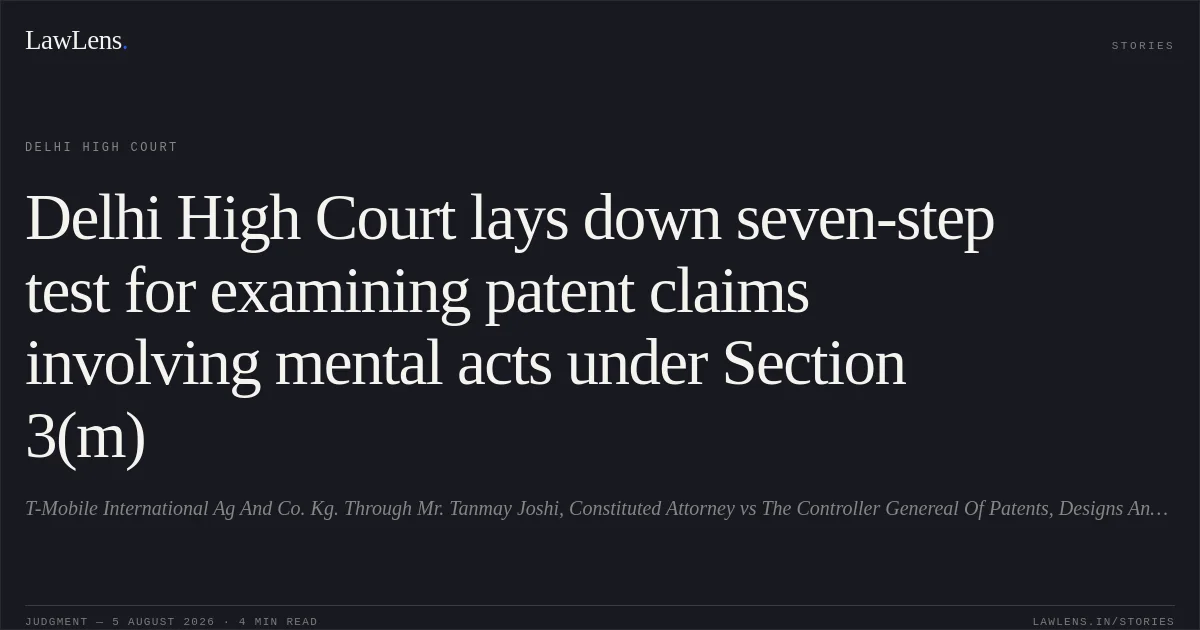
The appellant challenged the order dated 29.12.2016 refusing patent application No. 468/DELNP/2008, titled “Method and Arrangement for Optimising the Operational Times and Cell Change Performance of Mobile Terminals,” under Sections 3(k) and 3(m) of the Patents Act, 1970.
Source reference: p.1The appeal was remanded for de novo consideration on merits by order dated 26.02.2026.
Source reference: p.1During the hearing, the parties acknowledged the absence of clear Patent Office guidelines for examining objections under Section 3(m).
Source reference: p.1The Court therefore retained the matter for the limited public-interest purpose of formulating such guidelines, with assistance from an appointed amicus curiae.
Source reference: pp.1–2The amicus and counsel submitted draft guidelines, culminating in an updated report dated 20.05.2026.
Source reference: p.2Issues
Whether Section 3(m) of the Patents Act creates independent exclusions for a mere scheme, rule, or method of performing a mental act, and for a method of playing a game, and how those exclusions are to be interpreted.
Source reference: pp.2–4Whether the Section 3(m) inquiry is independent of the requirements of novelty and inventive step under Section 2(1)(j)/(ja).
Source reference: p.4Whether a claim is excluded under Section 3(m) when, read as a whole, it includes physical means, interaction between hardware and software, or produces a tangible output.
Source reference: pp.4–8Whether computer implementation of a claimed method should be examined under Section 3(m) or separately under Section 3(k).
Source reference: p.7What procedural and substantive guidelines should govern examination of Section 3(m) objections by the Patent Office.
Source reference: pp.6–10Law Applied
Section 3(m) of the Patents Act excludes from patentability “a mere scheme or rule or method of performing mental act or method of playing game”.
Source reference: p.3The Court construed the provision as containing four disjunctive exclusions: a mere scheme, rule, or method of performing a mental act, and a method of playing a game.
Source reference: p.3The word “mere” qualifies the first three categories, limiting the exclusion to claims that amount solely to a mental act; mental acts include calculation, reasoning, evaluation, cognition, logic, judgment, and decision-making.
Source reference: p.3Section 3(m) is an independent patentability exclusion and must not be conflated with novelty or inventive step under Sections 2(1)(j) and 2(1)(ja).
Source reference: p.4The Court relied on Koninklijke Philips N.V. v. Maj. (Retd.) Sukesh Behl & Anr. , 2025 SCC OnLine Del 1121, Lava International Ltd. v. Telefonaktiebolaget LM Ericsson , 2024 SCC OnLine Del 2497, and Robert Bosch Ltd. v. Deputy Controller of Patents & Designs , CMA(PT) 1/2024, for the principle that physical or technical implementation, tangible outputs, and hardware-software interaction may take a claim outside Section 3(m).
Source reference: p.5The Court also considered the analogous exclusion under Article 52(2)(c) of the European Patent Convention and the EPO decisions in T 914/02, T 619/02, and T 471/05, which distinguish purely abstract mental activities from technical or physical implementations.
Source reference: pp.3, 5–6Reasoning
The Court held that Section 3(m) must be applied to the claim construed as a whole, in light of the specification and from the perspective of a person skilled in the art, without importing limitations from the specification.
Source reference: p.6A genuine product claim defined by physical features cannot ordinarily be treated as a scheme, rule, or method under Section 3(m).
Source reference: p.6For a process claim, the examiner must identify what the claim as a whole monopolises rather than dissecting it and isolating a single mental step.
Source reference: p.7The practical test is whether the claim could be infringed by a person doing nothing more than thinking, calculating, reasoning, evaluating, judging, or deciding; if so, the monopoly is over a mental act and is excluded.
Source reference: p.7Conversely, Section 3(m) is not attracted where the claim recites physical means integral to performance, requires interaction between physical components—including hardware and software—to achieve a practical result, or produces a tangible output.
Source reference: p.7Merely adding a nominal physical step, such as displaying, printing, or presenting the result, does not avoid the exclusion if the substantive monopoly remains mental.
Source reference: p.7Computer implementation does not itself invoke Section 3(m); such claims must instead be examined separately under Section 3(k).
Source reference: p.8The illustrations demonstrate the distinction: solving Sudoku by logical deduction is excluded, whereas a sensor-controlled physical process, signal generation through circuits, or a computer-implemented method producing a layout file is not excluded under Section 3(m), subject to examination under other statutory provisions.
Source reference: pp.8–10Holding
The Court formulated and adopted guidelines requiring Section 3(m) objections to be assessed claim-by-claim and as a whole, with particular attention to whether the claim monopolises only a mental act or instead involves integral physical or technical implementation.
It clarified that Section 3(m) operates independently of novelty and inventive step, and that computer-implemented claims should be considered separately under Section 3(k).
Source reference: pp.7–8The guidelines were directed to be placed before the Controller General of Patents, Designs and Trademarks for appropriate action within six weeks of receipt of the order.
Source reference: p.10Since the appeal had already been disposed of on merits by order dated 26.02.2026 and remained pending only for formulation of the guidelines, the Court finally closed the appeal.
Source reference: p.10Original Court PDF
T-Mobile International Ag And Co. Kg. Through Mr. Tanmay Joshi, Constituted AttorneyvsThe Controller Genereal Of Patents, Designs And Trademarks And Anr.
Click to open original judgment
Original judgment, available to read, download and summarize on LawLens.in