Facts
The petitioners sought quashing under Section 528 of the BNSS of FIR No. 60/2022, registered under Sections 323/354/34 IPC and Section 8 of the POCSO Act.
Source reference: pp. 1–3, paras. 1–4.4The complainant, respondent no. 2, alleged that during a family dispute, petitioners nos. 1 and 2 sexually and physically assaulted her while petitioners nos. 3 and 4 directed them to do so; a chargesheet had been filed.
Source reference: pp. 1–3, paras. 1–4.4The parties’ wider family disputes were later settled through an agreement dated 14 July 2026 between respondent no. 2’s brother and his wife.
Source reference: pp. 3–4, paras. 6–13Although that agreement did not specifically refer to this FIR, respondent no. 2 confirmed the settlement and told the Court she did not wish to pursue the case; connected FIRs had also been quashed.
Source reference: pp. 3–4, paras. 6–13Issues
1. Whether the High Court should exercise its inherent jurisdiction under Section 528 BNSS to quash the non-compoundable offences alleged in the FIR on the basis of settlement between the parties
Source reference: pp. 4–6, paras. 14–182. Whether the FIR could be quashed despite the settlement agreement not expressly providing for its quashing, given the complainant’s stated wishes and the broader resolution of the parties’ disputes
Source reference: pp. 3–4, paras. 7–11; p. 6, paras. 17–18Law Applied
Section 528 BNSS preserves the High Court’s inherent power to prevent abuse of the process of any court or secure the ends of justice, corresponding to Section 482 CrPC.
Source reference: p. 4, para. 14Under Gian Singh v. State of Punjab, (2012) 10 SCC 303, that power may extend to quashing non-compoundable offences where settlement makes continuation futile and quashing serves the ends of justice.
Source reference: p. 4, para. 14Parbatbhai Aahir v. State of Gujarat, (2017) 9 SCC 641, requires the Court to assess the facts and circumstances, the nature and gravity of the offence, the public interest involved, and whether conviction is remote and continuation would cause oppression or prejudice; serious offences ordinarily should not be quashed merely because the parties have settled.
Source reference: pp. 4–6, para. 15Reasoning
The Court treated the FIR as arising from the wider disputes between the families, noting that the connected FIRs had already been quashed and that respondent no. 2 personally affirmed the settlement and her wish not to continue the proceedings.
Source reference: p. 6, paras. 16–17Although the settlement agreement did not expressly mention this FIR, the Court considered it part of the cross-disputes resolved by the parties.
Source reference: pp. 3–4, paras. 7, 13; p. 6, paras. 17–18In the circumstances, and with the State expressing no objection, the Court concluded that continuing the proceedings would serve no useful purpose.
Source reference: pp. 3–4, paras. 7, 13; p. 6, paras. 17–18Holding
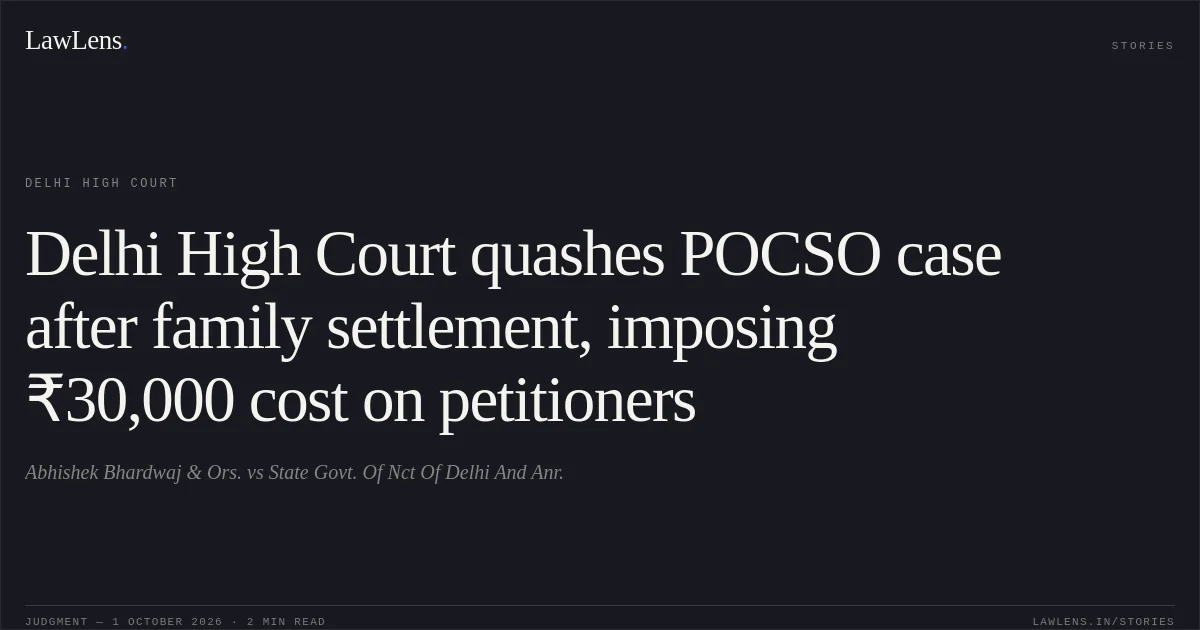
The Court allowed the petition and quashed FIR No. 60/2022 and all proceedings arising from it.
The quashing was conditional on the petitioners paying Rs. 30,000 to the Delhi High Court B.A. Costs Account within four weeks and filing proof of payment.
Source reference: pp. 6–7, paras. 19–23The parties remained bound by the settlement agreement, and the petition and pending application were disposed of.
Source reference: pp. 6–7, paras. 19–23Acts & Sections Cited
7 provisions across 4 statutes referred to in this judgment. Each provision opens on LawLens.
Bharatiya Nagarik Suraksha Sanhita, 20231
Indian Penal Code, 18603
Protection of Children from Sexual Offences Act, 20121
Code of Criminal Procedure, 19732
Original Court PDF
Abhishek Bhardwaj & Ors.vsState Govt. Of Nct Of Delhi And Anr.
Click to open original judgment
Original judgment, available to read, download and summarize on LawLens.in