Facts
The suit was initially filed as a commercial suit. On 5 May 2025, the Single Judge held that it was not a commercial dispute and directed that it proceed as an ordinary civil suit.
Source reference: pp. 1–2After the appellants failed to file their written statement within the prescribed period, the Joint Registrar closed their right to file it on 20 January 2026.
Source reference: pp. 1–2The appellants’ Chamber Appeal was dismissed by the Single Judge on 23 July 2026, who held that the written statement had not been filed within 120 days of the order of 5 May 2025.
Source reference: pp. 1–2The appellants appealed, contending that the Court could extend time under Rule 4 of Chapter VII of the Delhi High Court (Original Side) Rules, 2018 (“DHC Rules”).
Source reference: pp. 1–2Issues
Whether the Supreme Court’s decisions treating Order VIII Rule 1 CPC as directory apply when interpreting Rule 4 of Chapter VII of the DHC Rules, and whether the contrary Division Bench decisions in Ram Sarup Lugani, Delhi Gymkhana Club and Manhar Sabharwal state the correct law.
Source reference: pp. 18–19Whether Rule 4 vests the power to extend time for filing a written statement exclusively in the Court, leaving the Registrar with only ministerial functions, or whether the Registrar has any power to extend time for accepting the written statement.
Source reference: p. 19Whether Rahul Gupta v. Pratap Singh is contrary to the Supreme Court’s decision in State of Orissa v. Commissioner of Land Records and Settlement and is liable to be overruled.
Source reference: p. 19Law Applied
Rule 4 of Chapter VII of the DHC Rules permits the Court, for sufficient cause and exceptional and unavoidable reasons, to extend the initial 30-day period for filing a written statement by a further period not exceeding 90 days, “but not thereafter”; it also provides for the Registrar to close the right to file where the written statement is not filed within the extended time.
Source reference: p. 2Order VIII Rules 1 and 10 CPC were relevant: Kailash v. Nanhku and Salem Advocate Bar Association v. Union of India held that Order VIII Rule 1 is directory and that, in exceptional cases, the Court may extend time beyond the stated period; Rule 10 gives the Court discretion as to the order to make when a written statement is not filed.
Source reference: pp. 3–8The judgment also considered Section 129 CPC and Section 7 of the Delhi High Court Act concerning the High Court’s power to frame Original Side rules, as well as State of Orissa v. Commissioner of Land Records and Settlement on the effect of a delegate’s order and review by the delegating authority.
Source reference: pp. 10–11, 16–18Reasoning
The Division Bench considered Rule 4’s language and structure alongside Order VIII Rules 1 and 10 CPC. It reasoned that the DHC Rules contain no provision replacing Order VIII Rule 10, and that Rule 4’s language is materially parallel to the non-commercial version of Order VIII Rule 1.
Source reference: pp. 11–15It therefore considered that the principles in Kailash and Salem Advocate Bar Association might apply, notwithstanding the DHC Rules’ “but not thereafter” wording and prior Division Bench decisions treating the 120-day limit as mandatory.
Source reference: pp. 11–15The Bench also expressed the view that the Registrar’s role under Rule 4 appeared ministerial, while identifying a conflict between Rahul Gupta and the Supreme Court’s decision in State of Orissa concerning review or re-examination of an order made by a delegate.
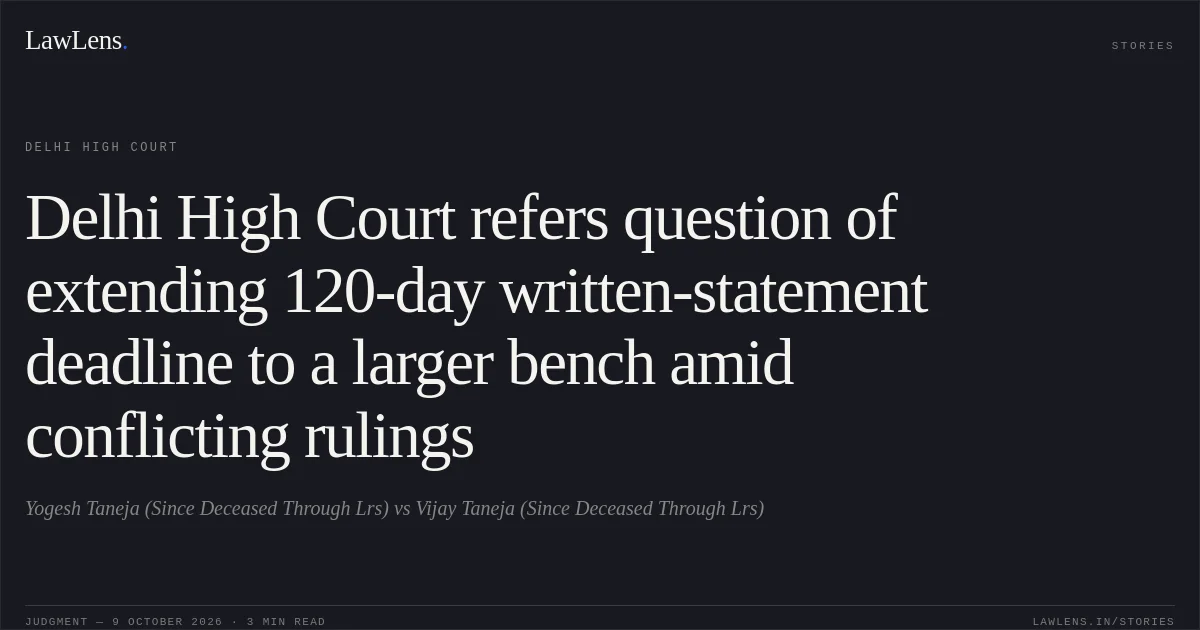
Source reference: pp. 15–18Because it was unable to agree with the earlier Division Bench decisions, it referred the questions to a larger Bench rather than deciding the appeal on the merits.
Source reference: pp. 18–19Holding
The Court made no final determination on whether the 120-day limit under Rule 4 is extendable, on the Registrar’s powers, or on the continued correctness of Rahul Gupta.
It directed that the matter be placed before the Chief Justice for consideration of constituting a larger Bench to decide the questions referred.
Source reference: pp. 18–19Acts & Sections Cited
4 provisions across 3 statutes referred to in this judgment. Each provision opens on LawLens.
Code of Civil Procedure, 19081
Delhi High Court Act, 19661
Arbitration and Conciliation Act, 19962
Original Court PDF
Yogesh Taneja (Since Deceased Through Lrs)vsVijay Taneja (Since Deceased Through Lrs)
Click to open original judgment
Original judgment, available to read, download and summarize on LawLens.in