Facts
Hindustan Shipyard Limited (“HSL”) and Anadolu Deniz Insaat Kizaklari Sanayi Ve Ticaret A.S. entered into a Collaborator Contract dated 20 March 2020 for design, supply of key machinery and technical assistance relating to five Fleet Support Ships for the Indian Navy.
Source reference: paras. 3.1, 19The Cabinet Committee on Security and the Ministry of Defence subsequently decided that the project would proceed through indigenous industry without the involvement of the Turkish defendant, and directed HSL to initiate termination proceedings.
Source reference: paras. 3.2, 4.7, 15–16HSL terminated the contract on 24 August 2023 under Article 23.8, followed by unsuccessful attempts at amicable settlement.
Source reference: paras. 3.3, 4.9–4.11In 2026, the defendant invoked arbitration under Article 25.1 and filed a Statement of Claim before the Indian Council of Arbitration (“ICA”), which registered the matter as ICA Case No. INTARB-0035.
Source reference: paras. 3.4–3.5The ICA thereafter directed HSL to file its Statement of Defence and nominate an arbitrator by email dated 19 August 2026.
Source reference: para. 3.6HSL instituted the present suit under Section 37 of the Specific Relief Act, 1963, seeking declaratory and injunctive relief against continuation of the arbitration, and sought interim relief under Order XXXIX Rules 1 and 2 CPC.
Source reference: paras. 1–2Issues
1. Whether the termination of the Collaborator Contract, being founded on the Government of India’s decision concerning a defence project and national security, was prima facie a sovereign and inherently non-arbitrable decision?
Source reference: paras. 10–232. Whether the ICA could proceed with the arbitration despite HSL’s objection that the underlying dispute was non-arbitrable?
Source reference: paras. 24–27, 35–383. Whether the Delhi High Court possessed territorial jurisdiction to entertain the suit despite the contract designating Visakhapatnam as the seat/place of arbitration?
Source reference: paras. 28–384. Whether HSL established a prima facie case, balance of convenience and irreparable injury warranting interim protection under Order XXXIX Rules 1 and 2 CPC?
Source reference: paras. 40–41Law Applied
The Court applied Articles 23.7 and 23.8 of the Collaborator Contract, which dealt with governmental prohibition and the consequences of termination, and Article 25 concerning arbitration.
Source reference: paras. 11–14Under Sections 2(3) and 5 of the Arbitration and Conciliation Act, 1996, disputes excluded from arbitration by law are not subject to the ordinary principle of minimal judicial intervention.
Source reference: no citationRelying principally on Vidya Drolia v. Durga Trading Corporation, (2021) 2 SCC 1, the Court applied the rule that inalienable sovereign and public-interest functions of the State are non-arbitrable, particularly where they affect national security and cannot be delegated to a private adjudicatory forum.
Source reference: para. 17The Court also considered the competence-competence principle under Section 16 of the Arbitration Act, the seat-related jurisdiction principles in BGS SGS SOMA JV v. NHPC, (2020) 4 SCC 234, Mankastu Impex Pvt. Ltd. v. Airvisual Ltd., (2020) 5 SCC 399, and J&K Economic Reconstruction Agency v. Rash Builders India (P) Ltd., 2026 SCC OnLine SC 596, but distinguished those cases as primarily concerning supervisory jurisdiction over arbitration.
Source reference: paras. 35–38For territorial jurisdiction at the plaint stage, the Court applied Section 20 CPC and the principle in Dahiben v. Arvindbhai Kalyanji Bhanusali, (2020) 7 SCC 366, that the plaint’s averments must be accepted at face value while considering threshold objections under Order VII Rule 11 CPC.
Source reference: paras. 29–32Interim relief was assessed under the established requirements of prima facie case, balance of convenience and irreparable injury under Order XXXIX Rules 1 and 2 CPC.
Source reference: para. 40Reasoning
The Court held that the contract concerned the construction of strategic naval assets and was inseparably connected with national defence and security.
Source reference: paras. 18–19The Government’s decision to proceed without the Turkish collaborator was not an ordinary contractual or commercial decision: the contract had been executed with governmental approval, and HSL was required to implement the Ministry of Defence’s direction.
Source reference: paras. 16, 19Article 23.8 was interpreted broadly; the expression “any such governmental prohibition” was not confined only to the specific prohibition contemplated by Article 23.7, but extended to governmental decisions arising from national-security and defence considerations.
Source reference: paras. 11–14Applying Vidya Drolia, the Court concluded prima facie that the Government’s decision was an inalienable and non-delegable sovereign function and therefore non-arbitrable.
Source reference: paras. 17–23The termination letter, being expressly based on that governmental decision, was consequently also prima facie non-arbitrable.
Source reference: paras. 21–23Although the defendants relied on the arbitral tribunal’s power under Section 16 and the agreed seat at Visakhapatnam, the Court held that those principles could not displace the prior question of inherent non-arbitrability of a sovereign decision.
Source reference: paras. 35–38At the interlocutory stage, the Court accepted the plaint’s assertions that the ICA proceedings were administered in Delhi and that the relevant sovereign decision was taken in Delhi; it therefore declined to conclusively reject territorial jurisdiction at that stage.
Source reference: paras. 28–32Given the strong prima facie case and the risk of permitting a private arbitral process to examine a sovereign defence-related decision, the balance of convenience and irreparable injury favoured HSL.
Source reference: para. 40Holding
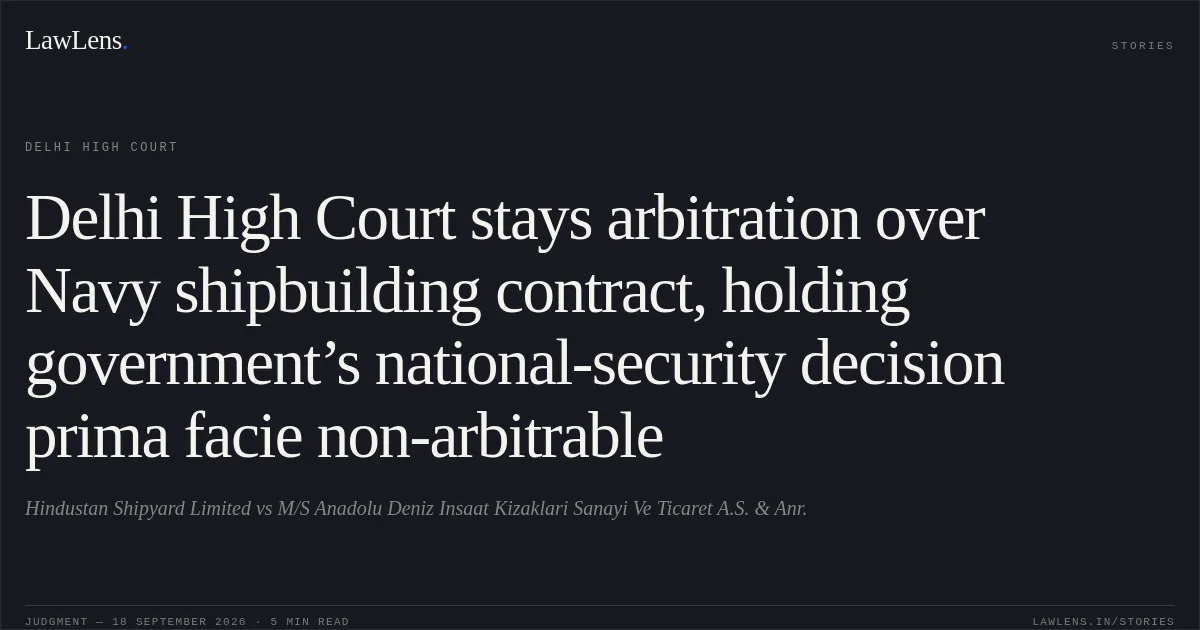
The Court formed a prima facie view that the Ministry of Defence/Government of India decision dated 23 August 2023 was a sovereign decision concerning national security and defence procurement, inherently non-arbitrable from the outset, and that HSL’s consequential termination dated 24 August 2023 was likewise prima facie non-arbitrable.
It consequently directed that the ICA’s email dated 19 August 2026 in ICA Case No. INTARB-0035 remain in abeyance until the next date of listing.
Source reference: para. 41Notice was issued in the interim-application, replies were directed within three weeks, and the matter was listed before the Joint Registrar on 17 November 2026 and before the Court on 8 December 2026.
Source reference: paras. 42–45The Court clarified that its observations were only prima facie and would not prejudice the final adjudication on merits.
Source reference: para. 46The applications concerning filing of clearer documents and exemption from pre-institution mediation were allowed/disposed of, and the suit was directed to be registered with summons issued.
Source reference: paras. 47–60Acts & Sections Cited
18 provisions across 4 statutes referred to in this judgment. Each provision opens on LawLens.
Code of Civil Procedure, 19082
Specific Relief Act, 19631
Arbitration and Conciliation Act, 1996
Presidency Small Cause Courts Act, 18821
Original Court PDF
Hindustan Shipyard LimitedvsM/S Anadolu Deniz Insaat Kizaklari Sanayi Ve Ticaret A.S. & Anr.
Click to open original judgment
Original judgment, available to read, download and summarize on LawLens.in