Facts
On 8 July 2003, the prosecutrix was allegedly taken from her house by Jagdish @ Jagga, Deepak @ Chiku, Anwar @ Guddu and another person.
Source reference: p. 1She was taken to a cinema hall, after which the other accused allegedly left and Jagdish took her to a relative’s house, where he allegedly raped her.
Source reference: p. 1Her father lodged a missing-person complaint on 9 July 2003, leading to registration of the FIR.
Source reference: p. 2The Trial Court convicted Jagdish under Sections 366 and 376 IPC and sentenced him to ten years’ rigorous imprisonment for each offence, along with fines; the co-accused were acquitted.
Source reference: p. 2In appeal, Jagdish disputed the allegations, relied on the alleged monetary dispute between him and the prosecutrix’s father, and contended that the prosecutrix had voluntarily accompanied him and was possibly major.
Source reference: pp. 3–7The defence relied on the ossification test estimating her age at 14–16 years, while the prosecution relied on the municipal birth record showing her date of birth as 5 December 1988.
Source reference: pp. 5–6Issues
Whether the evidence established that Jagdish kidnapped or enticed the prosecutrix so as to attract liability under Section 366 IPC, notwithstanding her having accompanied him to a cinema hall and other public places without raising an alarm?
Source reference: pp. 3–5, 8–10Whether the testimony of the prosecutrix, considered alongside the MLC, FSL material and surrounding circumstances, was sufficient to sustain Jagdish’s conviction under Section 376 IPC?
Source reference: pp. 5–10Whether the prosecutrix’s age and alleged consent affected the offences charged, particularly where the age evidence comprised a municipal record and an ossification test?
Source reference: pp. 5–7, 8–10Whether the sentence should be reduced in view of the appellant’s age, the period already undergone and the lapse of more than two decades since the incident?
Source reference: pp. 10–11Law Applied
The Court applied Sections 366 and 376 IPC.
Source reference: pp. 5–6, 9–10It proceeded on the principle that, where the prosecutrix is a minor, her consent is legally inconsequential; it further held that even if she were major, voluntary accompaniment would not authorise a forcible sexual assault.
Source reference: pp. 5–6, 9–10The Court assessed the prosecutrix’s testimony as substantive evidence and held that it could sustain a conviction when reliable, although it required careful scrutiny in the circumstances of the case.
Source reference: p. 8The Court also relied on C. Muniappan v. State of Tamil Nadu, (2010) 9 SCC 567; Ganga Singh v. State of M.P., (2013) 7 SCC 278; Sunil Kundu v. State of Jharkhand, (2013) 4 SCC 422; and Surajit Sarkar v. State of West Bengal, (2013) 2 SCC 146, for the principle that investigative lapses do not by themselves justify acquittal unless they create a reasonable doubt or affect the substratum of the prosecution case.
Source reference: pp. 7–8The Court considered the age-related provisions relied upon by the defence, including Section 94 of the Juvenile Justice (Care and Protection of Children) Act, 2015 and Rule 12 of the Juvenile Justice Model Rules, 2007, but found that the question of age was not determinative of the result.
Source reference: pp. 6–8Section 428 Cr.P.C. was applied to grant set-off for the period already undergone.
Source reference: p. 11Reasoning
The Court found that the prosecutrix had consistently stated in her Section 164 Cr.P.C. statement and in her substantive deposition that Jagdish had enticed and taken her away and had forcibly raped her.
Source reference: p. 8Although her conduct—watching a film and travelling through public places without raising an alarm—created doubts regarding the allegation of forcible removal, the Court held that her testimony was not completely shaken in cross-examination and therefore remained acceptable.
Source reference: pp. 8–9The MLC did not record sexual contact, the FSL report did not detect semen, and the torn hymen was not shown to be a recent injury; nevertheless, the Court held that the prosecutrix’s failure to attribute the assault to Jagdish before the doctor had not been put to her in cross-examination, preventing the appellant from relying on that discrepancy.
Source reference: pp. 5, 8–10The Court rejected the alleged employer–employee monetary dispute as a sufficient basis for false implication and held that, even assuming the prosecutrix had voluntarily accompanied Jagdish, such conduct could not justify rape.
Source reference: p. 9The investigative omissions, including the absence of certain site plans and public witnesses, were held not to undermine the prosecution case under the cited precedents.
Source reference: pp. 7–8On sentencing, the Court considered the passage of over twenty years, the appellant’s age at the time of the offence and his having undergone more than seven years’ imprisonment.
Source reference: pp. 10–11Holding
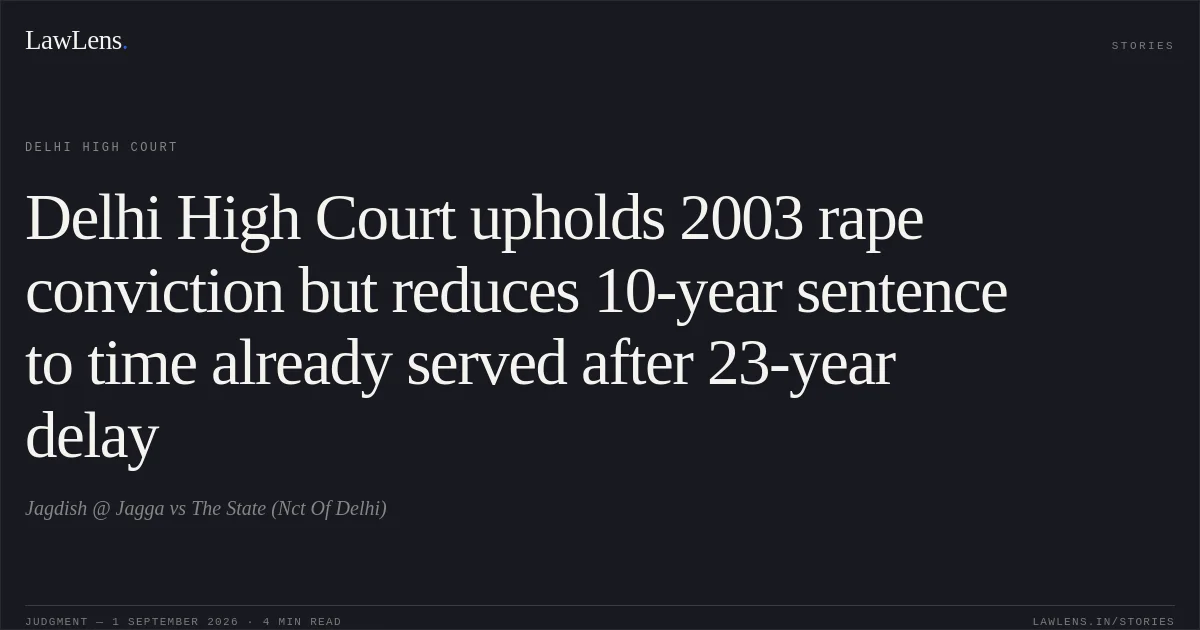
The appeal against conviction was dismissed.
Jagdish’s convictions under Sections 366 and 376 IPC were upheld.
Source reference: p. 10However, the substantive sentences were reduced to the period already undergone, recorded as more than seven years, with the sentences to run concurrently.
Source reference: p. 11The fines of ₹5,000 for each offence were maintained, but the default sentences were modified to six months’ simple imprisonment for the offence under Section 376 IPC and three months’ simple imprisonment for the offence under Section 366 IPC.
Source reference: p. 11The appellant was granted the benefit of set-off under Section 428 Cr.P.C. and was directed to surrender forthwith to undergo any remaining sentence, if applicable.
Source reference: pp. 11–12 / para. 24Acts & Sections Cited
6 provisions across 3 statutes referred to in this judgment. Each provision opens on LawLens.
Indian Penal Code, 18603
Juvenile Justice (Care and Protection of Children) Act, 2015.1
Code of Criminal Procedure, 19732
Original Court PDF
Jagdish @ JaggavsThe State (Nct Of Delhi)
Click to open original judgment
Original judgment, available to read, download and summarize on LawLens.in