Facts
The CBI registered RC No. 2212022E0030 concerning the alleged unauthorised interception, recording and examination of telephone calls of NSE employees through iSEC Services Pvt. Ltd., engaged by NSE under work orders described as “Periodic Study of Cyber Vulnerabilities” between 2009 and 2017.
Source reference: paras. 3–11Sanjay Pandey, formerly associated with iSEC, was alleged to have continued controlling its affairs, while Chitra Ramakrishna, a senior NSE functionary, was alleged to have approved and facilitated the arrangement.
Source reference: paras. 3–11The CBI alleged that call data was copied, examined and transcribed without lawful authorisation and that NSE paid approximately ₹4.54 crores to iSEC.
Source reference: paras. 3–11Both respondents were arrested by the CBI in September 2022.
Source reference: paras. 12–18On 21 December 2022, the Special Judge granted them regular bail, substantially relying on the High Court’s earlier order dated 8 December 2022 granting Sanjay Pandey bail in connected ED/PMLA proceedings arising from the same factual transaction.
Source reference: paras. 12–18The CBI challenged both bail orders under Section 482 CrPC read with Article 227 of the Constitution, contending that the Special Judge had failed to independently assess the CBI’s case, the investigation material and the respondents’ respective roles.
Source reference: paras. 19–26Issues
Whether the Special Judge’s consideration of the earlier PMLA bail judgment arising from the same FIR and factual foundation amounted to abdication of jurisdiction or an impermissible substitution of the PMLA court’s prima facie assessment for an independent decision in the CBI proceedings.
Source reference: paras. 51–60Whether the bail orders were perverse, illegal, materially irregular or vitiated by non-application of mind because the Special Judge allegedly failed to consider the CBI’s allegations, investigation material and the distinct roles attributed to the respondents.
Source reference: paras. 51–53, 60–70Whether the subsequent filing of the charge-sheet, including alteration or addition of penal provisions, justified setting aside the bail orders passed on 21 December 2022.
Source reference: para. 71Law Applied
The Court applied the distinction between setting aside an original bail order and cancelling bail on account of subsequent misconduct or supervening circumstances.
Source reference: paras. 45–50Under Neeru Yadav v. State of U.P., Y v. State of Rajasthan, Meena Devi v. State of U.P. and Ashok Dhankad v. State (NCT of Delhi), a superior court may interfere with a bail order where the discretion is perverse, illegal, arbitrary, founded on irrelevant considerations, or rendered without considering material circumstances; however, it cannot conduct a threadbare evaluation of the evidence or merely substitute its own view.
Source reference: paras. 45–50A bail order in connected proceedings is relevant but not conclusive: P. Chidambaram v. Directorate of Enforcement holds that precedent in another case cannot by itself determine the grant or refusal of bail, while Ramesh Bhavan Rathod v. Vishanbhai Hirabhai Makwana requires individual consideration of the accused’s role and prohibits mechanical application of parity.
Source reference: paras. 58–59The Court also considered Section 45 of the PMLA, the regular-bail jurisdiction under Section 439 CrPC, Section 482 CrPC, Article 227 of the Constitution, and the principle recognised in Arvind Kejriwal v. CBI that bail granted in connected PMLA proceedings may be a relevant circumstance in a CBI case arising from the same factual foundation.
Source reference: paras. 54–58Reasoning
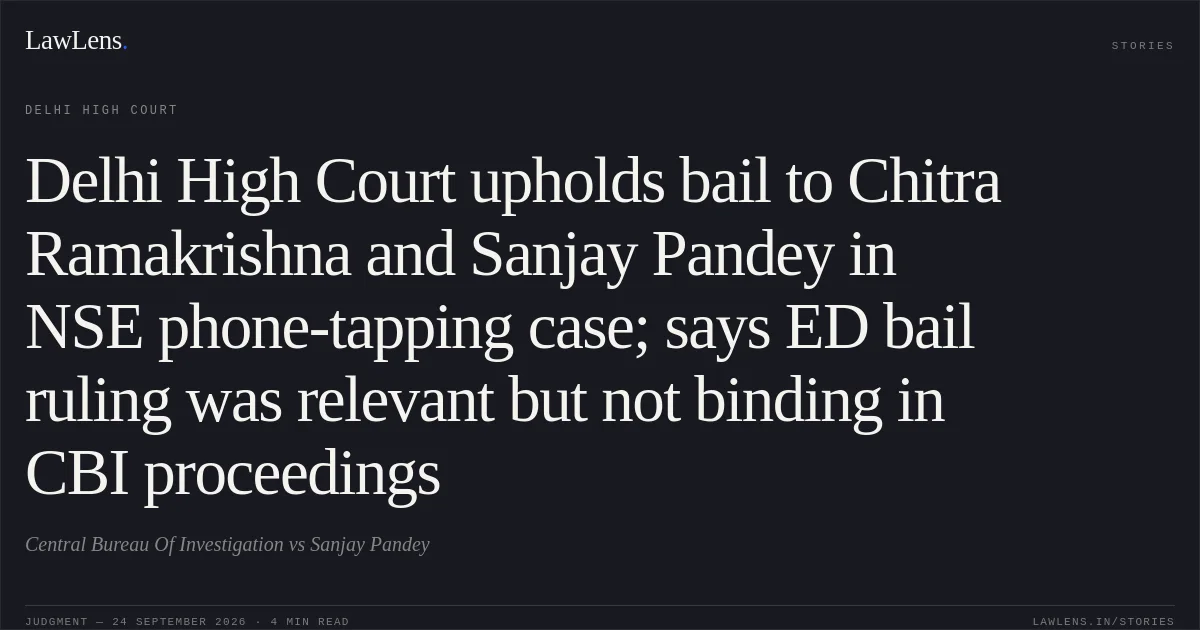
The Court held that the CBI and ED proceedings were legally distinct and that the PMLA judgment did not bind the CBI or confer immunity upon the respondents.
Source reference: paras. 54–60Nevertheless, because both proceedings arose from the same FIR, NSE–iSEC arrangement and alleged interception of telephone calls, the earlier PMLA judgment was a relevant circumstance that the Special Judge was entitled to consider.
Source reference: paras. 54–60In Sanjay Pandey’s case, the Special Judge recorded the CBI’s objections, identified the common factual and legal foundation, noted the prima facie nature of the earlier findings, considered the stringent requirements of Section 45 PMLA and observed that the remaining offences were bailable.
Source reference: paras. 61–64The order therefore was not a mechanical adoption of the earlier judgment.
Source reference: paras. 61–64In Chitra Ramakrishna’s case, although she had not yet received bail in the ED proceedings and her role was alleged to be different, the Special Judge expressly recorded the allegation that she had approved or processed the relevant work orders in her senior NSE positions and considered the alleged wrongful gain and loss.
Source reference: paras. 65–69Reliance on the earlier judgment concerned the common ingredients of the alleged offences and did not amount to treating her role as identical to Pandey’s.
Source reference: paras. 65–69The Court further held that the later charge-sheet could not retrospectively make the bail orders perverse; their legality had to be assessed on the material available when the orders were passed.
Source reference: para. 71The CBI failed to identify any material circumstance that had been ignored or any perversity, illegality or material irregularity in the exercise of discretion.
Source reference: paras. 70–73Holding
The High Court dismissed both CBI petitions and declined to interfere with the regular-bail orders dated 21 December 2022.
It held that the earlier PMLA bail judgment was relevant but not binding, and that the Special Judge had independently applied the applicable bail principles, considered the CBI’s objections and addressed the respondents’ respective roles.
Source reference: paras. 74–80The subsequent charge-sheet did not justify retrospective interference.
Source reference: paras. 74–80Pending applications were disposed of, interim orders, if any, were vacated, and the Trial Court was directed to proceed uninfluenced by the prima facie observations in the bail orders, the earlier PMLA judgment or the present judgment.
Source reference: paras. 74–80Acts & Sections Cited
17 provisions across 7 statutes referred to in this judgment. Each provision opens on LawLens.
Code of Criminal Procedure, 19733
Indian Penal Code, 18603
Information Technology Act, 20001
Indian Telegraph Act, 18855
Prevention of Corruption Act, 19881
Prevention of Money-Laundering Act, 20022
Original Court PDF
Central Bureau Of InvestigationvsSanjay Pandey
Click to open original judgment
Original judgment, available to read, download and summarize on LawLens.in