Facts
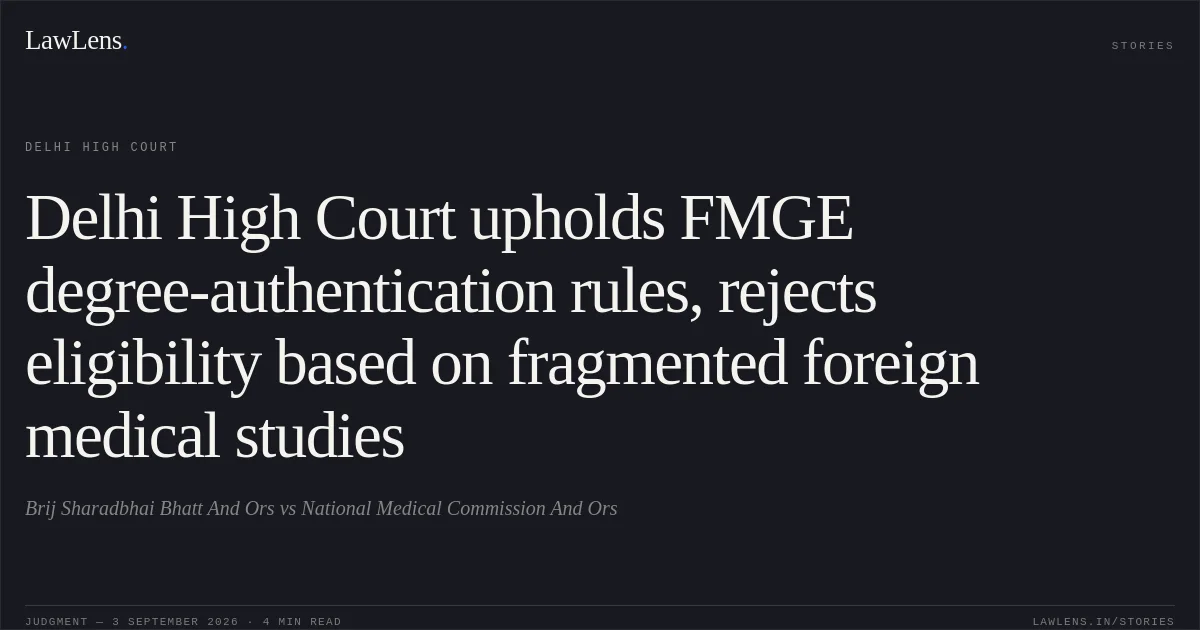
The petitioners, Indian citizens who pursued allopathic medical studies abroad, sought eligibility to appear in the Foreign Medical Graduate Examination (FMGE), which is required for registration and practice of medicine in India.
Source reference: paras. 1, 7They challenged: (i) Regulation 4(1) of the Screening Test Regulations, 2002, as substituted on 26.09.2009, which required confirmation by the concerned Indian Embassy that the foreign qualification was recognised for enrolment as a medical practitioner in the country of award; (ii) Clause 2.14 of the FMGE Information Bulletin, requiring foreign medical degrees to be attested by the Indian Embassy or apostilled by the competent foreign authority; and (iii) the communication dated 14.05.2025 declaring them ineligible to appear in the FMGE.
Source reference: paras. 2–5The petitioners had initially relied on qualifications from New Tokyo Medical College, Federated States of Micronesia, but were not permitted to appear because the documents were not duly attested or apostilled.
Source reference: paras. 5–7They later submitted certificates from Central America Health Sciences University, Belize, for the same period of study, based on an arrangement between the two institutions.
Source reference: paras. 5–7The respondents treated this as reliance on alternate qualifications arising from fragmented studies undertaken at multiple foreign institutions and denied FMGE eligibility.
Source reference: paras. 35–37Issues
Whether Regulation 4(1) of the Screening Test Regulations, 2002, excluding reliance solely on the WHO World Directory of Medical Schools and requiring confirmation by the concerned Indian Embassy, was ultra vires, arbitrary or unconstitutional.
Source reference: paras. 20–21, 38Whether Clause 2.14 of the FMGE Information Bulletin, requiring attestation or apostillation of foreign medical degrees, was beyond the statutory authority of the respondents or otherwise unlawful.
Source reference: paras. 22–23, 39–40Whether the communication dated 14.05.2025 declaring the petitioners ineligible to appear in the FMGE was legally sustainable, particularly where the petitioners relied on qualifications from different institutions for the same period of study.
Source reference: paras. 24, 35–37, 42–43Law Applied
The Court applied Section 13(4A) of the Indian Medical Council Act, 1956, under which an Indian citizen possessing a foreign medical qualification must qualify the prescribed Screening Test before being entered on a medical register.
Source reference: para. 15Section 33(ma) authorised the Medical Council of India, with prior governmental sanction, to frame regulations prescribing the modalities for conducting the Screening Test.
Source reference: para. 14Under Section 61(2) of the National Medical Commission Act, 2019, the earlier statutory standards, requirements and regulations continued in force until superseded.
Source reference: paras. 12–13Regulation 2(f) of the Screening Regulations defined “Primary Medical Qualification” as a foreign medical qualification recognised for enrolment as a medical practitioner in the country of award and equivalent to an Indian MBBS degree.
Source reference: paras. 16–17The Court applied judicial restraint towards expert regulatory determinations in matters of medical education, permitting interference only where the prescription was manifestly arbitrary.
Source reference: para. 38It also relied on Yash Ahuja v. Medical Council of India, (2009) 10 SCC 313, which recognised that the screening requirement exists to ensure adequate knowledge and skills and to prevent persons with half-baked medical training from treating patients in India.
Source reference: para. 43The Court distinguished Rohit Naresh Agarwal v. Union of India, 2013 SCC OnLine Del 3904, which concerned the retrospective imposition of a fresh eligibility condition under Regulation 4(3), rather than authentication of an existing foreign qualification.
Source reference: para. 41Reasoning
The Court held that the 2009 amendment to Regulation 4(1) was within the regulatory framework and was based on relevant considerations concerning the reliability and quality of foreign medical institutions.
Source reference: para. 38The requirement of Indian Embassy confirmation was therefore entitled to deference as an expert determination and was not shown to be manifestly arbitrary.
Source reference: para. 38Clause 2.14 was upheld because attestation or apostillation merely authenticates the foreign degree and assists the examination authority in excluding false or forged qualifications; it did not impose an impermissible substantive eligibility condition.
Source reference: paras. 39–41The petitioners’ challenge to Clause 2.14 was also considered belated, since they had applied for the FMGE without challenging the clause and raised the challenge only after being declared ineligible.
Source reference: para. 39Regarding the impugned communication, the Court accepted the respondents’ reliance on the Embassy advisory stating that the Embassy could not authenticate documents issued by Micronesia Medical College due to the absence of requisite governmental verification.
Source reference: paras. 33–34, 42It further found that the petitioners had relied on qualifications issued by two institutions for the same period and had pursued fragmented medical education.
Source reference: para. 43Accepting such qualifications would compromise the objective of ensuring adequate medical training and would not be in the public interest.
Source reference: para. 43Holding
The Delhi High Court dismissed the writ petition and all pending applications.
It upheld Regulation 4(1) of the Screening Test Regulations, 2002, and Clause 2.14 of the FMGE Information Bulletin, finding the Embassy-confirmation and attestation/apostillation requirements legally valid.
Source reference: paras. 38–41The Court also sustained the communication dated 14.05.2025 declaring the petitioners ineligible to appear in the FMGE because their documents could not be authenticated and their claimed qualifications reflected fragmented studies and alternate certificates for the same period.
Source reference: paras. 42–45No order as to costs was made.
Source reference: para. 46Acts & Sections Cited
3 provisions across 1 statute referred to in this judgment. Each provision opens on LawLens.
National Medical Commission Act, 20193
Original Court PDF
Brij Sharadbhai Bhatt And OrsvsNational Medical Commission And Ors
Click to open original judgment
Original judgment, available to read, download and summarize on LawLens.in