Facts
The petitioner, a Constable in the Central Industrial Security Force (CISF), was served a charge memorandum on March 12, 2020, containing five articles of charge including: making scandalous allegations against a superior officer.
Source reference: para. 3Insolent behavior and clandestine recording.
Source reference: para. 4Illegal collection of diaries from contractors.
Source reference: para. 5Habitual misconduct (10 previous penalties).
Source reference: para. 7The petitioner alleged the proceedings were retaliatory for his reporting of a copper cable theft involving a superior.
Source reference: para. 8Despite multiple service attempts—including physical tender, speed post, and eventually house-affixation—the petitioner repeatedly refused to receive official communications and declined to participate in the inquiry after the preliminary hearing.
Source reference: paras. 44-46The disciplinary authority proceeded ex parte, resulting in removal from service on October 15, 2020.
Source reference: para. 23This order was upheld by both the Appellate and Revisional Authorities.
Source reference: paras. 15, 25Issues
1. Whether the disciplinary proceedings were vitiated by a violation of the principles of natural justice and procedural impropriety due to the petitioner’s alleged non-participation and the language of the inquiry.
Source reference: para. 49 / para. 542. Whether the revisional order was arbitrary and failed to consider the petitioner's specific grievances.
Source reference: para. 27 / para. 313. Whether the punishment of removal from service was disproportionate to the alleged misconduct.
Source reference: para. 30 / para. 37Law Applied
The court applied the "Doctrine of De Facto Prejudice," which posits that natural justice is not a technical formality and requires the aggrieved party to prove actual prejudice.
Source reference: para. 60It relied on Biecco Lawrie Ltd. & Anr. v. State of West Bengal, establishing that ex parte inquiries are valid if the employee willfully refuses to attend.
Source reference: para. 59The court further applied the limits of judicial review under Article 226 as defined in State of Karnataka v. N. Gangaraj and B.C. Chaturvedi v. Union of India, which restricted the Court from acting as an appellate authority or re-appreciating evidence unless the findings are perverse or based on "no evidence".
Source reference: para. 61The principle of "waived right" from State of Uttar Pradesh v. Ram Prakash Singh was applied regarding the petitioner’s non-cooperation.
Source reference: para. 62Reasoning
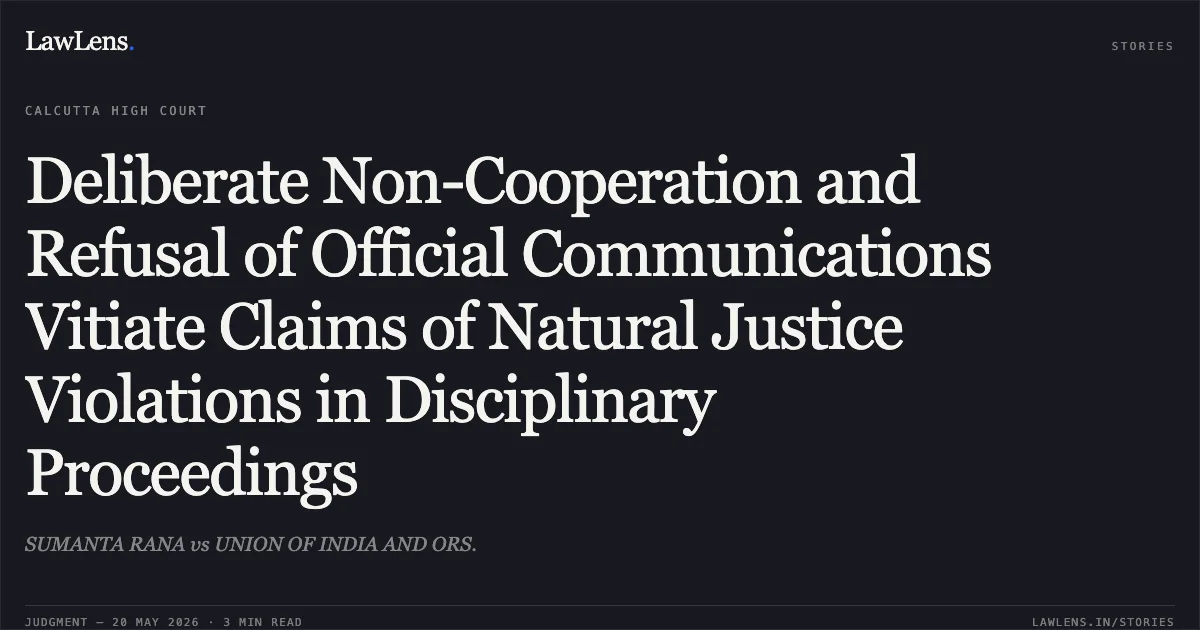
The Court found that the respondents made exhaustive efforts to serve the petitioner, and his repeated refusals to accept notices nullified his claim of natural justice violations; an employee cannot paralyze administration through deliberate non-cooperation.
Source reference: paras. 54-56On the issue of bias, the Court noted that the petitioner’s allegations of provincial prejudice by his superiors were speculative and lacked evidentiary support.
Source reference: para. 64Regarding the Revisional Order, the Court observed that the Inspector General had sufficiently reviewed the record, noting the petitioner’s status as a habitual offender with ten prior penalties in ten years of service.
Source reference: paras. 67-68The Court emphasized that in a "disciplined force" like the CISF, insubordination and refusal to acknowledge official command are grave offenses that strike at the foundation of the institution, justifying a high degree of administrative rigor.
Source reference: paras. 65-66Holding
The Court answered the issues in the negative, holding that the inquiry was conducted in substantial conformity with statutory rules and that no prejudice was caused to the petitioner by his own voluntary absence.
The Court held it cannot substitute the disciplinary authority's judgment on the gravity of misconduct or the quantum of punishment unless it shocks the conscience, which was not the case here.
Source reference: paras. 69-70The petition was dismissed, and the order of removal from service was upheld.
Source reference: para. 71Acts & Sections Cited
1 provisions across 1 statute referred to in this judgment. Each provision opens on LawLens.
Central Industrial Security Force Act, 19681
Original Court PDF
SUMANTA RANAvsUNION OF INDIA AND ORS.
Click to open original judgment
Original judgment, available to read, download and summarize on LawLens.in