Facts
The petitioner sought anticipatory/pre-arrest bail under Section 482 of the Bharatiya Nagarik Suraksha Sanhita, 2023, in Crime No. 27 dated 23 December 2025, registered under Sections 8, 21 and 29 of the Narcotic Drugs and Psychotropic Substances Act, 1985, by the Narcotics Control Bureau, Chandigarh/Sahnewal, Ludhiana.
Source reference: para. 1The prosecution case arose from the recovery of 117.61 grams of heroin from co-accused Manjeet Kaur.
Source reference: para. 2During investigation, the co-accused allegedly made a disclosure implicating the petitioner, and the prosecution relied upon call-detail records and other material indicating contact between the petitioner and the co-accused.
Source reference: paras. 2–3The petitioner’s application for anticipatory bail had been rejected by the Special Judge, Ludhiana, on 1 June 2026.
Source reference: para. 2In the petition, the petitioner represented that she was a first-time offender and disclosed no other criminal case.
Source reference: para. 3During the preliminary hearing, however, the Narcotics Control Bureau stated that she was involved in multiple other cases.
Source reference: para. 3The prosecution subsequently placed on record the petitioner’s antecedents, namely FIR Nos. 365/2017 and 64/2017 under the NDPS Act at Police Station Sidhuwa Bet, FIR No. 83/2023 under the NDPS Act at Police Station Sadar Jagraon, and FIR No. 07/2025 at Police Station City Jagraon.
Source reference: para. 3The petitioner then sought amendment of the petition to disclose those cases, asserting that the omission was neither intentional nor motivated by an attempt to mislead the Court.
Source reference: paras. 3–4Issues
Whether an application for anticipatory bail can be dismissed solely on the ground that the applicant deliberately suppressed or failed to disclose material criminal antecedents, without examining the merits of the prosecution case?
Source reference: para. 6Whether the petitioner’s subsequent disclosure of her antecedents, after the objection was raised by the Narcotics Control Bureau, cured the original non-disclosure and entitled her to consideration of the bail application on merits?
Source reference: paras. 14–15Law Applied
The Court applied Section 482 BNSS, corresponding to the former Section 438 CrPC, under which anticipatory bail is an extraordinary, discretionary and equitable remedy requiring complete candour and utmost good faith.
Source reference: para. 7Relying on K.D. Sharma v. Steel Authority of India Ltd., (2008) 12 SCC 481, the Court held that suppression of material facts or an attempt to mislead the Court may justify dismissal of the proceeding without examination of its merits.
Source reference: para. 7.1The Court further relied on Ash Mohammad v. Shiv Raj Singh, (2012) 9 SCC 446, Neeru Yadav v. State of Uttar Pradesh, (2016) 15 SCC 422, and Brijmani Devi v. Pappu Kumar, (2022) 4 SCC 497, for the proposition that criminal antecedents are a significant factor in bail adjudication and cannot be ignored.
Source reference: paras. 7.2–7.4It also relied on Munnesh v. State of Uttar Pradesh, order dated 3 April 2025, Firoj @ Farhu v. State of Rajasthan, and Zeba Khan v. State of Uttar Pradesh, for the principle that non-disclosure of criminal cases or other material facts in bail proceedings can independently justify rejection of bail.
Source reference: para. 8Rule 5 of Chapter 1-A(b), Volume V of the Punjab and Haryana High Court Rules and Orders requires every bail applicant to disclose involvement in other criminal cases and provide their particulars and outcomes.
Source reference: para. 9Reasoning
The Court held that the petitioner had not approached it with clean hands because she expressly described herself as a first-time offender despite the existence of four other criminal cases.
Source reference: para. 14The original petition was supported by the petitioner’s own affidavit, and no plausible explanation was furnished for the failure to disclose those cases.
Source reference: para. 14The subsequent application seeking amendment was filed only after the prosecution pointed out the omission; therefore, it did not erase the material suppression existing when the Court’s jurisdiction was invoked.
Source reference: paras. 14–15Given the extraordinary and equitable nature of anticipatory bail, the Court treated the non-disclosure as a deliberate and material suppression rather than a technical or inadvertent omission.
Source reference: no citationApplying the principles governing suppression of facts and the relevance of antecedents in bail matters, the Court concluded that the petitioner had forfeited her entitlement to discretionary pre-arrest protection.
Source reference: no citationIt consequently found it unnecessary to examine the evidentiary value of the co-accused’s disclosure, the call-detail records, or the merits of the NDPS allegations.
Source reference: para. 15Holding
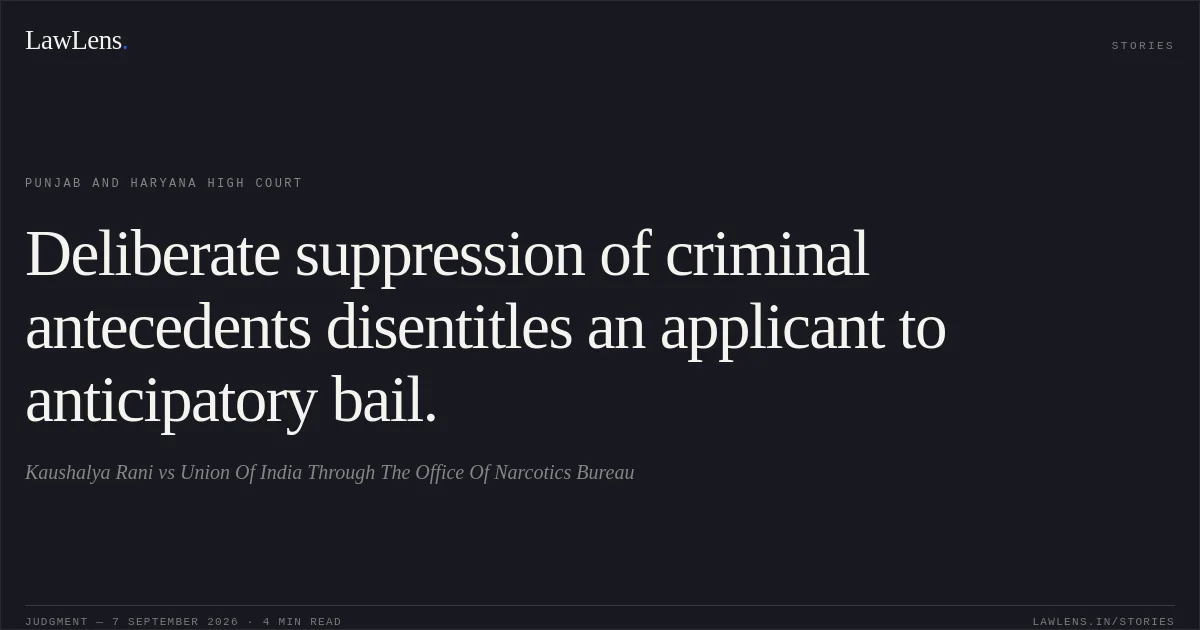
The Court dismissed the anticipatory-bail petition solely on the ground of deliberate suppression of the petitioner’s criminal antecedents, without adjudicating the merits of the prosecution case.
Costs of ₹50,000 were imposed, payable before the Chief Judicial Magistrate, Ludhiana, within four weeks, for remittance to the Punjab State Legal Services Authority, Mohali.
Source reference: para. 15In default, the amount was directed to be recovered as arrears of land revenue.
Source reference: para. 15The Court clarified that its observations would not affect the merits of the case or influence the investigating agency or the trial Court.
Source reference: para. 15Acts & Sections Cited
7 provisions across 3 statutes referred to in this judgment. Each provision opens on LawLens.
Bharatiya Nagarik Suraksha Sanhita, 20232
Narcotic Drugs and Psychotropic Substances Act, 19853
Code of Criminal Procedure, 19732
Original Court PDF
Kaushalya RanivsUnion Of India Through The Office Of Narcotics Bureau
Click to open original judgment
Original judgment, available to read, download and summarize on LawLens.in