Facts
The appellants applied pursuant to the RPF/RPSF recruitment notice dated 23 February 2011 for appointment as constables. They cleared the written, physical and efficiency tests, were included in the select list, underwent document verification and medical examination, and were sent for training.
Source reference: paras. 3–4In their attestation/verification forms, the appellants answered “No” to questions concerning arrest and prosecution, despite criminal cases being pending against them.
Source reference: paras. 4, 17, 20Upon discovering the pending cases and the non-disclosure, the authorities discharged them between June and October 2015 under Rules 52 and 67 of the RPF Rules, 1987, Clause 9(f) of the recruitment notice, and the attestation-form conditions.
Source reference: para. 5In the first round of litigation, the Allahabad High Court directed reconsideration in accordance with Avtar Singh v. Union of India ; upon reconsideration, the authorities again passed reasoned discharge orders in 2017.
Source reference: paras. 6–8The Single Judges and subsequently the Division Bench upheld the discharge orders.
Source reference: paras. 10–12Issues
Whether the appellants’ deliberate non-disclosure of pending criminal cases in the attestation/verification form justified their discharge from RPF/RPSF service under the applicable rules and recruitment conditions.
Source reference: paras. 13–18, 20–22Whether the principles in Avtar Singh v. Union of India required the authorities to overlook or reconsider the appellants’ suppression, particularly in view of their subsequent acquittals.
Source reference: paras. 19–25Whether the appellants were entitled to parity with other candidates who had allegedly been reinstated despite non-disclosure of criminal antecedents.
Source reference: paras. 26–29Whether the discharge orders were vitiated by violation of natural justice.
Source reference: para. 23Law Applied
Rules 52.1 and 52.2 of the Railway Protection Force Rules, 1987 require verification of a recruit’s character and antecedents before formal appointment and prohibit appointment where the recruit is found unsuitable.
Source reference: para. 15Rule 67.2 permits discharge of a direct recruit at any stage before formal appointment, for reasons recorded in writing, in the interest of the Force.
Source reference: para. 15Clause 9(f) of the recruitment notice warned that adverse antecedents or a false declaration could result in disqualification and dismissal from service.
Source reference: para. 16The attestation form similarly made suppression of factual information a disqualification and required disclosure regarding arrest and prosecution.
Source reference: para. 17Applying Avtar Singh v. Union of India , (2016) 8 SCC 471, the Court reiterated that information regarding criminal antecedents must be truthful; the employer must consider applicable rules and special circumstances; and deliberate suppression concerning multiple pending criminal cases may itself justify cancellation of candidature or termination/discharge.
Source reference: para. 19The Court also applied the principle that a finding of suppression requires attributable knowledge of the relevant fact.
Source reference: para. 19Reasoning
The Court held that the attestation form specifically required disclosure of criminal proceedings and that the appellants knowingly answered “No” despite pending cases; therefore, the non-disclosure constituted suppression of material information.
Source reference: para. 20Their cases fell within paragraph 38.7 of Avtar Singh , concerning deliberate suppression of multiple pending criminal cases, in which the false declaration itself assumes significance and the employer may cancel candidature or terminate service.
Source reference: paras. 21–22The subsequent acquittals did not erase the fact that the appellants had made false declarations when the cases were pending and when the forms were completed.
Source reference: para. 24Pawan Kumar was distinguishable because the accused therein had been acquitted before submitting the attestation form.
Source reference: para. 24Satpal Singh was also inapplicable because it concerned an employee who had already served for twelve years and involved different procedural circumstances.
Source reference: para. 25The Court further found that the authorities had reconsidered the cases pursuant to the High Court’s directions and had issued reasoned orders in 2017, thereby satisfying natural justice.
Source reference: para. 23The reinstated candidates did not establish discrimination: some had been acquitted before completing the attestation form, while others were reinstated pursuant to court directions or after case-specific findings of triviality.
Source reference: paras. 27–28Holding
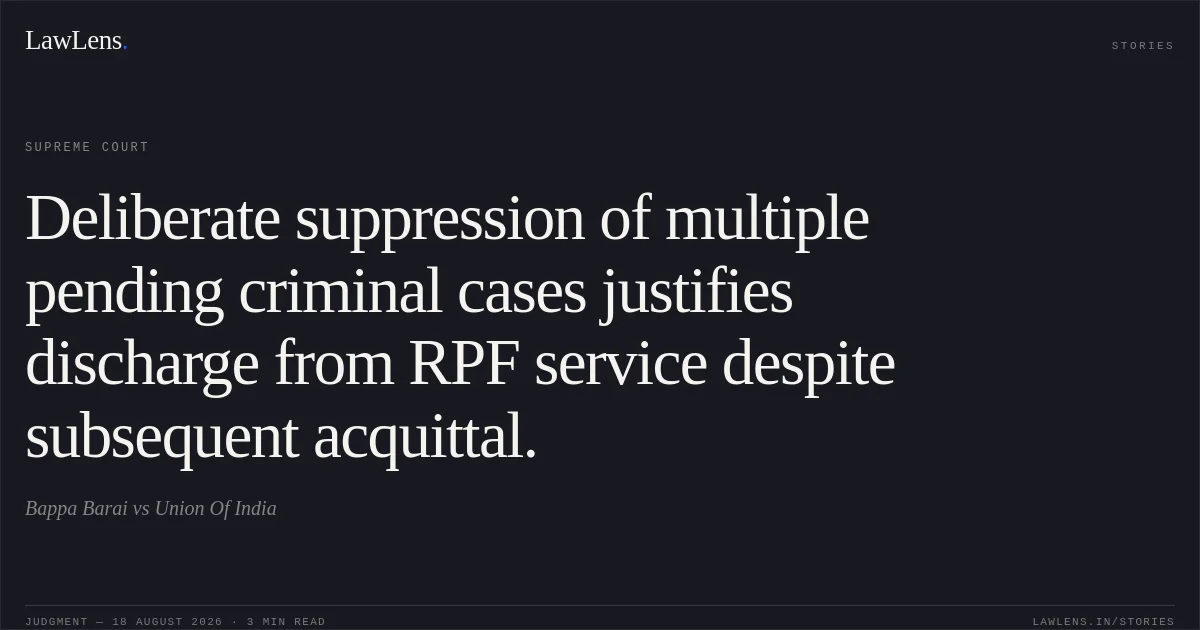
The Supreme Court held that the appellants’ deliberate suppression of pending criminal cases in the attestation forms validly attracted Rules 52 and 67 of the RPF Rules, 1987 and the applicable recruitment conditions.
The authorities had independently reconsidered the matter in accordance with Avtar Singh and had passed reasoned discharge orders.
Source reference: paras. 29–30The appellants were not entitled to benefit from their subsequent acquittals, the cited precedents, or parity with differently situated candidates.
Source reference: paras. 29–30Finding no error in the Allahabad High Court’s judgment, the Court dismissed all the civil appeals and made no order as to costs.
Source reference: paras. 29–30Original Court PDF
Bappa BaraivsUnion Of India
Click to open original judgment
Original judgment, available to read, download and summarize on LawLens.in