01Facts
The petitioners challenged an order dated 25 September 2025 passed by the Commissioner, Bidhannagar Municipal Corporation, concerning alleged illegal and unauthorised construction at Premises No. 448/A, Nabapally, Salt Lake, Sector-IV, Kolkata.
A previous demolition order dated 23 August 2025 had been challenged by the petitioners in WPA 19085 of 2025. In that proceeding, the Coordinate Bench set aside the demolition order and directed the petitioners to produce the original sanctioned plan and granted them an opportunity of hearing before the Municipal Commissioner regarding the alleged unauthorised construction.
¶ 2The petitioners contended that they were not afforded an adequate hearing and that their written submissions were sent by email because the Corporation’s receiving section was closed at the relevant time.
¶ 3They further alleged that the Corporation was attempting, under the guise of demolition, to evict them from the property.
¶ 3The Corporation maintained that the petitioners had been heard pursuant to the earlier order and that the Municipal Building Tribunal constituted under Section 295A of the West Bengal Municipal Corporation Act, 2006, was functional.
¶ 4, 602Issues
i.1. Whether the order dated 25 September 2025 passed by the Bidhannagar Municipal Corporation was liable to be set aside for violation of natural justice or denial of an adequate opportunity of hearing.
¶ 2–4ii.2. Whether implementation of the demolition order could result in the petitioners’ eviction from the property.
¶ 4iii.3. Whether the petitioners had an efficacious statutory remedy before the Municipal Building Tribunal under Section 295A of the West Bengal Municipal Corporation Act, 2006.
¶ 603Law Applied
The Court applied the principle of natural justice requiring a reasonable opportunity of hearing before an adverse administrative or municipal order is passed, while recognising that the petitioners had already been granted such an opportunity pursuant to the Coordinate Bench’s earlier order.
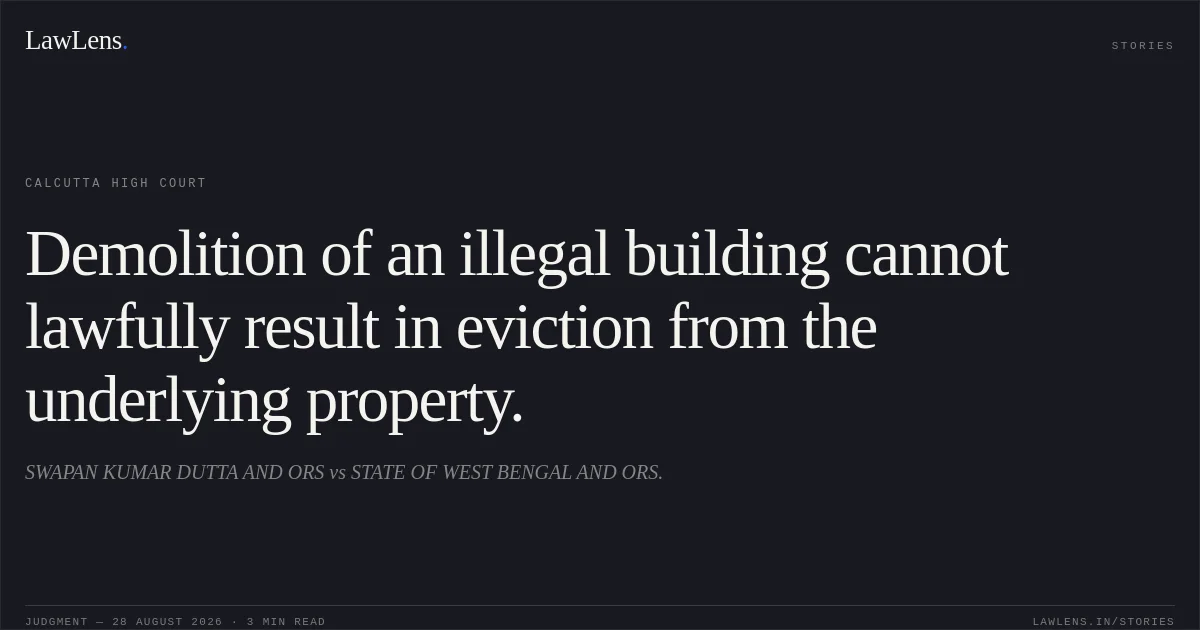
¶ 2, 4It further applied the legal distinction between demolition of an illegal or unauthorised structure and eviction from the underlying property: a demolition order may authorise removal of the illegal construction but cannot, by itself, dispossess the owners or occupants from their property.
¶ 4The Court also recognised the statutory appellate remedy before the Municipal Building Tribunal constituted under Section 295A of the West Bengal Municipal Corporation Act, 2006.
¶ 6Provisions in the judgment · 1
Right To Fair Compensation And Transparency In Land Acquisition, Rehabilitation and Resettlement Act, 2013 Section 295A
04Reasoning
The Court found that the principal grievance concerned the validity of the municipal demolition order.
Since the earlier writ proceedings had expressly directed the petitioners to appear before the Corporation, produce the sanctioned plan, and receive an opportunity of hearing, and since such an opportunity had subsequently been afforded, the Court found no procedural defect sufficient to invalidate the impugned order.
¶ 2, 4The Court also held that the municipal order did not authorise eviction: its legal effect was confined to demolition of the unauthorised building, and any attempt to evict the petitioners would not be sanctioned by law.
¶ 4As the municipal order did not appear perverse and an appellate remedy was available before the Municipal Building Tribunal, the Court declined to exercise writ jurisdiction.
¶ 4–605Holding
The writ petition was not entertained and was disposed of.
¶ 4–7The Court declined to interfere with the demolition order dated 25 September 2025, while clarifying that its implementation could extend only to demolition of the illegal or unauthorised building and could not be used to evict the petitioners from the property.
¶ 4–7The petitioners were expressly left at liberty to challenge the order by filing a statutory appeal before the Municipal Building Tribunal under Section 295A of the West Bengal Municipal Corporation Act, 2006, if so advised.
¶ 6Original Court PDF
SWAPAN KUMAR DUTTA AND ORSvsSTATE OF WEST BENGAL AND ORS.
Click to open original judgment
Original judgment, available to read, download and summarize on LawLens.in