Facts
The petitioner, originally an Assistant Teacher, was granted a promotion to the post of Upper Division Teacher in the pay scale of Rs. 9300-34800 via an order dated 01.07.2016.
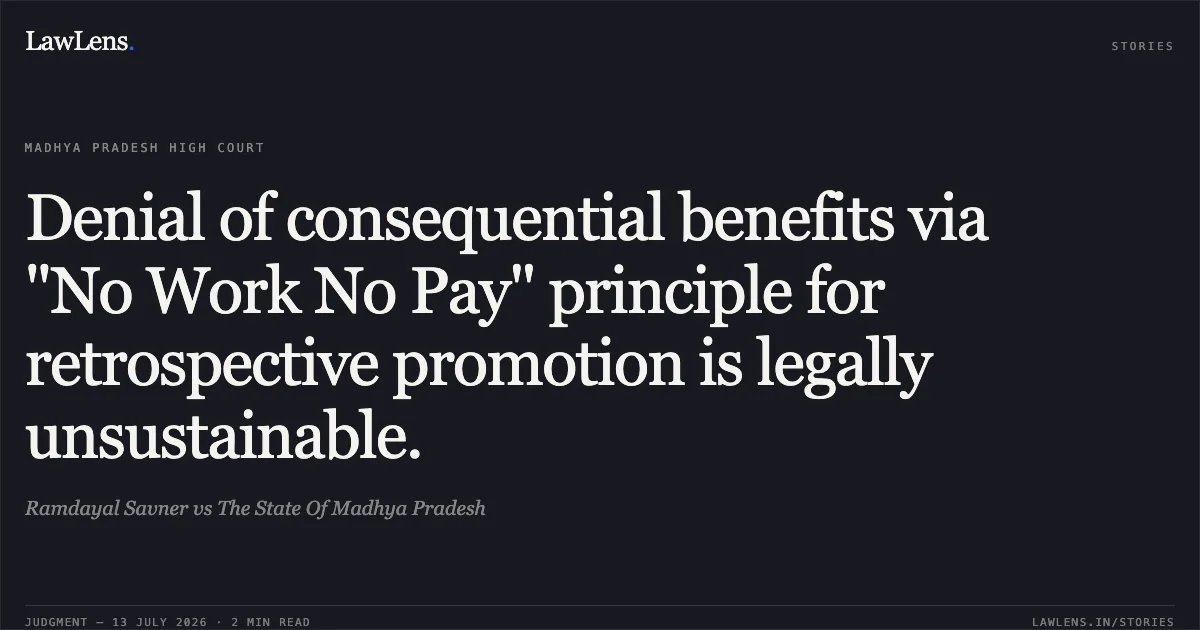
Source reference: para. 2, 3While the promotion was granted retrospectively with effect from 02.08.2013, the respondents incorporated a "No Work No Pay" condition in the order, denying the petitioner salary arrears and pay benefits for the period between 02.08.2013 and 01.07.2016.
Source reference: para. 2, 3The petitioner challenged this specific condition via a writ petition under Article 226 of the Constitution, contending it was discriminatory as juniors had received benefits without such conditions, and that the delay in promotion was not attributable to him.
Source reference: para. 4Issues
1. Whether the imposition of the "No Work No Pay" principle is legally sustainable when an employee is granted promotion from a retrospective date and the delay is not attributable to the employee.
Source reference: para. 2, 9Law Applied
The Court primarily relied on the legal principle established in Nayaz Mohammed v. State of M.P. and Another [2007 (I) MPJR 98], which dictates that if an employee is restrained from working in a promotional post for which they are entitled without valid reason, the "No Work No Pay" doctrine cannot be used to deny consequential monetary benefits upon retrospective promotion.
Source reference: para. 9, 10The Court also functioned under the writ jurisdiction of Article 226 of the Constitution of India.
Source reference: para. 1Reasoning
The Court observed that the petitioner’s case was squarely covered by the precedent in Nayaz Mohammed.
Source reference: para. 9It reasoned that since the petitioner was officially granted promotion effective from 02.08.2013, the denial of pay and arrears for the intervening period was arbitrary.
Source reference: para. 12The court noted that the respondents failed to demonstrate any fault or reason attributable to the petitioner for the delay in granting the promotion when it was due.
Source reference: para. 12Consequently, because the petitioner was effectively denied the opportunity to work at the higher grade during that period due to administrative delay rather than personal conduct, the principle of "No Work No Pay" was held to be inapplicable.
Source reference: para. 12, 13Holding
The Court answered the issue in the negative, holding that the "No Work No Pay" condition was unsustainable.
The High Court set aside the impugned condition in the order dated 01.07.2016 and directed the respondents to extend all consequential benefits, including pay fixation and arrears of salary effective from 02.08.2013, to the petitioner in accordance with the law.
Source reference: para. 13, 14The writ petition was allowed.
Source reference: para. 14Original Court PDF
Ramdayal SavnervsThe State Of Madhya Pradesh
Click to open original judgment
Original judgment, available to read, download and summarize on LawLens.in