Facts
The Plaintiff (Respondent) filed a suit seeking eviction and recovery of arrear rents, claiming absolute ownership of a plot (0B-1K-0L) in Dibrugarh, purchased from Borbari Land Development Corporation.
Source reference: p. 3, 8The Plaintiff alleged that the Defendant (Petitioner) entered the premises as a tenant in February 1990 via an 11-month agreement (Exhibit-6) at a monthly rent of Rs. 100/-, but became a defaulter in January 2008.
Source reference: p. 3-4The Defendants contested, asserting they had occupied the land for over 100 years and had an agreement to purchase the land from the same Corporation for Rs. 25,000/-.
Source reference: p. 4-5The Trial Court (Munsiff No. 1, Dibrugarh) initially dismissed the suit, but the Appellate Court (Civil Judge, Dibrugarh) reversed the decision, holding that a landlord-tenant relationship existed and that the Defendants were defaulters.
Source reference: p. 2-3, 10The Defendants then moved the High Court in revision.
Source reference: no citationIssues
1. Whether a landlord-tenant relationship was established between the parties based on the evidence produced.
Source reference: p. 3, 82. Whether the Defendants committed a default in the payment of rent.
Source reference: p. 3, 113. Whether the High Court, in its revisional jurisdiction under Section 115 CPC, can reassess evidence to overturn the findings of the lower appellate court.
Source reference: p. 11Law Applied
The court applied Section 115 of the Code of Civil Procedure (CPC), which limits revisional jurisdiction to cases of jurisdictional error, illegality, or material irregularity, excluding a total reassessment of evidence.
Source reference: p. 11It also referred to the principle under Order 7 Rule 7 CPC, as interpreted in Bhupati Bhushan Dey v. Julfi Begum (2006 1 GLT 161), which allows a court to grant the equitable relief of ejectment based on proven title even if the landlord-tenant relationship is not established, provided the title was fairly tried.
Source reference: p. 10Reasoning
The High Court observed that the Plaintiff successfully proved title through a Sale Deed (Exhibit-1), the authenticity of which was not challenged by the Defendants during cross-examination.
Source reference: p. 8, 10Regarding the tenancy, the court found that Exhibit-6 (the tenancy agreement) clearly established the relationship.
Source reference: p. 8-9The Defendants’ claim of a prior purchase agreement was rejected because the document was executed in 2009—after the rent default began—suggesting it was manufactured to evade eviction.
Source reference: p. 7Furthermore, the original Defendant (Kishan Dushad) failed to testify, and the defense witness (DW-1) lacked personal knowledge of the tenancy's inception.
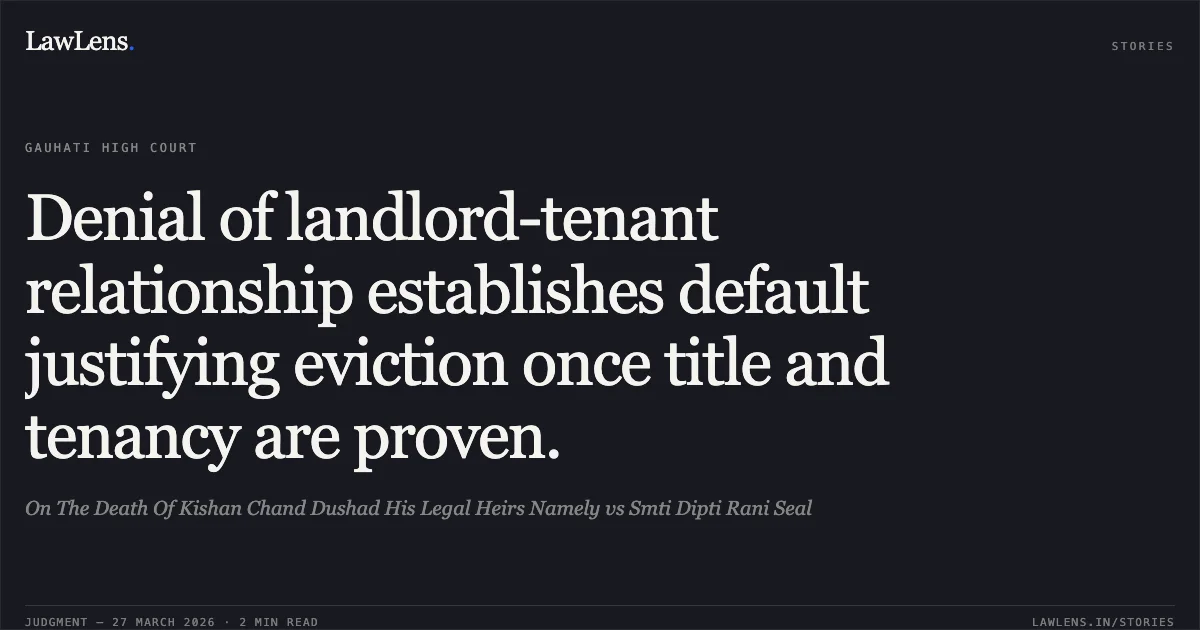
Source reference: p. 7The court reasoned that since the Defendants denied the landlord-tenant relationship, their failure to pay rent automatically constituted a "default" once the relationship was legally affirmed.
Source reference: p. 10-11Finally, the court emphasized that as a revisional body, it cannot embark on a reassessment of evidence unless the subordinate court acted without jurisdiction or with material irregularity.
Source reference: p. 11Holding
The High Court dismissed the revision petition, upholding the Appellate Court’s judgment and decree for eviction and recovery of rent.
The court held that the Plaintiff sufficiently established both title and a landlord-tenant relationship, and the Defendants were confirmed to be defaulters.
Source reference: p. 10-11No jurisdictional error or material irregularity was found to warrant interference under Section 115 CPC.
Source reference: p. 11All connected miscellaneous cases were closed.
Source reference: p. 11Original Court PDF
On The Death Of Kishan Chand Dushad His Legal Heirs NamelyvsSmti Dipti Rani Seal
Click to open original judgment
Original judgment, available to read, download and summarize on LawLens.in