Facts
The Petitioners, persons with benchmark disabilities (PwD), were recruited as Probationary Officers (POs) by the State Bank of India (SBI) in 2018.
Source reference: p. 2Under SBI’s 2019 policy, POs underwent a continuous assessment of 1000 marks for two purposes: (i) confirmation in JMGS-I (requiring 50% marks, relaxed to 45% for SC/ST and PwD) and (ii) direct placement in the higher MMGS-II grade (requiring 75% marks, relaxed to 70% for SC/ST alone).
Source reference: p. 2, 6All Petitioners scored between 70% and 75%.
Source reference: p. 6, 7SBI granted the 5% relaxation to SC/ST candidates for MMGS-II placement but denied it to PwD candidates, treating them as general category for this specific benefit.
Source reference: p. 3Petitioners challenged this exclusion as discriminatory under Article 14 and the RPwD Act, 2016.
Source reference: p. 7, 8Issues
1. Whether the Court has territorial jurisdiction and whether the petitions are barred by delay or acquiescence.
Source reference: p. 14, 152. Whether direct placement in MMGS-II upon confirmation constitutes a promotion or an incentive-based placement route.
Source reference: p. 14, 163. Whether SBI could validly grant a 5% relaxation to SC/ST candidates for MMGS-II placement while denying the same to PwD candidates within the same assessment framework.
Source reference: p. 14, 174. Whether Article 335 of the Constitution or Government notifications regarding "reservation in promotion" justify the exclusion of PwD candidates from relaxed standards.
Source reference: p. 14, 22Law Applied
The Court applied Article 14 of the Constitution (Right to Equality) and the Rights of Persons with Disabilities (RPwD) Act, 2016.
Source reference: p. 20, 26The principle from Anamol Bhandari v. Delhi Technological University that PwD candidates are entitled to the same relaxations as SC/ST candidates in the absence of a rational basis for distinction.
Source reference: p. 7, 20Aryan Raj v. Chandigarh Administration, affirming parity in relaxed standards within the same selection framework.
Source reference: p. 7, 21The doctrine that disability rights extend beyond recruitment to encompass equal opportunity and career progression, as established in State of Kerala v. Leesamma Joseph and Siddaraju v. State of Karnataka.
Source reference: p. 8, 21Reasoning
The Court found that MMGS-II placement was an "incentive-based placement route" embedded in the confirmation process, not a regular promotion.
Source reference: p. 16, 17It rejected SBI's reliance on Article 335 and MoF notifications because those pertain to reservation of vacancies, whereas the issue here was the relaxation of qualifying marks.
Source reference: p. 18, 22The Court observed that SBI already recognized the need for parity by granting PwD candidates the same 45% relaxation as SC/STs for confirmation.
Source reference: p. 23Therefore, denying the same parity for MMGS-II placement—within the same 1000-mark assessment—was arbitrary.
Source reference: p. 23The Court held that once an employer creates a relaxation for one protected class (SC/ST), it cannot exclude another (PwD) without a rational nexus to the object of efficiency, which SBI failed to demonstrate.
Source reference: p. 19, 25Holding
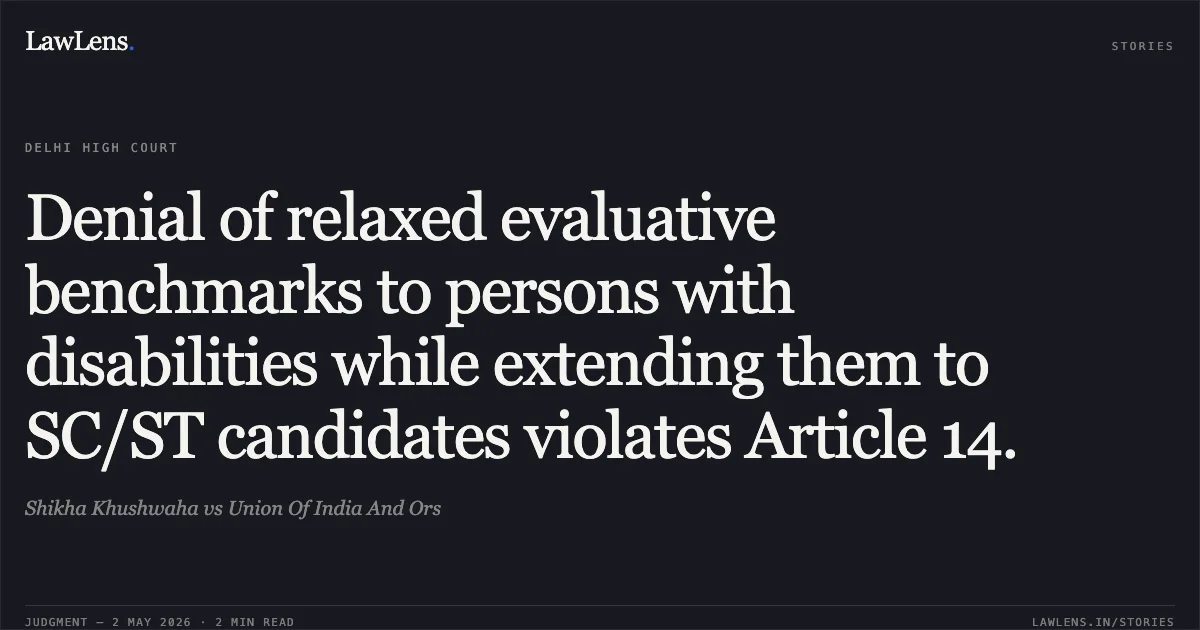
The Court allowed the petitions, holding that Clause 5(G)(ii) of the 2019 Circular was arbitrary and violative of Article 14.
The Court ordered SBI to: (i) read down the policy to extend the 5% relaxation to PwD candidates; (ii) grant Petitioners notional placement in MMGS-II from the date their batchmates were promoted; (iii) refix their seniority and pay notionally; (iv) pay differential monetary benefits within twelve weeks; and (v) allow Petitioners to participate in the MMGS-III promotional exercise with consequential benefits for the 2024-25 year.
Source reference: p. 27, 28Acts & Sections Cited
1 provisions across 1 statute referred to in this judgment. Each provision opens on LawLens.
Rights of Persons with Disabilities Act, 2016.1
Original Court PDF
Shikha KhushwahavsUnion Of India And Ors
Click to open original judgment
Original judgment, available to read, download and summarize on LawLens.in


