Facts
The dispute arose from a Deed of Assignment of Development Rights dated December 6, 2010
Source reference: para. 2Following a Section 9 petition in 2019, the High Court referred the parties to arbitration and appointed a sole arbitrator
Source reference: para. 2After an interim order was passed on August 31, 2020, no further progress occurred for over two years
Source reference: para. 2, 16The Applicants subsequently filed a petition under Section 29A of the Arbitration and Conciliation Act, 1996 ("the Act") seeking an extension of the arbitrator’s mandate.
Source reference: para. 2, 16By an order dated October 18, 2024, the Court refused the extension, recording a specific finding that the Applicants had "abandoned the arbitration proceedings"
Source reference: para. 2, 16This order was upheld by the Supreme Court on February 14, 2025
Source reference: para. 2, 18The Applicants then issued a fresh notice invoking arbitration, alleging a continuous cause of action, and filed the present Section 11(6) application for the appointment of a new arbitrator
Source reference: para. 3Issues
1. Whether the Court can appoint an arbitrator under Section 11(6) of the Act after it has expressly refused to extend the mandate of a previous arbitrator under Section 29A due to the fault of the applicant
Source reference: para. 1, 202. Whether the refusal to extend a mandate under Section 29A results in the termination of the arbitral proceedings themselves, or merely the mandate of the specific arbitrator
Source reference: para. 1, 30Law Applied
The Court analyzed the interplay between Section 11 (appointment of arbitrators), Section 29A (time limit for awards), and Section 32 (termination of proceedings) of the Act.
Source reference: para. 10, 34-35It relied on the Supreme Court’s decision in Rohan Builders (India) Private Limited v. Berger Paints India Limited, which established that while Section 29A(4) makes a tribunal functus officio, it does not terminate proceedings in absolute terms for a "faultless party"
Source reference: para. 10, 34-35The Court further applied the principle from Fedbank Financial Service Ltd. v. Narendra H Shelar, holding that arbitration clauses cannot be constantly revived if a party was remiss in diligent prosecution
Source reference: para. 8, 26-27It distinguished between the "termination of mandate" (Sections 14, 15, 29A) and "termination of proceedings" (Section 32), noting that while the former does not always cause the latter, a finding of "abandonment" by a competent court effectively ends the proceedings
Source reference: para. 22-24, 31Reasoning
The Court observed that while the expiration of a mandate under Section 29A(4) generally terminates the arbitrator's authority, it does not automatically terminate the arbitral proceedings under Section 32 unless the party is at fault
Source reference: para. 29-31Applying Rohan Builders, the Court held that the key determinant is whether the applicant is a "faultless party"
Source reference: para. 36In the present case, the Section 29A Court had already recorded a final, emphatic finding—upheld by the Supreme Court—that the Applicants had "abandoned" the proceedings due to gross negligence
Source reference: para. 17, 32The Court reasoned that if it were to appoint a new arbitrator under Section 11(6) after such a finding, it would essentially be sitting in appeal or review of the Section 29A order
Source reference: para. 31, 33The Court rejected the Applicants' plea of "continuous cause of action," noting that the fresh invocation was merely an attempt to re-litigate the same disputes covered by the abandoned proceedings and overreach the previous judicial refusal to extend the mandate
Source reference: para. 39Holding
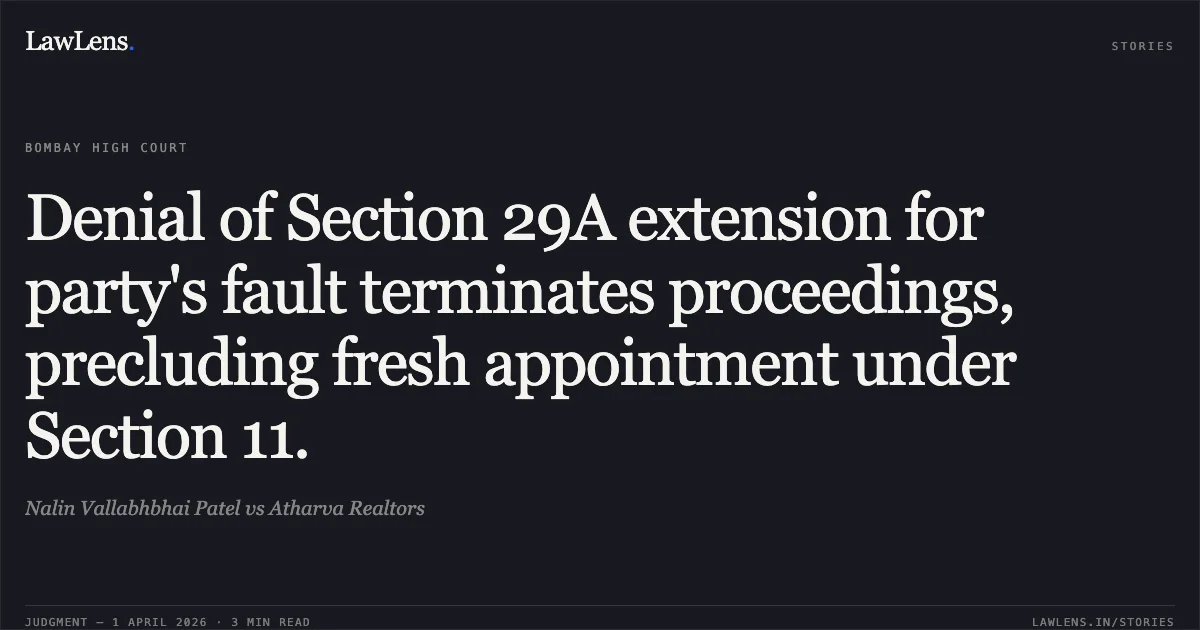
The Court dismissed the application, holding that a Section 11 application is not maintainable when a mandate extension under Section 29A was refused due to the applicant's own fault or abandonment
The Court concluded that where a party's conduct has led to a judicial finding of abandonment, the arbitral proceedings are terminated, and the referral court cannot exercise jurisdiction to appoint a substitute arbitrator, as the reference itself is no longer alive
Source reference: para. 37, 40Acts & Sections Cited
16 provisions across 2 statutes referred to in this judgment. Each provision opens on LawLens.
Arbitration and Conciliation Act, 1996
Code of Civil Procedure, 19081
Original Court PDF
Nalin Vallabhbhai PatelvsAtharva Realtors
Click to open original judgment
Original judgment, available to read, download and summarize on LawLens.in


