Facts
The petitioner (plaintiff) filed a suit for declaration and permanent injunction regarding land, placing reliance on an Ikrarnama (agreement) dated March 4, 1999.
Source reference: para. 2The respondent (defendant) filed a written statement disputing the authenticity of his signatures on said document.
Source reference: para. 3Consequently, the petitioner filed an application under Section 45 of the Indian Evidence Act, 1872, seeking an expert examination of the signatures.
Source reference: para. 3The Trial Court (III Civil Judge, Senior Division, Dabra) rejected the application on January 16, 2026, reasoning that since the defendant had already denied the signatures, no grounds existed for expert opinion.
Source reference: para. 3The petitioner challenged this order under Article 227 of the Constitution of India.
Source reference: para. 1Issues
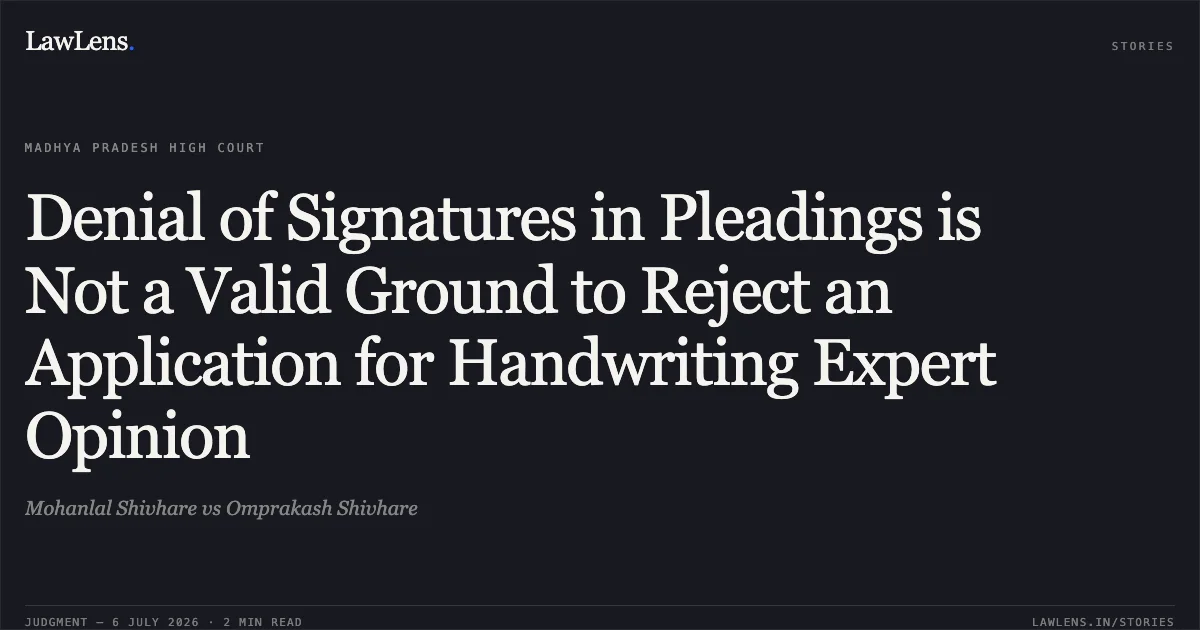
1. Whether the mere denial of signatures by a defendant in a written statement constitutes a valid ground for a Trial Court to reject an application for a handwriting expert’s opinion under Section 45 of the Evidence Act.
Source reference: para. 72. Whether the denial of a document's execution by a plaintiff’s witness (PW/4) precludes the plaintiff from seeking expert opinion on the disputed signatures.
Source reference: para. 8Law Applied
Section 45 of the Indian Evidence Act, 1872, which permits the court to seek the opinion of experts on points of science or art, including the identity of handwriting.
Source reference: para. 1Division Bench precedent in L.S. Trading Company (M/s.) v. Manish Mishra (2010), which established that when signatures are disputed, such dispute itself constitutes a valid ground for seeking an expert’s opinion to "take out the grain from the chaff".
Source reference: para. 4, 6Section 67 of the Evidence Act regarding the various modes of proving signatures and handwriting.
Source reference: para. 6Reasoning
The High Court found the Trial Court’s reasoning—that a denial of signatures removes the need for an expert—to be legally unsustainable and contrary to established precedent.
Source reference: para. 4, 7The Court observed that the very purpose of Section 45 is activated when such a dispute arises; a denial necessitates, rather than precludes, expert evidence.
Source reference: para. 7The evidentiary value or credibility of a witness's testimony (PW/4) is a matter for final adjudication and cannot deprive a party of a legally permissible mode of proving a document during the trial process.
Source reference: para. 8The court emphasized that it must only examine if the expert opinion is relevant and necessary for effective adjudication.
Source reference: para. 8Holding
The Court answered the issues in the negative, holding that the Trial Court committed an error by arbitrarily rejecting the application.
The High Court set aside the order dated January 16, 2026, and allowed the petition, directing the Trial Court to afford the petitioner an opportunity to have the signatures examined by a handwriting expert.
Source reference: para. 10It further granted the respondent the right to seek a second expert opinion should the first report be adverse to them.
Source reference: para. 10The petition was disposed of with no order as to costs.
Source reference: para. 11Acts & Sections Cited
2 provisions across 1 statute referred to in this judgment. Linked provisions open on LawLens.
Indian Evidence Act, 18722
Original Court PDF
Mohanlal ShivharevsOmprakash Shivhare
Click to open original judgment
Original judgment, available to read, download and summarize on LawLens.in