Facts
The applicants were engaged as casual laborers by the respondents (All India Radio, Srinagar) in 1998 and 2011 respectively
Source reference: para. 02They alleged that since June 2022, the respondents stopped permitting them to work and withheld their wages without issuing formal disengagement orders
Source reference: para. 03The applicants claimed to have submitted several representations requesting re-engagement and release of wages, though no documentary evidence of such representations was produced
Source reference: para. 04, 15Seeking parity with a similarly situated person (Javed Ahmad Dar) who obtained a favorable order from the Tribunal in early 2025, the applicants filed the present Original Application (OA) alongside a Miscellaneous Application (MA) for condonation of a nearly three-year delay
Source reference: para. 05, 15The respondents resisted, characterizing the applicants as "fence-sitters" who failed to explain the inordinate delay
Source reference: para. 10Issues
1. Whether the applicants demonstrated "sufficient cause" under Section 21(3) of the Administrative Tribunals Act, 1985 to warrant condonation of the delay in filing the OA
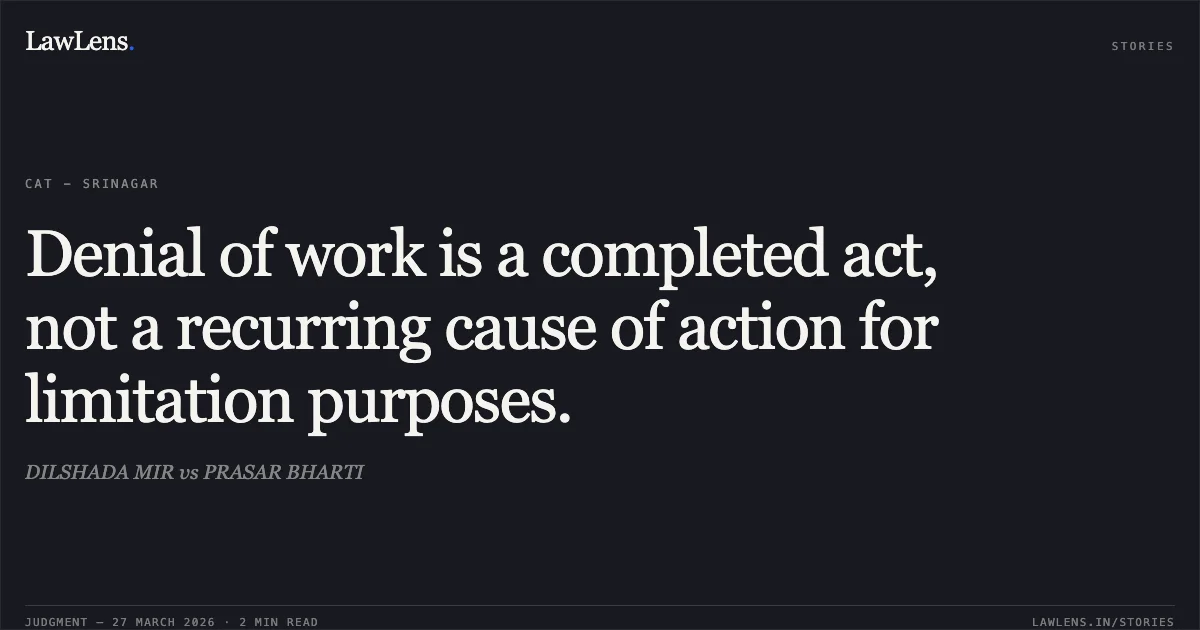
Source reference: para. 11, 132. Whether the denial of work and non-payment of wages constitutes a "recurring or continuing cause of action" that exempts the claim from the standard limitation period
Source reference: para. 06, 20Law Applied
The court applied Section 21 of the Administrative Tribunals Act, 1985, which mandates that an application must be filed within one year of a final order or within one year after the expiry of six months from a pending representation
Source reference: para. 11It relied on Union of India v. Tarsem Singh, which distinguished a "continuing wrong" from the "continuing effect of a completed act," holding that a one-time wrongful act does not become a recurring cause of action merely because its effects persist
Source reference: para. 20The court further applied Bharat Sanchar Nigam Limited v. Ghanshyam Dass, which held that "fence-sitters" who wait for the outcome of others' litigation cannot claim relief after a long lapse of time
Source reference: para. 17C. Jacob v. Director of Geology and Mining, which established that stale claims cannot be revived by filing fresh representations
Source reference: para. 19Reasoning
The Tribunal found that the cause of action arose in March/June 2022 when the applicants were allegedly prevented from working and their wages were stopped
Source reference: para. 21The court reasoned that this constituted a "one-time cause of action" rather than a recurring wrong; the subsequent financial hardship was merely the continuing effect of a completed act of disengagement
Source reference: para. 21The Tribunal noted the total absence of documentary evidence proving that the applicants had consistently agitated their grievances through representations between 2022 and 2025
Source reference: para. 15, 18The court observed that the applicants only approached the Tribunal after a favorable order was passed in a different case (Javed Ahmad Dar), which categorized them as "fence-sitters" who failed to remain vigilant regarding their own rights
Source reference: para. 17, 18Consequently, the three-year delay remained legally unexplained and the cause of action was deemed extinguished by the lapse of time
Source reference: para. 21, 22Holding
The Tribunal held that the applicants failed to demonstrate "sufficient cause" for the delay and that the doctrine of recurring cause of action was inapplicable to the facts
The court dismissed M.A. No. 91/2026 for condonation of delay
Source reference: para. 24Consequently, O.A. No. 1393/2025 was dismissed as ex facie barred by limitation
Source reference: para. 24No order as to costs was made
Source reference: para. 25Original Court PDF
DILSHADA MIRvsPRASAR BHARTI
Click to open original judgment
Original judgment, available to read, download and summarize on LawLens.in