Facts
The petitioner, a constable in the 17th Battalion, Special Armed Force, was removed from service after a departmental enquiry found charges against him proved.
Source reference: p. 2–3His appeal and subsequent petition were dismissed.
Source reference: p. 2–3The petitioner and his brother, who faced proceedings arising from the same allegations, later submitted a joint mercy petition.
Source reference: p. 6–7The Director General of Police modified the brother’s dismissal to compulsory retirement but denied the petitioner similar relief, citing the earlier rejection of his mercy petition.
Source reference: p. 6–7The petitioner challenged that decision and the orders imposing and affirming his removal
Source reference: p. 2–3, 6–7Issues
Whether denying the petitioner reconsideration of his punishment, while granting his brother compulsory retirement in connection with the same matter, amounted to discriminatory treatment contrary to Article 14
Source reference: p. 6–7, 10–11Whether the orders concerning the petitioner could be set aside and his case remitted for fresh consideration
Source reference: p. 10–11Law Applied
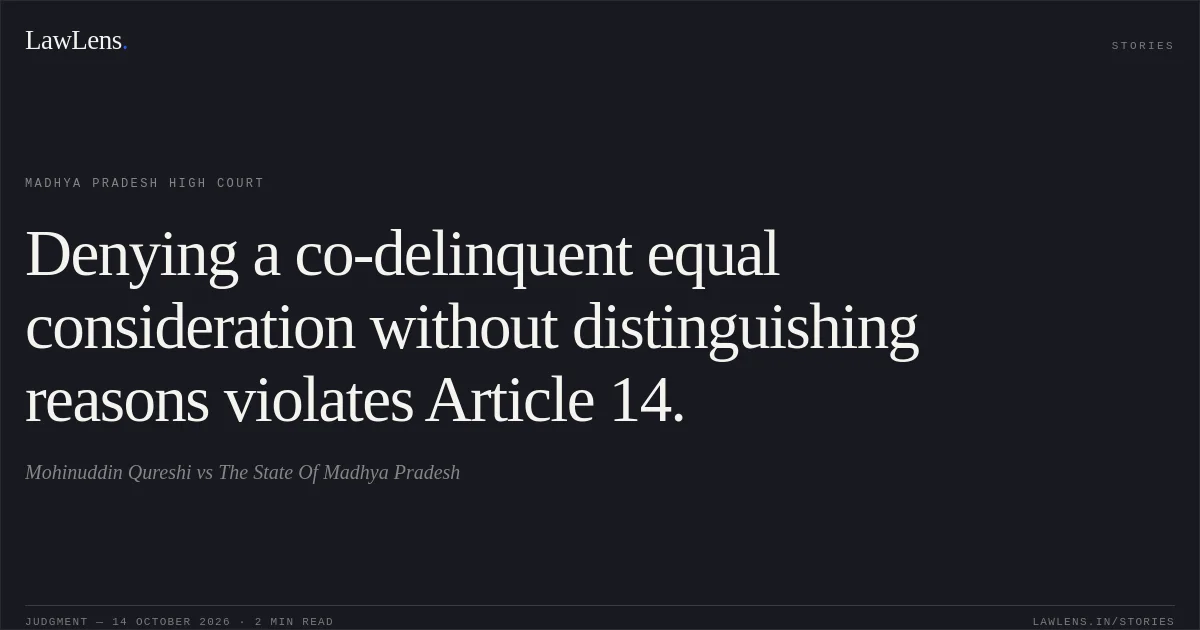
Article 14 requires fairness and equal treatment in State action, including the imposition of liability and punishment; similarly situated persons should not receive discriminatory treatment without a relevant basis.
Source reference: p. 7–10The Court relied on Man Singh v. State of Haryana and Others, (2008) 12 SCC 331, on equality and fairness in disciplinary punishment.
Source reference: p. 7–10It also relied on Kranti Associates (P) Ltd. v. Masood Ahmed Khan, (2010) 9 SCC 496, for the requirement that authorities give reasons in decisions affecting a person’s rights.
Source reference: p. 10State of Punjab v. V.K. Khanna and Others, (2001) 2 SCC 330, was cited for the principle that an enquiry must be conducted without bias where circumstances indicate a real likelihood of bias; the Court did not decide the petitioner’s bias objection.
Source reference: p. 10Reasoning
The petitioner and his brother had submitted a joint mercy petition and were co-delinquents in the same matter.
Source reference: p. 6–7Although the DGP granted the brother compulsory retirement, the petitioner was denied comparable consideration without any recorded distinguishing circumstance; reliance on the earlier rejection of the petitioner’s mercy petition did not adequately address the later joint petition.
Source reference: p. 6–7, 10–11The Court therefore found the differential treatment unfair and inconsistent with Article 14, and the DGP’s order lacked cogent reasons for the distinction.
Source reference: p. 6–7, 10–11It declined to reappraise the enquiry evidence or determine the bias objection, instead directing the competent authority to reconsider the petitioner’s case.
Source reference: p. 10Holding
The petition was allowed.
The orders dated 18 December 2005, 20 April 2006 and 28 March 2007, and the DGP’s order dated 4 August 2011, were set aside insofar as they related to the petitioner.
Source reference: p. 11–12The disciplinary authority was directed to reconsider his case in light of the relief granted to his brother, the principle of parity and Article 14, after providing a personal hearing and issuing a reasoned order within three months of receiving the certified order.
Source reference: p. 11–12Consequential benefits were made subject to the fresh decision.
Source reference: p. 11–12Original Court PDF
Mohinuddin QureshivsThe State Of Madhya Pradesh
Click to open original judgment
Original judgment, available to read, download and summarize on LawLens.in