Facts
The petitioner, a Public Works Department road-roller driver, had been deployed to the Collectorate for one year from 5 April 2012.
Source reference: p. 2–4After sanctioned earned leave from 21 January to 10 February 2013, he reported to his parent divisional office on 11 February 2013 and claimed that he thereafter attended work.
Source reference: p. 2–4The State’s position was that he was required to return to the Collectorate, had not been relieved from that posting, and did not provide attendance evidence for the disputed period.
Source reference: p. 2–4By an order dated 13 August 2015, the department treated his absence as extraordinary leave. Following an earlier direction to consider his claim, the petitioner challenged that order and sought salary for the period from 11 February to 11 October 2013.
Source reference: p. 2–4He contended, among other things, that the order was contrary to Rule 23 of the Madhya Pradesh Civil Services (Leave) Rules, 1977.
Source reference: p. 2–3Issues
1. Whether the petitioner’s claim to salary for the disputed period could be adjudicated in a writ petition when the parties disputed whether, where, and in what capacity he had performed duty
Source reference: p. 4–52. Whether the impugned order treating the period as extraordinary leave warranted interference under Article 226 on the material before the Court
Source reference: p. 9Law Applied
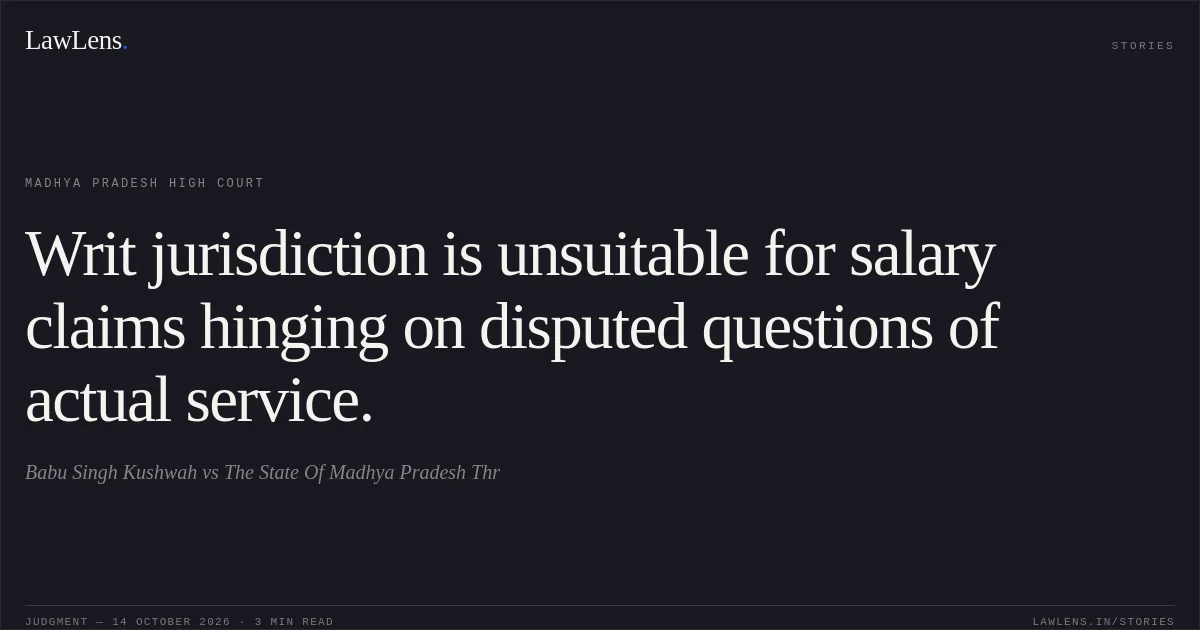
Article 226 jurisdiction is generally not the appropriate forum for resolving disputed questions of fact that require evidentiary assessment; the High Court may decline writ relief and leave the parties to an appropriate alternative forum.
Source reference: p. 5–9The Court relied on Chairman, Grid Corporation of Orissa Ltd. v. Sukamani Das (1999) 7 SCC 298, S.P.S. Rathore v. State of Haryana (2005) 10 SCC 1, Shubhas Jain v. Rajeshwari Shivam 2021 SCC OnLine SC 562, Union of India v. Puna Hinda (2021) 10 SCC 690, and M.P. Power Management Co. Ltd. v. Sky Power Southeast Solar India (P) Ltd. (2023) 2 SCC 703 for the principle that disputed factual matters may be unsuitable for writ adjudication, particularly where their resolution is necessary to determine entitlement to relief.
Source reference: p. 5–9Although the petitioner invoked Rule 23 of the Madhya Pradesh Civil Services (Leave) Rules, 1977, the Court did not determine its application to the merits of his leave claim.
Source reference: p. 2–3; p. 9Reasoning
The petitioner produced no attendance register, attendance or duty certificate, muster roll, or other official record establishing that he attended work or performed duties during the relevant period.
Source reference: p. 4The State, in contrast, maintained that he was required to report to the Collectorate, had not obtained a relieving order before reporting to the divisional office, and failed to submit attendance evidence despite being directed to join the Collectorate.
Source reference: p. 4–5Determining whether he attended or was permitted to work, whether his joining at the divisional office was validly accepted, and where he was required to serve would therefore require resolution of disputed facts.
Source reference: p. 5–9Applying the cited Article 226 principles, the Court declined to determine those matters on the conflicting pleadings and affidavit material.
Source reference: p. 5–9Holding
The Court held that the petitioner’s claim involved disputed questions of fact and that he had not produced cogent documentary material proving that he discharged duties during the disputed period.
It therefore found no basis to interfere with the order dated 13 August 2015 under Article 226 and dismissed the writ petition, while granting the petitioner liberty to file a civil suit concerning the factual disputes.
Source reference: p. 9Acts & Sections Cited
1 provisions across 1 statute referred to in this judgment. Linked provisions open on LawLens.
the Act (alias, unresolved)1
Original Court PDF
Babu Singh KushwahvsThe State Of Madhya Pradesh Thr
Click to open original judgment
Original judgment, available to read, download and summarize on LawLens.in