Facts
The petitioner, an Assistant Inspector General of Registration, faced a vigilance FIR alleging possession of assets worth approximately ₹2.06 crore disproportionate to his known sources of income.
Source reference: para. 3A departmental proceeding was initiated under Rule 17(2) of the Bihar Government Servants (Classification, Control and Appeal) Rules, 2005.
Source reference: paras. 3–11The inquiry officer found charges under Rules 3 and 19 of the Bihar Government Servants’ Conduct Rules, 1976 proved.
Source reference: paras. 3–11After considering the petitioner’s response and obtaining the required approvals, the department dismissed him from service on 4 October 2025. His review application was rejected on 2 March 2026. He challenged the disciplinary process, dismissal and rejection of review before the High Court
Source reference: paras. 3–11, 14–15Issues
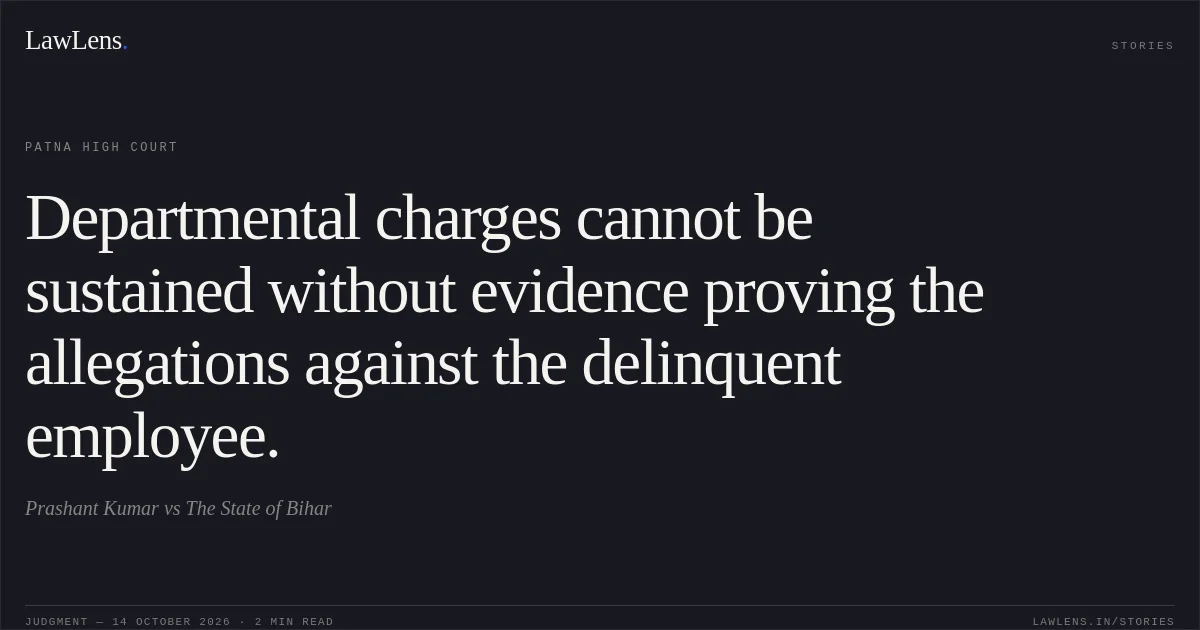
Whether the charges in the departmental proceeding were proved by material evidence led before the inquiry officer
Source reference: paras. 18–20Whether the finding of violation of Rule 19 could stand when no charge under that rule had been framed
Source reference: paras. 20–21Whether the dismissal and rejection of the review application were sustainable
Source reference: paras. 22–23Law Applied
A departmental proceeding is quasi-judicial, and charges against a delinquent employee must be proved through material evidence brought on record before the inquiry officer; witnesses must be examined and documents relied upon to establish the charges. The Court relied on Roop Singh Negi v. Punjab National Bank, (2009) 5 SCC 570, and Satyendra Singh v. State of U.P., 2024 SCC OnLine SC 3325, for these principles
Source reference: para. 19A finding of misconduct on a charge that was not framed against the employee is unsustainable
Source reference: paras. 20–21Reasoning
The Court found that the two witnesses were the investigating officer and the officer who directed registration of the FIR. Their evidence did not establish how the departmental charges were proved, and neither witness proved the documents or their contents. The inquiry report therefore lacked the evidentiary foundation required in a quasi-judicial proceeding
Source reference: paras. 18–20Further, although no charge under Rule 19 had been framed, the inquiry officer found that rule violated, making that finding unsustainable
Source reference: paras. 20–21The Court also held that the review order could not stand because the petitioner’s review contentions had not been considered
Source reference: para. 22Holding
The High Court allowed the writ petition and set aside the dismissal order dated 4 October 2025 and the review-rejection order dated 2 March 2026.
It directed payment of consequential benefits, including salary arrears, within four months of receipt or production of the order.
Source reference: paras. 23–25The respondents were, however, permitted to proceed against the petitioner from the inquiry stage after conclusion of the criminal case
Source reference: paras. 23–25Acts & Sections Cited
2 provisions across 1 statute referred to in this judgment. Each provision opens on LawLens.
Prevention of Corruption Act, 19882
Original Court PDF
Prashant KumarvsThe State of Bihar
Click to open original judgment
Original judgment, available to read, download and summarize on LawLens.in