Facts
The applicant was recruited as a Sorting Assistant in the Department of Posts via a 2011 direct recruitment process and joined on March 11, 2014
Source reference: p. 3In June 2017—six years after the application—the respondents collected the applicant’s sample handwriting and signatures to compare them with examination documents (OMR sheets, typing tests, etc.) following allegations of impersonation in the 2011-12 exam
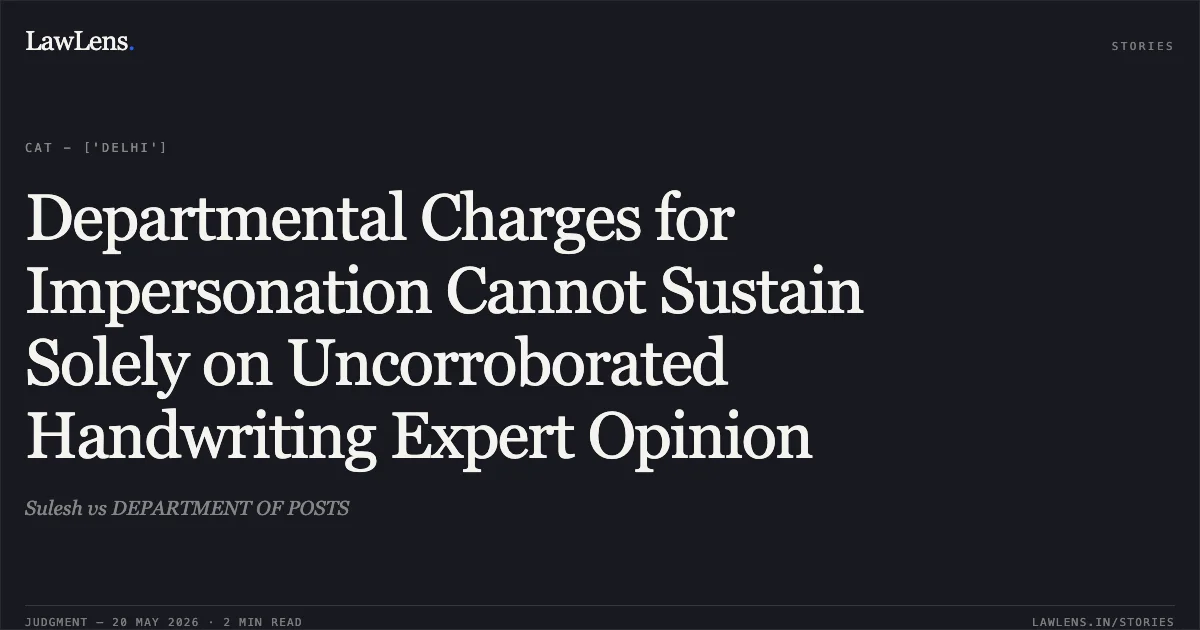
Source reference: p. 3, 4Based on a CFSL report dated October 17, 2023, which concluded the signatures did not match, the respondents initiated major penalty proceedings via a memorandum dated July 25, 2025, and appointed an Inquiry Officer
Source reference: p. 4The applicant challenged these proceedings, asserting the issue was settled by prior judicial precedents
Source reference: p. 3Issues
1. Whether the departmental proceedings initiated solely on the basis of a CFSL handwriting expert’s opinion, several years after recruitment, are sustainable in law?
Source reference: p. 3 / para. 52. Whether the applicant is entitled to parity with the judgment in Navneet v. Union of India Anr. (O.A. No. 4260/2024)?
Source reference: p. 3 / para. 5Law Applied
The Tribunal primarily applied Rule 14 of the CCS (CCA) Rules, 1965, regarding the procedure for imposing major penalties
Source reference: p. 2It relied on the principle that an expert opinion under the Indian Evidence Act is a "weak piece of evidence" and cannot be the sole basis for a stigmatic charge like impersonation without substantial corroboration, as established in Magan Bihari Lal v. State of Punjab [AIR 1977 SC 1091] and Ramchandra v. State [AIR 1957 SC 361], both cited via the Ahmedabad Bench precedent
Source reference: p. 8The court further followed the binding precedent of the Gujarat High Court in Union of India v. Anil Kumar (Special Civil Application No. 18023/2023), which held that such proceedings based only on specimen signatures without considering other factors (CCTV, invigilator logs) are invalid
Source reference: p. 10-11Reasoning
The Tribunal noted that the facts of the present case are identical to Navneet v. Union of India and Ashish Kumar M. Patel v. UOI, where similar charges based on CFSL reports were quashed
Source reference: p. 3, 5The court reasoned that handwriting expert opinions are not conclusive and must be received with caution
Source reference: p. 8It observed that the respondents failed to provide corroborative evidence, such as CCTV footage or invigilator reports, and initiated proceedings in a "casual manner" after a significant delay
Source reference: p. 9The Tribunal distinguished the respondents' reliance on the Patna Bench's Lala Thakur case, noting that the Ahmedabad Bench decision (upheld by the Supreme Court in SLP No. 16083/2025) carried greater precedential weight and specifically addressed identical circumstances of the 2011-12 Exam
Source reference: p. 6, 11-12Holding
The Tribunal answered the issues in favour of the applicant, holding that the disciplinary proceedings were legally unsustainable.
It quashed the impugned memorandum dated July 25, 2025, and the subsequent orders appointing the Inquiry and Presenting Officers. The Tribunal directed that the applicant be accorded all consequential benefits, including monetary and seniority benefits, in accordance with the relevant rules. No order as to costs was made.
Source reference: p. 12Acts & Sections Cited
1 provisions across 1 statute referred to in this judgment. Each provision opens on LawLens.
Administrative Tribunals Act, 19851
Original Court PDF
SuleshvsDEPARTMENT OF POSTS
Click to open original judgment
Original judgment, available to read, download and summarize on LawLens.in