Facts
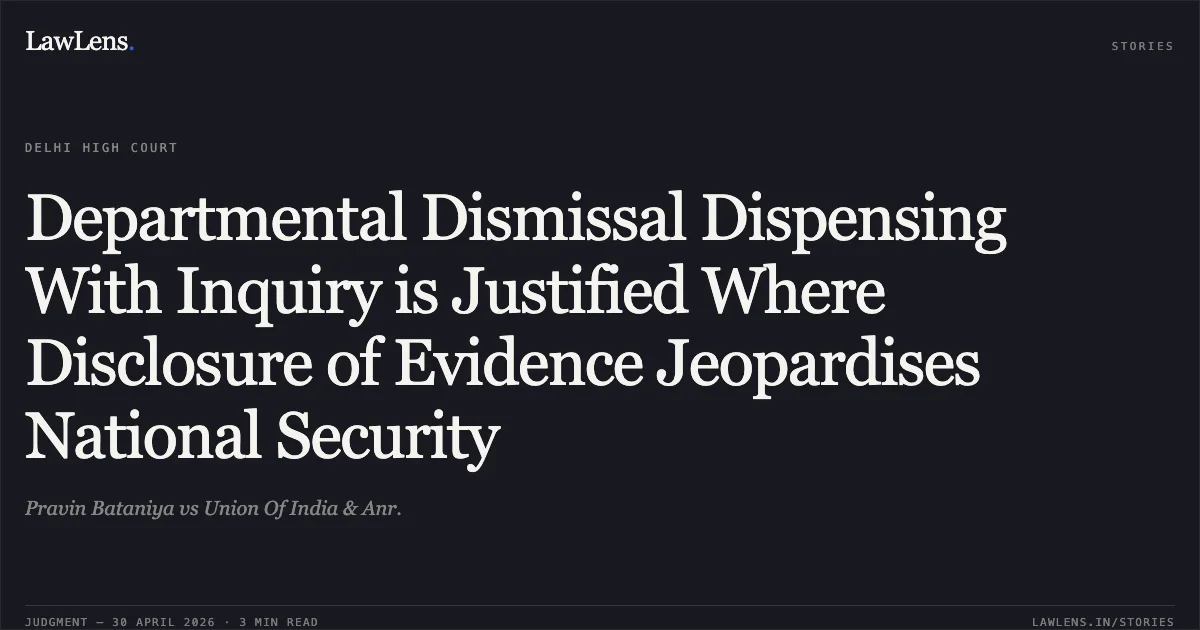
The Petitioner, a Constable in the Border Security Force (BSF), was dismissed from service on November 30, 2020, following a Staff Court of Inquiry (SCOI).
Source reference: para. 2The SCOI concluded that the Petitioner befriended a Pakistani Intelligence Operative (PIO) on social media, shared sensitive information regarding unit deployment and movement (from Samba to Shillong), and received ₹5,000 in his salary account from the operative.
Source reference: para. 15, 21Simultaneously, an FIR was registered against him; however, the police filed a final report citing a lack of concrete evidence, and the Petitioner was discharged by the Judicial Magistrate on May 26, 2023.
Source reference: para. 7Following this discharge, the Petitioner sought reinstatement, which was rejected by the BSF on September 20, 2023.
Source reference: para. 7, 14The Petitioner challenged the dismissal, alleging violation of natural justice and Rule 173(8) of the BSF Rules, as no show-cause notice was issued and no full trial/Security Force Court was conducted.
Source reference: para. 9, 11Issues
1. Whether the dismissal of the Petitioner without a full Security Force Court trial or show-cause notice was legally justified under Rule 22(1)(b) of the BSF Rules.
Source reference: para. 2, 212. Whether the Petitioner's discharge in the criminal case necessitated his reinstatement or precluded the department from dismissing him.
Source reference: para. 223. Whether the non-supply of SCOI proceedings and alleged non-compliance with Rule 173(8) and Rule 176 of the BSF Rules vitiated the termination.
Source reference: para. 30Law Applied
Section 11 of the BSF Act, 1968, and Rule 22(1)(b) of the BSF Rules, which empowers the competent authority to dispense with a show-cause notice if it is "not expedient or reasonably practicable" to provide one, provided reasons are recorded in writing.
Source reference: para. 18, 27The "interest of the security of the State" is a subjective satisfaction of the authority and an inquiry can be dispensed with if it risks disclosing secret sources or operational details (Union of India v. Tulsiram Patel).
Source reference: para. 26Departmental and criminal proceedings operate in different fields with different standards of proof (preponderance of probability vs. beyond reasonable doubt) (Ajit Kumar Nag v. GM (PJ) Indian Oil Corp. Ltd.).
Source reference: para. 24BSF Rules 173(8) and 176 do not cast an absolute obligation to supply SCOI copies unless specifically demanded or if a trial was actually being conducted.
Source reference: para. 31Reasoning
The BSF authorities had recorded specific reasons for dispensing with the inquiry, noting that a public trial or show-cause notice would likely disclose "minute operational and deployment related secret information" to unauthorized persons, thereby jeopardizing international border security.
Source reference: para. 21, 27The Court held that it cannot sit as an appellate authority over the subjective satisfaction of the Disciplinary Authority in matters of national security.
Source reference: para. 27-28The lack of "concrete evidence" for a criminal conviction does not absolve a soldier of misconduct in a departmental context where the Petitioner admitted to being in contact with a stranger and receiving money.
Source reference: para. 22-25The Petitioner was offered a chance to cross-examine witnesses during the SCOI but declined; since the subsequent trial was dispensed with under Rule 22(1)(b), the entitlement to SCOI copies under Rule 176 (which aids in trial defense) was not triggered.
Source reference: para. 15, 31, 32Holding
The discharge in the criminal trial did not bar the dismissal based on the SCOI findings, as national security is paramount and any infraction by border-guarding personnel must be viewed sternly.
The writ petition was dismissed, upholding the orders dated November 30, 2020, and September 20, 2023.
Source reference: para. 34Acts & Sections Cited
2 provisions across 1 statute referred to in this judgment. Each provision opens on LawLens.
Border Security Force Act, 19682
Original Court PDF
Pravin BataniyavsUnion Of India & Anr.
Click to open original judgment
Original judgment, available to read, download and summarize on LawLens.in