01Facts
The petitioner, a Professor and Head of the Department of Pharmacology at KIMS, Hubballi, challenged the report dated 1.6.2018 of the inquiry committee chaired by the Principal, which inquired into allegations made by Respondent No. 3.
¶ 1 · p. 3A show cause notice was issued on certain accusations and was replied to by the petitioner.
¶ 3 · pp. 3–4No charge memo or supporting documents followed.
¶ 3 · pp. 3–4The Disciplinary Authority instead conducted the inquiry in the form of a meeting, in which other issues were raised for the first time under the heading "other matters" (Sl. No. 10).
¶ 3 · p. 4 · ¶ 9 · p. 7A second show cause notice was issued on 29.07.2017 and replied to, but the reply was not considered.
¶ 4 · pp. 4–5 · ¶ 10 · p. 7A warning notice dated 23.02.2018 was then issued.
¶ 4 · p. 5The petitioner stated that the warning notice caused collateral prejudice, including an earlier transfer (set aside by this Court) and withdrawal of HOD administrative powers (matter pending before the Supreme Court).
¶ 5 · pp. 5–6Respondents 2 and 3 contended that the petitioner answered every query in the inquiry, that only a warning was issued, and that the transfer was incidental to service conditions.
¶ 6 · p. 6Respondents 4 and 5 supported dismissal.
¶ 7 · p. 702Issues
i.1. Whether the disciplinary inquiry is vitiated where no charge memo or supporting documents were issued after the show cause notice, and the inquiry was conducted as a meeting that examined matters outside the show cause notice.
¶ 9 · p. 7 · ¶ 11 · p. 8ii.2. Whether the subsequent proceedings, including the warning notice, must be set aside because the reply to the show cause notice was not duly considered.
¶ 10 · pp. 7–8 · ¶ 12 · pp. 8–903Law Applied
The "cardinal principle of service law" that an inquiry must be held in accordance with law. This requires, after a show cause notice and reply, an order directing an inquiry, issuance of a charge memo, supply of documents with the charge memo, and an opportunity to participate, with the inquiry confined to the specific charges.
¶ 11 · p. 8The principles of natural justice, which govern any further action.
¶ 12(2) · pp. 8–9The "principles settled in Service Law" referred to generally, without naming any statute, rule, or precedent.
¶ 11, no citationThe writ jurisdiction under Articles 226 and 227 of the Constitution of India, invoked by the petitioner.
p. 104Reasoning
The Disciplinary Authority skipped the charge-memo stage, deferring it to the inquiry, and then conducted an inquiry as a meeting.
¶ 9 · p. 7Issues not contained in the show cause notice were discussed and included in the report.
¶ 11 · p. 8The petitioner's participation did not cure the defect, because he was never given an understanding of the specific charges or a proper opportunity to meet them.
¶ 11 · p. 8The reply to the second show cause notice was not considered, which led directly to the warning notice.
¶ 10 · pp. 7–8On these grounds, the entire inquiry proceeding stood vitiated.
¶ 11 · p. 8The Court declined to pass orders on the warning notice as such, since it was only a warning, but it recognised that its consequences had seriously prejudiced the petitioner's rights.
¶ 10 · pp. 7–805Holding
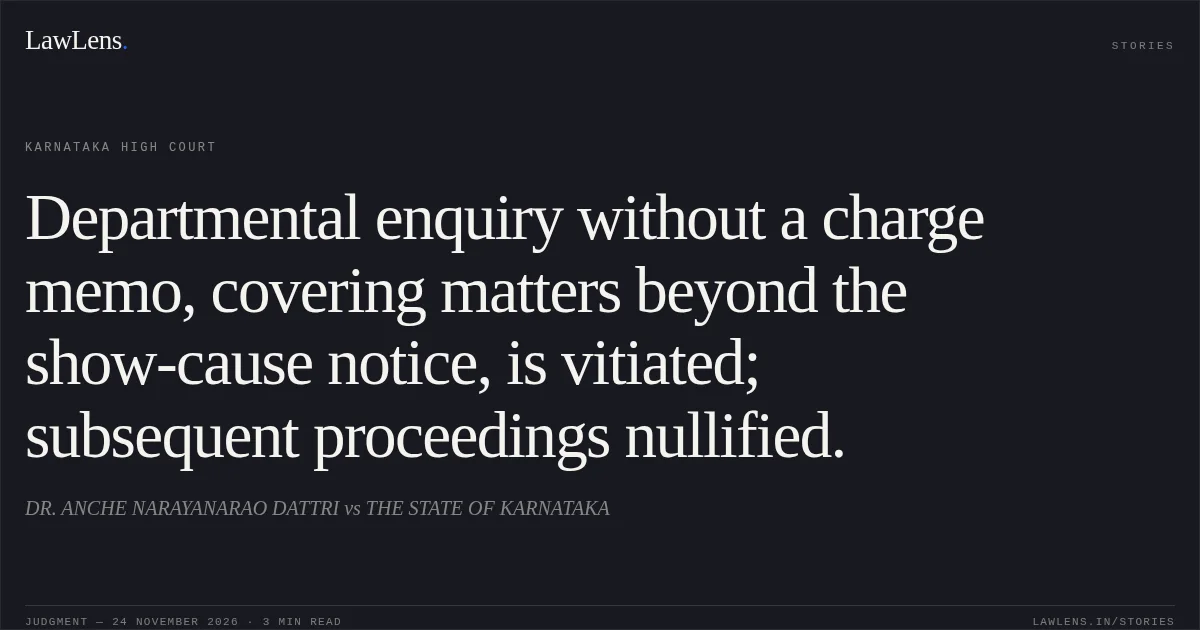
The writ petition is allowed in part. The inquiry was held vitiated for violation of settled service-law principles.
¶ 11 · p. 8All subsequent proceedings arising from the date of reply to the earlier show cause notice stand obliterated.
¶ 12(1) · pp. 8–9The authorities are granted liberty to pass an appropriate order on the petitioner's reply, either accepting or rejecting it, and to take action afresh in accordance with service jurisprudence and principles of natural justice.
¶ 12(2) · p. 9The Court did not expressly quash the 1.6.2018 committee report by name, nor did it decide the transfer or HOD-powers issues, which were treated as pending elsewhere.
¶ 5–6 · pp. 5–7 · ¶ 12 · pp. 8–9Original Court PDF
DR. ANCHE NARAYANARAO DATTRIvsTHE STATE OF KARNATAKA
Click to open original judgment
Original judgment, available to read, download and summarize on LawLens.in