01Facts
The petitioner, an FDA at the Sandur Branch of the Ballari District Central Co-operative (BDCC) Bank Ltd., challenged a show cause notice dated 09.07.2026 (Annexure-D) issued by Respondent No. 5, the Chief Executive Officer/Disciplinary Authority, and a consequential order dated 24.09.2026 (Annexure-F).
¶ 1 · p. 3On 08.10.2026, the Court, relying on State of Uttar Pradesh v. Ram Prakash Singh, 2025 LiveLaw (SC) 463, stayed further proceedings under both notices until further orders and listed the matter for 04.11.2026.
¶ 2 · pp. 3–7Counsel for the petitioner contended that where a court or tribunal fixes a time limit for disciplinary action, the authority must seek and obtain extension of that time.
¶ 2 · pp. 4–5Counsel for Respondents 4 and 5 submitted, fairly, that an application seeking extension of time had already been filed before the concerned original authority, which had remanded the matter for time-bound action.
¶ 3 · pp. 7–8The order does not disclose the original time limit or the date of the remand.
02Issues
i.1. Whether disciplinary proceedings may continue where a time-bound direction has been issued and an application for extension of time is pending before the original authority.
¶ 2 · p. 7 · ¶ 4 · p. 8ii.2. Whether, if the extension is declined, the disciplinary proceedings stand obliterated in light of the Ram Prakash Singh principles.
¶ 4 · p. 803Law Applied
The Court relied on paragraphs 62 and 63 of State of Uttar Pradesh v. Ram Prakash Singh, 2025 LiveLaw (SC) 463.
pp. 5–8Under para. 62, an application for extension of a tribunal- or court-fixed time limit is desirable before expiry, but may be moved after expiry in exceptional cases, and the tribunal may allow or reject it depending on the cause shown.
pp. 5–6If the extension is rejected, proceedings cannot be carried forward unless a superior court reverses the rejection.
p. 6If the delinquent employee objects to continuation beyond the time limit, the authority should apply for extension and halt proceedings pending the decision, since proceeding over objection risks apprehension of bias.
p. 6Even without objection, the authority must seek and obtain extension before the final order, as court orders cannot be disregarded.
p. 6Where the time limit carries a lapse clause, the authority loses jurisdiction unless the default clause is recalled on genuine grounds.
pp. 6–7Under para. 63, continuation beyond the time limit may invite interdiction absent a bona fide attempt to seek extension, although the court may overlook laxity in exceptional cases.
p. 704Reasoning
The Court treated the Ram Prakash Singh framework as governing any disciplinary action subject to a time-bound direction.
¶ 2 · pp. 3–7Because the respondents had already filed an extension application, the Court did not decide whether the time limit was breached or whether the proceedings were valid. It instead made the continuation of proceedings conditional on the outcome of that application.
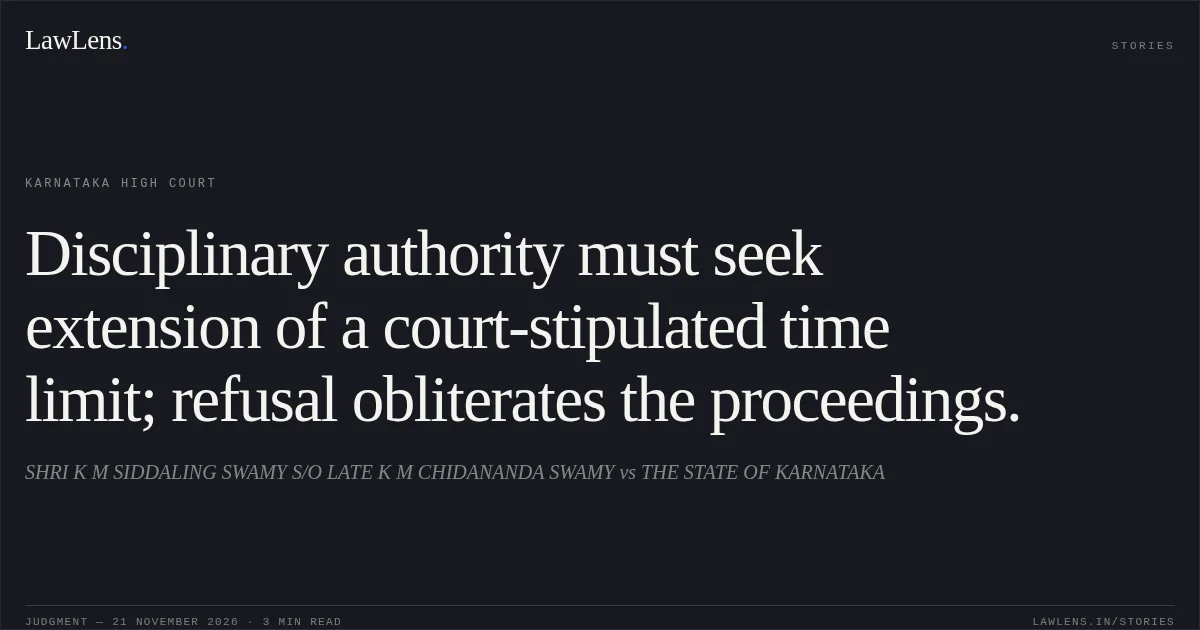
¶ 4 · p. 8If the extension is granted, the Disciplinary Authority may proceed with the enquiry. If it is refused, the proceedings stand obliterated under the principle that a rejected extension bars further action absent superior-court intervention.
¶ 4 · p. 8 · Ram Prakash Singh · ¶ 62 · p. 6The Court directed the original authority to decide the extension application on its own merits, without being influenced by its observations.
¶ 5 · p. 8The approach reflects the balance in para. 62 between the employer's need to act and the employee's protection against proceedings beyond a court-fixed deadline.
p. 605Holding
The Court held that the writ petition stands disposed of on the respondents' concession that an extension application is pending.
¶ 3–4 · pp. 7–8The Court directed that if the extension is allowed, the Disciplinary Authority shall proceed with the enquiry; if the application is declined, the entire disciplinary proceedings stand obliterated.
¶ 4 · p. 8The original authority must decide the extension application on its merits, uninfluenced by the Court's observations.
¶ 5 · p. 8The order does not expressly vacate the interim stay granted on 08.10.2026.
¶ 2 · p. 7The petitioner's prayers to quash the show cause notice dated 09.07.2026 and the order dated 24.09.2026 were not adjudicated on merits.
¶ 1 · p. 3 · ¶ 4 · p. 8Original Court PDF
SHRI K M SIDDALING SWAMY S/O LATE K M CHIDANANDA SWAMYvsTHE STATE OF KARNATAKA
Click to open original judgment
Original judgment, available to read, download and summarize on LawLens.in