01Facts
Hanamanthappa, an employee of respondent No. 1 (HESCOM), was last known to have reported for duty on 11.03.1999 and was unheard of thereafter.
¶ 2His wife and children (petitioners) presumed him dead.
¶ 2Respondent No. 1 issued notices dated 17.10.2003 and 21.10.2003 directing him to report for duty, and published a newspaper notice on 14.01.2006.
¶ 2 · ¶ 3On no response, respondent No. 1 dismissed him from service by order dated 25.01.2006 (Annexure-C).
¶ 3The petitioners sought compassionate appointment for petitioner No. 2 on 11.02.2008, which was rejected on 26.02.2008.
¶ 4The petitioners instituted OS No. 707/2008 before the Civil Court, seeking a declaration of death and a mandatory injunction for release of service benefits.
¶ 5On 25.05.2010 the Civil Court granted a declaration, under Section 108 of the Indian Evidence Act, 1872, that Hanamanthappa had not been heard of since 11.03.1999 by those who would naturally have heard of him, but refused the mandatory injunction.
¶ 6A further representation dated 20.04.2011 was rejected on 18.04.2013 on the ground that a dismissed employee's family is not entitled to family pension or compassionate appointment.
¶ 7The petitioners filed this writ petition under Articles 226 and 227 seeking quashing of the dismissal order and release of benefits.
preamble · ¶ 7The opening paragraph of the order refers to the dismissal order as dated 25.05.2006, whereas para. 3 and the operative order refer to 25.01.2006.
¶ 1 · ¶ 3 · Order (ii)02Issues
i.1. Whether the dismissal order dated 25.01.2006 can be sustained where the employer failed to rebut the presumption of death arising from the employee's seven years of unexplained absence, and a civil court has declared him dead under Section 108 of the Evidence Act.
¶ 9 · ¶ 10ii.2. Whether the deceased employee should be deemed to have died on 11.03.1999, and his terminal benefits calculated and disbursed to the petitioners.
¶ 12 · ¶ 13iii.3. Whether the petitioners' claim for compassionate appointment, made in 2008, is tenable given the delay in applying.
¶ 1103Law Applied
The court relied on Section 108 of the Indian Evidence Act, 1872, which provides that where it is proved that a person has not been heard of for seven years by those who would naturally have heard of him if alive, the burden of proving that he is alive shifts to the person who asserts it.
¶ 9The court applied the principle that an order of dismissal founded on a premise of continued life cannot survive where the employer fails to discharge that burden.
¶ 10Its general equitable approach, "in the interest of justice and equity," guided the relief granted.
preamble · ¶ 12On compassionate appointment, the court applied the general principle that such relief is subject to applicable rules, including time limits for applications.
¶ 11No specific judicial precedents are cited in the judgment.
Provisions in the judgment · 1
Indian Evidence Act, 1872 Section 108
04Reasoning
The court observed that the employer itself continued to assert Hanamanthappa's survival while dismissing him for unauthorised absence.
¶ 10Having obtained a Section 108 declaration, the petitioners shifted the burden to the employer, which did not discharge it. Consequently, the dismissal order rested on an untenable premise and could not stand.
¶ 10The court therefore quashed the dismissal and held that the employee must be treated as having died on 11.03.1999.
¶ 12This deemed date fixes the entitlement to terminal benefits payable for service rendered up to that date.
¶ 13On compassionate appointment, the court noted that the employee would have attained majority around 2004, and that the 2008 application was made years later, so it "may not be tenable" under the applicable rules.
¶ 11The court expressed this as a doubt rather than a firm finding, and did not direct any appointment.
¶ 1105Holding
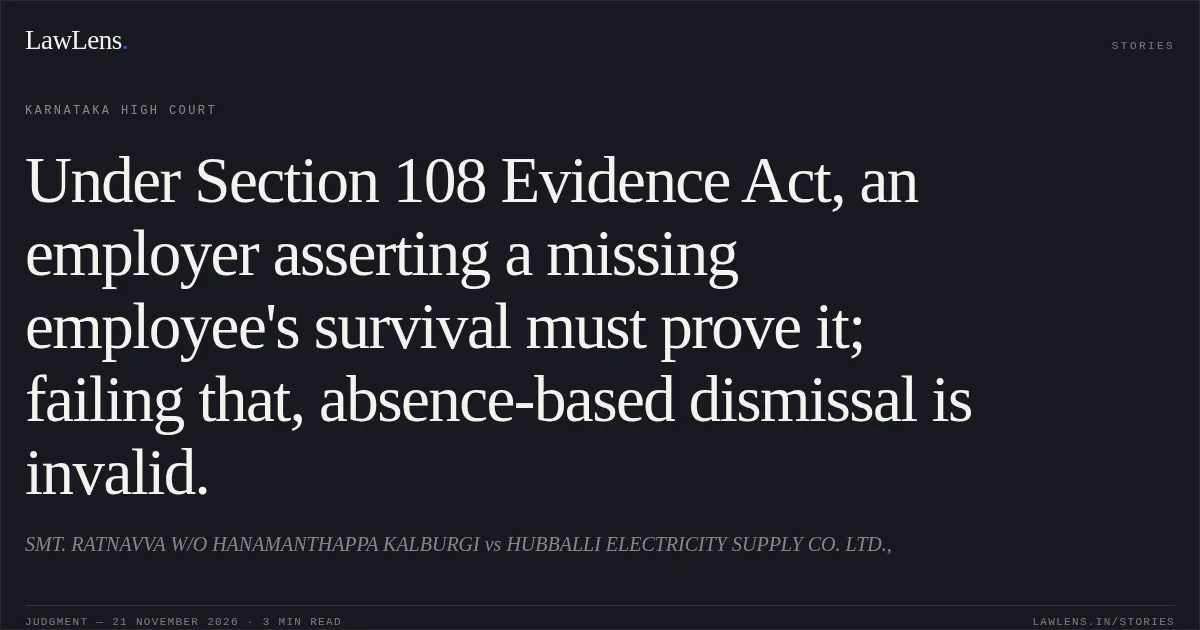
The court held that the dismissal order dated 25.01.2006 (Annexure-C) was not valid because the employer failed to rebut the presumption under Section 108 of the Evidence Act.
¶ 10 · ¶ 12The court directed that the deceased employee be treated as having died on 11.03.1999.
¶ 12The writ petition was partly allowed: the dismissal order was set aside, and respondent No. 1 was directed to calculate all terminal benefits admissible as on 11.03.1999 and disburse them to the petitioners within eight weeks of receipt of the order.
Order (ii)–(iii) · ¶ 13No relief was granted on compassionate appointment, and no order as to costs was made.
¶ 11 · OrderOriginal Court PDF
SMT. RATNAVVA W/O HANAMANTHAPPA KALBURGIvsHUBBALLI ELECTRICITY SUPPLY CO. LTD.,
Click to open original judgment
Original judgment, available to read, download and summarize on LawLens.in