Facts
The petitioner, appointed as a Lecturer in 1996, had been serving as Head of the Mechanical Engineering Department at Government Polytechnic, Etawah, since 2017, and was appointed Officiating Principal in 2023.
Source reference: para. 2A complaint dated 17 January 2025 was submitted by one Bablu alleging that the petitioner had sent obscene messages to a female student. The complaint was neither supported by an affidavit nor made by the student herself, and the complainant did not participate in the inquiry.
Source reference: paras. 2–3, 19A disciplinary inquiry was initiated under Rule 7 of the U.P. Government Servant (Discipline and Appeal) Rules, 1999, and the petitioner was suspended.
Source reference: para. 3The charge-sheet dated 8 March 2025 relied substantially on the complaint but did not disclose the student’s name, the contents of the alleged messages, or adequate particulars of the alleged misconduct.
Source reference: paras. 3–5, 11The petitioner denied the allegations and sought an opportunity to cross-examine the complainant and the student.
Source reference: para. 8The student’s statement was recorded on 30 April 2025 without prior intimation to the petitioner, while the petitioner’s statement had been recorded on 23 April 2025. The petitioner was consequently denied an opportunity to cross-examine the student.
Source reference: paras. 8–9, 14The inquiry relied upon screenshots showing the name “Anil Kumar Yadav” but not the petitioner’s mobile number.
Source reference: paras. 6–7, 12–14The original messages had allegedly been deleted, and the Inquiry Officer himself observed that it could not be conclusively established that the messages had been sent from the petitioner’s mobile number.
Source reference: paras. 6–7, 12–14The faculty member, Ms. Vinita, to whom the student allegedly forwarded the messages, was not examined.
Source reference: paras. 6–7, 12–14The disciplinary authority thereafter passed the impugned order dated 11 February 2026.
Source reference: para. 22Issues
Whether the disciplinary proceedings were vitiated because the complaint against the petitioner, a Class-I government employee, was not supported by the affidavit required under the Government Order dated 9 May 1992?
Source reference: paras. 3, 11, 19Whether the charge-sheet was legally defective for being vague and failing to disclose the identity of the student, the contents of the alleged messages, and sufficient particulars of the alleged misconduct?
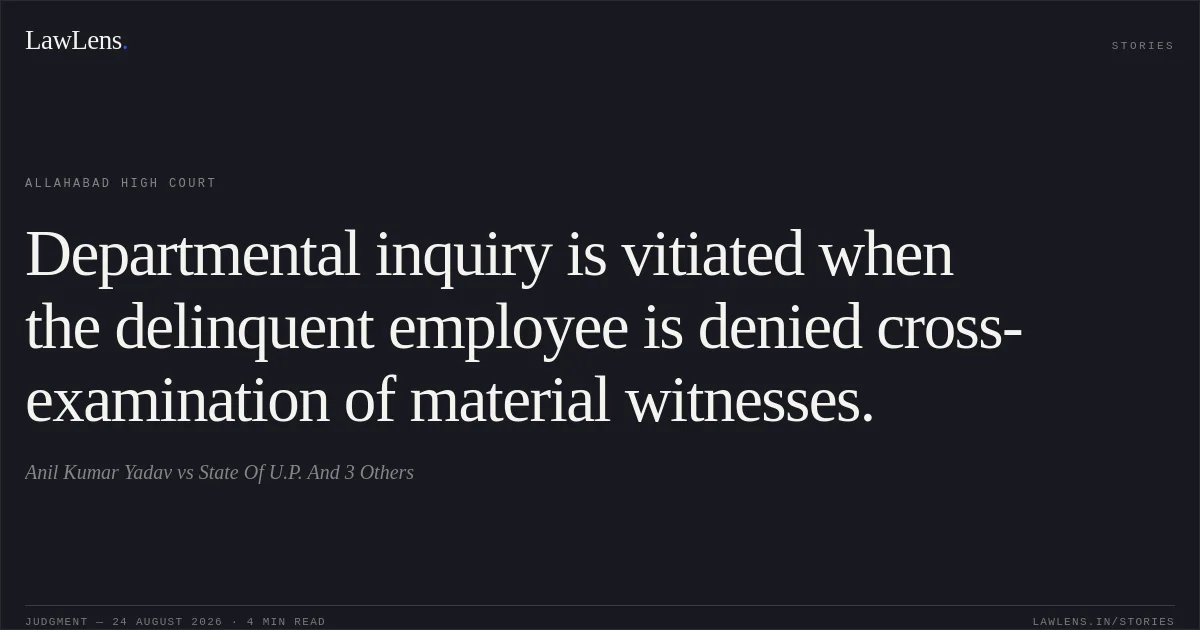
Source reference: paras. 4–5, 11, 16Whether the inquiry violated Rule 7(vii) of the 1999 Rules and the principles of natural justice by recording the student’s evidence in the petitioner’s absence and denying him an opportunity of cross-examination?
Source reference: paras. 8–9, 14, 16–18Whether the inquiry findings were sustainable when the principal documentary evidence consisted of screenshots that did not display the petitioner’s mobile number and the Inquiry Officer could not conclusively attribute the messages to him?
Source reference: paras. 6–7, 13–14Law Applied
The Court applied the Government Order dated 9 May 1992, under which the credentials of a complainant against a Class-I government employee are required to be verified through an affidavit.
Source reference: paras. 3, 19It applied Rule 7(vii) of the U.P. Government Servant (Discipline and Appeal) Rules, 1999, which requires the Inquiry Officer, where the charges are denied, to examine the witnesses proposed in the charge-sheet in the presence of the charged employee and provide an opportunity for cross-examination.
Source reference: para. 8The Court further applied the principles of audi alteram partem and natural justice, requiring specific charges, disclosure of relied-upon documents and witnesses, notice of the date, time and place of inquiry, and a meaningful opportunity to confront and test the evidence.
Source reference: paras. 15–18It relied upon Abdul Salam v. State of U.P. and Others, Special Appeal No. 191 of 2007, decided on 21 December 2010, concerning the application of natural justice in quasi-judicial disciplinary proceedings, and referred persuasively to Debaraj Sahoo v. Union of India, Writ-C No. 39597 of 2023, on the necessity of cross-examination where witness evidence is relied upon.
Source reference: paras. 15, 21–22Reasoning
The Court held that the proceedings originated from a complaint that was neither supported by the mandatory affidavit nor made by the student allegedly subjected to the misconduct; the complainant also did not appear for examination or cross-examination.
Source reference: paras. 11, 19Although the Department could, in an appropriate case, initiate proceedings suo motu upon learning of serious misconduct, it was still required to follow the prescribed procedure and natural justice.
Source reference: para. 20The charge-sheet was vague because it omitted the student’s identity and the contents and particulars of the alleged messages, thereby depriving the petitioner of clear notice of the case he had to meet.
Source reference: paras. 5, 11, 16Further, the student’s statement was recorded in the petitioner’s absence and on a different date from the recording of the petitioner’s statement, contrary to Rule 7(vii), which required the evidence of the prosecution witness to be recorded in the presence of the petitioner with an opportunity for cross-examination.
Source reference: paras. 9, 14, 16–18The evidentiary basis was also inadequate: the screenshots displayed only the name “Anil Kumar Yadav,” not the petitioner’s mobile number; the original messages had been deleted; Ms. Vinita was not examined despite allegedly receiving the messages; and the Inquiry Officer himself acknowledged that authorship of the messages could not be conclusively confirmed.
Source reference: paras. 7, 12–14These cumulative procedural and evidentiary defects rendered the inquiry and consequential disciplinary order unsustainable.
Source reference: para. 22Holding
The Court allowed the writ petition and set aside the impugned order dated 11 February 2026 as being legally unsustainable.
The respondent authorities were directed to reinstate the petitioner as Officiating Principal of Government Polytechnic, Etawah.
Source reference: para. 22The Court clarified that the authorities were at liberty to initiate a de novo proceeding if otherwise permissible in law, provided that such proceeding strictly complied with the 1999 Rules and the principles of natural justice.
Source reference: para. 23Original Court PDF
Anil Kumar YadavvsState Of U.P. And 3 Others
Click to open original judgment
Original judgment, available to read, download and summarize on LawLens.in