Facts
The respondent, a Deputy Tahsildar in the Revenue Department, was subjected to departmental disciplinary proceedings.
Source reference: no citationA charge memorandum containing six charges and a list of relied-upon documents was issued on 21 May 2018
Source reference: p.2, para.2The respondent contended that he had attained superannuation on 31 March 2000 and had been permitted to retire without prejudice to the disciplinary proceedings, which were to continue under Rule 9 of the Tamil Nadu Pension Rules, 1978
Source reference: pp.2–3, paras.2–3He challenged the charge memorandum by filing a writ petition.
Source reference: no citationThe Writ Court, relying on The State of Tamil Nadu v. R. Karuppiah, held that the charge memorandum was invalid because the respondent had been allowed to retire without invocation of Rule 56(1) of the Fundamental Rules, and accordingly quashed it
Source reference: p.3, para.4The State preferred the present intra-court appeal.
Source reference: no citationIssues
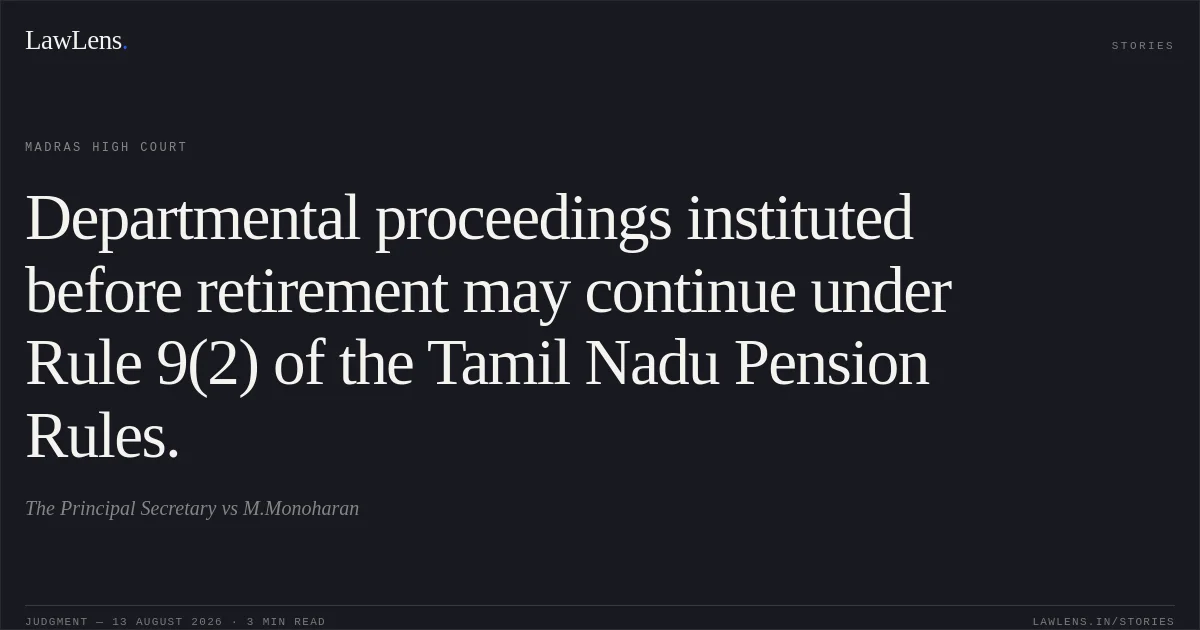
Whether departmental disciplinary proceedings and a charge memorandum can continue after a Government servant has been permitted to retire without prejudice to such proceedings, under Rule 9(2) of the Tamil Nadu Pension Rules, 1978
Source reference: pp.3–4, paras.5–6Whether the Writ Court correctly quashed the charge memorandum by relying on The State of Tamil Nadu v. R. Karuppiah, despite the subsequent Full Bench decision in C. Mathesu v. Secretary to Government, Revenue Department holding the contrary view
Source reference: pp.5–6, paras.6–7Whether invocation of Rule 56(1)(c) of the Fundamental Rules was essential to sustain the disciplinary proceedings after the respondent’s retirement
Source reference: pp.3–4, paras.5–6Law Applied
The Court applied Rule 9(2) of the Tamil Nadu Pension Rules, 1978, which permits departmental proceedings to continue after retirement and enables the Government, in appropriate cases, to withhold, withdraw, or reduce pension.
Source reference: pp.4–5, para.6The Court also considered Rule 9(2)(b), under which proceedings instituted after retirement require Government sanction and are subject to the applicable four-year limitation
Source reference: pp.4–5, para.6Rule 56(1)(c) of the Fundamental Rules permits a Government servant to be retained in service or placed under suspension beyond the age of superannuation where disciplinary proceedings are pending; however, the Full Bench in C. Mathesu v. Secretary to Government, Revenue Department, 2013 (3) CTC 369, held that Rule 56(1)(c) and Rule 9 of the Pension Rules must be construed harmoniously.
Source reference: pp.4–6, para.6It further held that proceedings instituted before retirement may continue after retirement under Rule 9(2), although dismissal or removal is unavailable once the employee has retired
Source reference: pp.4–6, para.6The Full Bench expressly disapproved The State of Tamil Nadu v. R. Karuppiah, 2005 (3) CTC 4, and other contrary decisions
Source reference: p.6, para.6Reasoning
The Division Bench held that retirement does not, by itself, extinguish disciplinary proceedings where the governing pension rules authorise their continuation.
Source reference: no citationThe respondent had been permitted to retire expressly without prejudice to the pending disciplinary proceedings, and Rule 9(2) therefore provided an independent statutory basis for continuing them
Source reference: pp.2–4, paras.3–5The Writ Court’s reliance on R. Karuppiah was erroneous because that decision had subsequently been declared incorrect by the Full Bench in C. Mathesu
Source reference: pp.5–6, paras.6–7Accordingly, the absence of an order under Rule 56(1)(c) did not invalidate the charge memorandum.
Source reference: no citationThe Court also emphasised that, after retirement, the proceedings could result only in pensionary consequences and not in dismissal or removal from service
Source reference: pp.4–5, para.6Holding
The Court answered the issues in favour of the State, holding that the respondent’s retirement did not render the charge memorandum or the disciplinary proceedings invalid, since they could continue under Rule 9(2) of the Tamil Nadu Pension Rules, 1978
The Writ Court’s order dated 17 September 2020 in W.P. No.13091 of 2018 was set aside, the writ appeal was allowed, and the connected miscellaneous petition was closed. No order as to costs was made
Source reference: p.7, para.9Acts & Sections Cited
2 provisions across 2 statutes referred to in this judgment. Linked provisions open on LawLens.
Letters Patent1
Punjab Town Improvement Act, 19221
Original Court PDF
The Principal SecretaryvsM.Monoharan
Click to open original judgment
Original judgment, available to read, download and summarize on LawLens.in