Facts
The respondent, T. Dhanalakshmi, was working as a Superintendent in the Forest Engineering Division, Harur.
Source reference: para. 3; p. 2A charge memo under Rule 17(b) of the Tamil Nadu Civil Services (Discipline and Appeal) Rules was issued against her on 03 March 2023, alleging demand and acceptance of illegal gratification; the charge memo contained the charges, statement of allegations, list of documents and list of witnesses.
Source reference: para. 3; p. 2A criminal case under the Prevention of Corruption Act was also pending against her in Spl.C.C. No. 5 of 2019 before the Special Court for Prevention of Corruption Act Cases, Dharmapuri.
Source reference: para. 4; p. 2The respondent filed W.P. No. 19671 of 2023 seeking to keep the departmental proceedings in abeyance until disposal of the criminal case, contending that both proceedings were based on identical allegations, documents and evidence.
Source reference: para. 5; p. 3The Single Judge’s order dated 14 October 2024 was challenged by the departmental authorities in the present intra-court appeal.
Source reference: paras. 1–2; p. 2Issues
Whether departmental disciplinary proceedings against the respondent could continue during the pendency of the criminal prosecution arising from the allegations of demand and acceptance of illegal gratification.
Source reference: paras. 4–6; pp. 2–3Whether the alleged identity of the facts, documents and evidence in the criminal and departmental proceedings required the departmental proceedings to be stayed until the criminal case was concluded.
Source reference: paras. 5–7; pp. 3–4Whether the pendency of, or a possible acquittal in, the criminal case would preclude the disciplinary authority from independently determining the respondent’s service misconduct under the Discipline and Appeal Rules.
Source reference: paras. 6–7, 10; pp. 3–4, 8Law Applied
The Court applied Rule 17(b) of the Tamil Nadu Civil Services (Discipline and Appeal) Rules, under which departmental disciplinary proceedings may be initiated for service misconduct, and distinguished such proceedings from criminal prosecution under the Prevention of Corruption Act.
Source reference: paras. 6–7; pp. 3–4Departmental proceedings and criminal trials serve different purposes, follow different procedures and apply different standards of proof: criminal guilt must be established beyond reasonable doubt, whereas departmental misconduct may be established on a preponderance of probabilities.
Source reference: paras. 6–7; pp. 3–4Relying on Avinash Sadashiv Bhosale v. Union of India, (2012) 13 SCC 142; Karnataka State Road Transport Corporation v. M.G. Vittal Rao, (2012) 1 SCC 442; NOIDA Entrepreneurs Association v. NOIDA, JT 2001 (2) SC 620; State Bank of India v. R.B. Sharma, AIR 2004 SC 4144; Ajit Kumar Nag v. General Manager (PJ), Indian Oil Corporation Ltd., (2005) 7 SCC 764; Employees’ Management, West Bokaro Colliery (TISCO Ltd.) v. Ram Parvesh Singh, (2008) 3 SCC 729; Stanzen Toyotetsu India Pvt. Ltd. v. Girish V., (2014) 3 SCC 636; and State of Rajasthan v. B.K. Meena, (1996) 6 SCC 417, the Court held that simultaneous proceedings are generally permissible.
Source reference: paras. 9–10; pp. 4–8A stay may be justified only where the criminal charge is grave, involves complex questions of fact and law, and continuation of the disciplinary inquiry is likely to prejudice the employee’s criminal defence; even then, staying the departmental proceedings is not an inflexible rule.
Source reference: paras. 9–10; pp. 4–8Acquittal in the criminal case does not, by itself, bar continuation of disciplinary proceedings or imposition of departmental punishment.
Source reference: paras. 6–7, 9–10; pp. 3–4, 7–8Reasoning
The Court found no procedural infirmity in the charge memo and treated the allegations of corruption as capable of independent examination in departmental proceedings.
Source reference: para. 4; p. 2Although the criminal and departmental cases arose from related allegations and may involve common evidence, that circumstance alone did not warrant a stay.
Source reference: paras. 6–7; pp. 3–4The departmental inquiry concerns service discipline and administrative efficiency, while the criminal trial determines criminal culpability under a higher standard of proof.
Source reference: paras. 6–7; pp. 3–4Since the departmental authorities possessed the material necessary to proceed, and no specific or sufficient prejudice to the respondent’s criminal defence was demonstrated, the disciplinary proceedings could continue independently and be concluded in accordance with the applicable Rules.
Source reference: paras. 7, 10; pp. 4, 8–9Holding
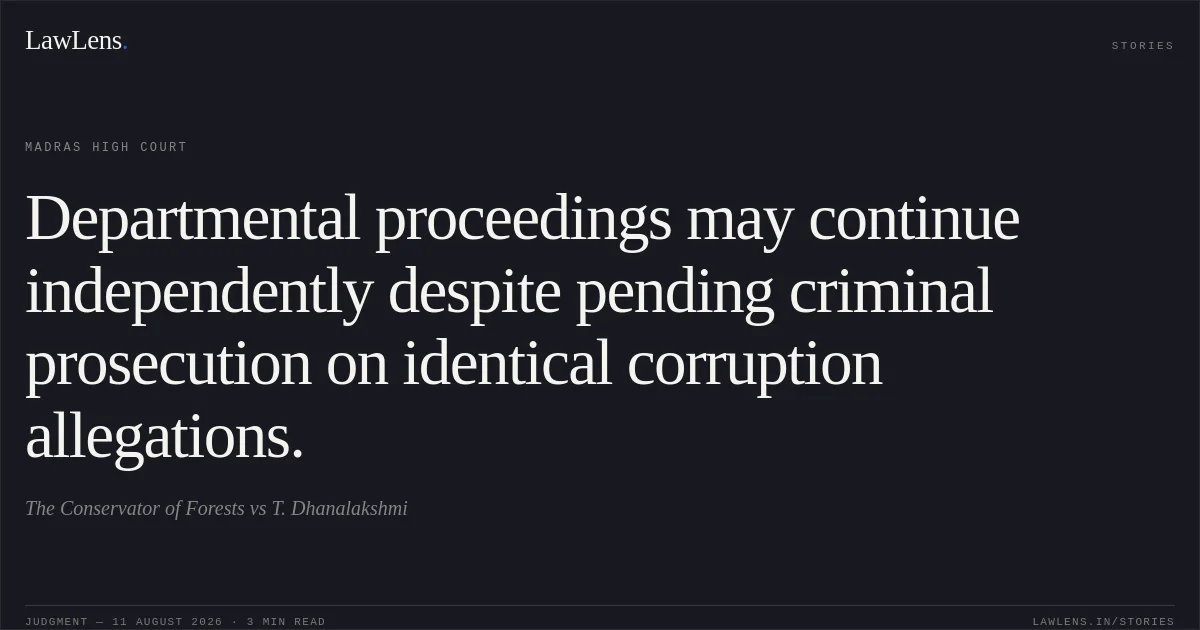
The Division Bench held that departmental proceedings in corruption-related cases may proceed independently despite the pendency of a criminal prosecution, and that the respondent was required to defend the two proceedings separately.
The order dated 14 October 2024 in W.P. No. 19671 of 2023 was set aside, the writ appeal was allowed, and the connected miscellaneous petition was closed.
Source reference: para. 11; p. 9No order as to costs was made.
Source reference: para. 11; p. 9Original Court PDF
The Conservator of ForestsvsT. Dhanalakshmi
Click to open original judgment
Original judgment, available to read, download and summarize on LawLens.in