01Facts
The petitioner, a Civil Police Constable, was charged departmentally over alleged wrongful confinement and assault of a complainant on 20 June 2015.
¶ 3The enquiry officer found the charges proved, and the disciplinary authority imposed the penalty of withholding two annual increments with cumulative effect; the appeal was dismissed.
¶ 3–5The petitioner challenged those orders before the Karnataka State Administrative Tribunal, which rejected his applications.
¶ 6In the related criminal case, the petitioner was acquitted after the trial court found that the prosecution had failed to prove his guilt.
¶ 14He then sought judicial review of the Tribunal’s decision.
02Issues
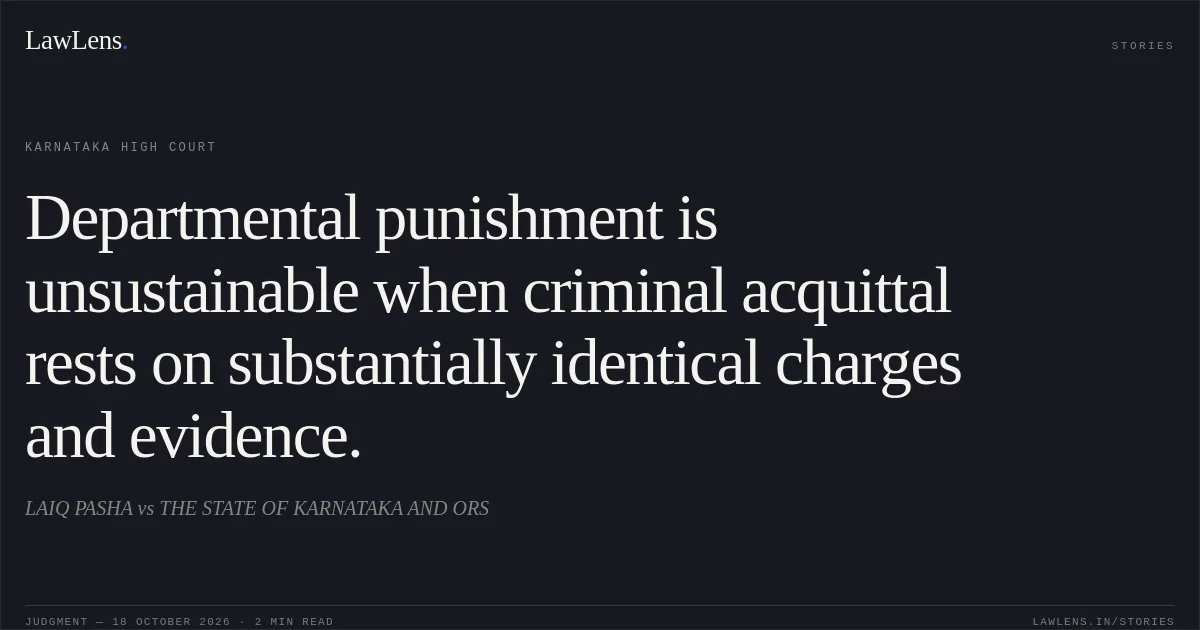
i.1. Whether the departmental penalty could stand where the petitioner was acquitted in the criminal case and the charges, evidence, and witnesses in the two proceedings were identical or substantially similar.
¶ 9, 15–18ii.2. Whether the Tribunal erred in rejecting the petitioner’s applications challenging the disciplinary and appellate orders.
¶ 6, 19–2003Law Applied
An acquittal in a criminal case does not automatically invalidate a disciplinary penalty.
However, where the charges, evidence, witnesses, and circumstances in the criminal and departmental proceedings are identical or substantially similar, sustaining the disciplinary findings may be unjust, unfair, and oppressive.
¶ 17The court also relied on G.M. Tank v. State of Gujarat and Ramlal v. State of Rajasthan, emphasizing that the substance and basis of the acquittal—not merely labels such as “benefit of doubt” or “honourably acquitted”—must be considered.
¶ 10, 18Provisions in the judgment · 9 · Linked ones open on LawLens
Indian Penal Code, 1860 9 provisions
Section 341Section 342Section 384Section 323Section 504Section 506Section 397Section 392Section 3404Reasoning
The Court compared the criminal and departmental records and found that the proceedings concerned substantially the same allegations and included several common witnesses, including the complainant.
¶ 15–16The trial court’s acquittal rested on its finding that the prosecution had failed to prove the petitioner’s guilt, rather than on a merely technical ground.
¶ 14, 18Applying the principle in Maharana Pratap Singh, the Court held that, in these circumstances, the Tribunal erred in allowing the disciplinary findings and penalty to stand.
¶ 17, 19–2005Holding
The Court allowed the writ petition, set aside the Tribunal’s order dated 10 January 2020, and allowed the petitioner’s applications before the Tribunal.
¶ 21(i)–(iii)It quashed the appellate order dated 22 June 2017 and the disciplinary penalty order dated 23 March 2017.
¶ 21(iv)Original Court PDF
LAIQ PASHAvsTHE STATE OF KARNATAKA AND ORS
Click to open original judgment
Original judgment, available to read, download and summarize on LawLens.in