Facts
The landlord obtained an eviction order under Section 14(1)(e) of the Delhi Rent Control Act, 1958, for premises required for her daughter-in-law, Ms. Samira Khandelwal.
Source reference: pp. 1–4, 6–13The tenant sought leave to defend, disputing the daughter-in-law’s dependency and alleging that the landlord had alternative accommodation.
Source reference: pp. 1–4, 6–13The Rent Controller rejected those contentions and passed an eviction order on 7 May 2026.
Source reference: pp. 1–4, 6–13In revision under Section 25B(8), the tenant did not press the landlord–tenant relationship ground and challenged the findings on dependency and alternative accommodation.
Source reference: pp. 1–4, 6–13Issues
1. Whether a daughter-in-law who has her own business and financial resources may nevertheless be treated as dependent on her mother-in-law for the purposes of Section 14(1)(e) of the DRC Act
Source reference: pp. 14–25; paras. 22–482. Whether the properties identified by the tenant constituted suitable alternative accommodation warranting leave to defend
Source reference: pp. 25–28; paras. 49–583. Whether the Rent Controller’s findings disclosed an error warranting interference under the limited revisional jurisdiction conferred by Section 25B(8)
Source reference: pp. 4–6, 28–29; paras. 13–19, 59–62Law Applied
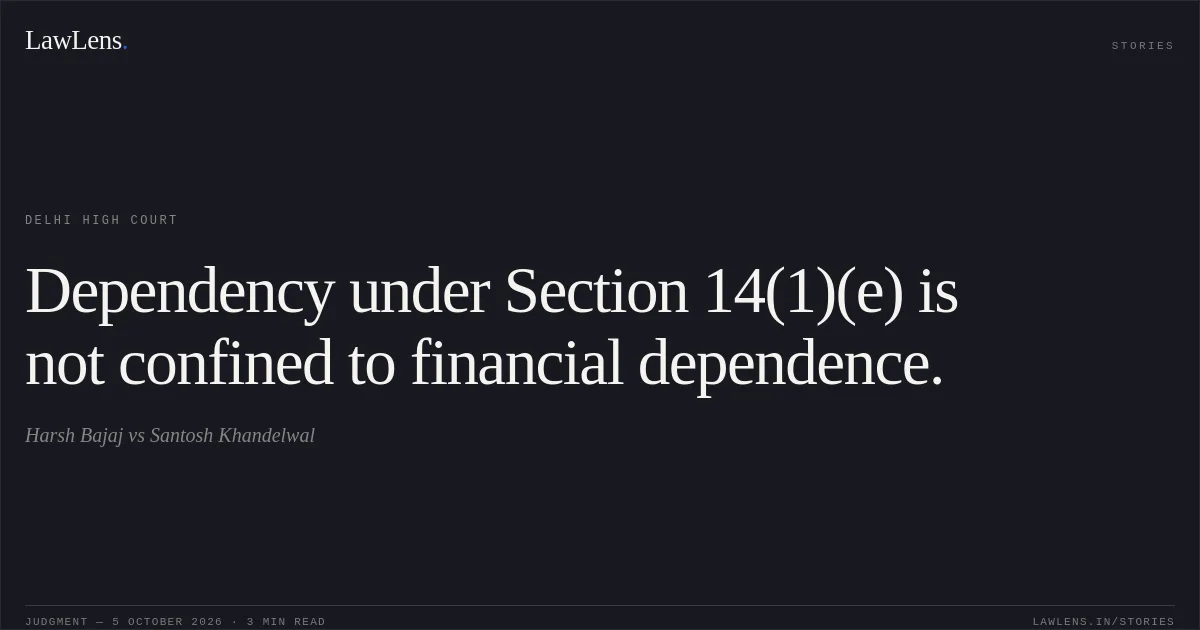
Section 14(1)(e) of the DRC Act permits eviction where premises are bona fide required by the landlord for a member of the landlord’s family dependent on the landlord; “dependency” is not confined to financial or physical dependence and may include emotional, familial or residential reliance (*Anil Kumar Gupta v. Deepika Verma*; *Charanjeet Singh v. Vivek Jain*; *Satya Narain v. Smt. Kamlesh Arora*).
Source reference: pp. 14–18Financial self-sufficiency or existing employment does not, by itself, negate bona fide need, and a landlord need not abandon an existing occupation before seeking premises for another business purpose (*Raghunath G. Panhale v. Chaganlal Sundarji & Co.*).
Source reference: pp. 19–23Alternative accommodation must be shown to be available and reasonably suitable; the tenant cannot dictate which suitable premises the landlord should use (*Ragavendra Kumar v. Firm Prem Machinery*).
Source reference: pp. 12–13, 27–28Under the proviso to Section 25B(8), the High Court exercises supervisory and revisional—not appellate—jurisdiction and does not reappraise evidence merely because another view is possible; interference is warranted for an error apparent, jurisdictional error, material irregularity or comparable defect (*Sarla Ahuja v. United India Insurance Co. Ltd.*; *Hindustan Petroleum Corporation Ltd. v. Dilbahar Singh*; *Abid-Ul-Islam v. Inder Sain Dua*).
Source reference: pp. 4–6Reasoning
The Court held that the tenant’s evidence of the daughter-in-law’s business, shareholdings and family wealth did not establish that she could not be regarded as dependent in the statutory sense, nor did it make the asserted business requirement inherently mala fide.
Source reference: pp. 19–25; paras. 29–48The Rent Controller had considered that evidence and was entitled to find that existing income did not prevent the landlord from enabling her daughter-in-law to establish or pursue another business.
Source reference: pp. 19–25; paras. 29–48The Court also found that the alleged alternative properties were either occupied, not shown to belong to or be available to the landlord, or not established as suitable; the allegation concerning the son’s accommodation was vague.
Source reference: pp. 25–28; paras. 49–58As these matters had been addressed by the Rent Controller, the tenant’s request for a different assessment would amount to an impermissible appeal on the evidence.
Source reference: pp. 28–29; paras. 59–61Holding
The High Court rejected the challenges to dependency and alternative accommodation and found no jurisdictional error, manifest illegality, material irregularity or perversity in the eviction order.
The revision petition was dismissed, and all pending applications were disposed of.
Source reference: p. 29; para. 63Acts & Sections Cited
1 provisions across 1 statute referred to in this judgment. Each provision opens on LawLens.
delhi rent control act, 19581
Original Court PDF
Harsh BajajvsSantosh Khandelwal
Click to open original judgment
Original judgment, available to read, download and summarize on LawLens.in