Facts
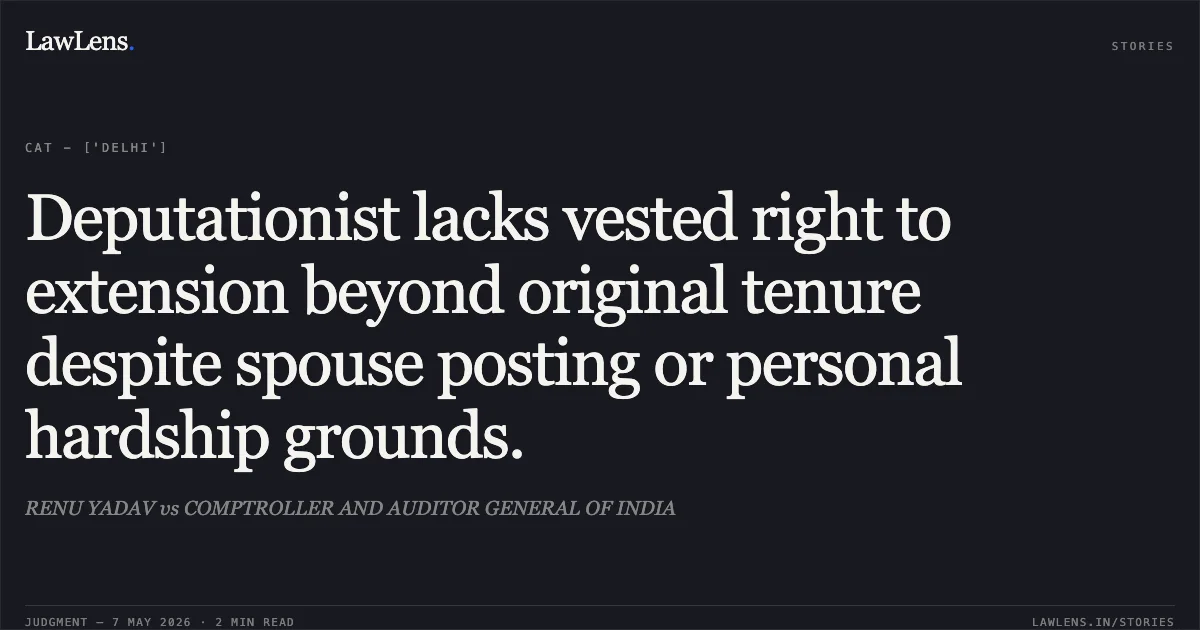
The applicant, a Senior Auditor in the Indian Audit and Accounts Department (IA), was serving on deputation in the office of Respondent No. 3 (New Delhi) from March 2021.
Source reference: para 3(i)Upon the completion of her fifth year of deputation on March 26, 2026, she sought a sixth-year extension on humanitarian grounds, citing her husband’s employment as a teacher in Delhi and the needs of her 22-month-old son.
Source reference: para 3(ii)The Parent Cadre Controlling Authority (Respondent No. 2) denied the extension, noting that the vacancy position in the parent office was 38%, exceeding the 25% ceiling mandated by the Revised Deputation Policy dated January 27, 2025.
Source reference: para 7An order dated April 30, 2026, was issued directing her repatriation to Chennai by May 8, 2026.
Source reference: para 1-2The applicant challenged this repatriation and sought a review of the 2025 policy.
Source reference: para 2Issues
1. Whether a deputationist has a legally enforceable right to continue on deputation beyond the stipulated period or claim an extension based on personal/spouse grounds.
Source reference: para 4(iv-v)2. Whether the revised Deputation Policy dated January 27, 2025, specifically the 25% vacancy cap for allowing deputations, is legally valid and binding.
Source reference: para 12-15Law Applied
The Tribunal applied the principle that deputation is not a vested right and a deputationist can be repatriated at any time to their parent department (U.P. Gram Panchayat Adhikari Sangh v. Daya Ram Saroj).
Source reference: para 14Transfers and postings are incidents of service governed by administrative exigencies, and while spouse-posting guidelines should be considered, they do not confer an indefeasible right (SK Nausad Rahaman v. Union of India and Union of India v. S.L. Abbas).
Source reference: para 13, 18The rule of stare decisis; the validity of the 2025 IAAD Deputation Policy was already upheld by the Jharkhand High Court in Adwin Vinifred Tirkey v. UOI (W.P.(S) No. 6056/2025), which serves as a binding precedent.
Source reference: para 12-13, 16Reasoning
The applicant’s request for extension directly conflicted with Clause (g) and (h) of the Revised Deputation Policy of 2025, which prohibit extensions if the parent office's vacancy exceeds 25%; in this case, the vacancy was 38%.
Source reference: para 9-10Administrative needs and the scarcity of staff in the parent department (Chennai) outweighed the applicant’s personal hardships regarding her spouse and child.
Source reference: para 13The Tribunal distinguished this case from others where deputation was curtailed prematurely, noting that the applicant had already completed the standard five-year maximum tenure.
Source reference: para 4(vi), 11By adhering to the hierarchical supremacy of decisions, the Tribunal concluded it was bound by the Jharkhand High Court's prior validation of the same policy and the same IAAD administrative constraints.
Source reference: para 15-17Holding
The Tribunal held that the applicant had no legal right to remain on deputation and that the repatriation order was in strict accordance with the prevailing policy.
The Original Application (O.A.) was dismissed at the admission stage and the Tribunal granted the applicant liberty to file a representation before the competent authority for consideration of her grievances.
Source reference: para 19-20Acts & Sections Cited
3 provisions across 2 statutes referred to in this judgment. Linked provisions open on LawLens.
Revised Deputation of Staff Policy within IA & AD dated 27.01.20252
DoP&T OM dated 24.11.20221
Original Court PDF
RENU YADAVvsCOMPTROLLER AND AUDITOR GENERAL OF INDIA
Click to open original judgment
Original judgment, available to read, download and summarize on LawLens.in