Facts
The Petitioners, employees of various Central and State Government departments, electricity boards and public-sector undertakings, were deputed to the Tala Hydro Electric Project Authority in Bhutan pursuant to the India–Bhutan Agreement dated 5 March 1996.
Source reference: pp. 2–3, paras. 2–4Their appointment letters provided that their service conditions would be governed by the terms prescribed in the Ministry of External Affairs’ letter dated 8 November 1977, as amended from time to time.
Source reference: pp. 2–3, paras. 2–4Under those terms, the Petitioners received Bhutan Compensatory Allowance (“BCA”), whereas employees of the Embassy of India in Bhutan received Foreign Allowance.
Source reference: pp. 3–4, paras. 5–8Although Foreign Allowance was revised periodically after 1997, no corresponding revision was made to BCA.
Source reference: p. 4, paras. 9–10The Government subsequently granted ad hoc increases of 25% from 1 January 2001 and 11% from 1 April 2005.
Source reference: p. 4, paras. 9–10The Petitioners sought revision of BCA at par with Foreign Allowance, relying principally on Article 14 of the Constitution and the decision in Captain Gurdev Singh v. Union of India.
Source reference: pp. 5–6, paras. 11–14Their representations were not accepted, and the Ministry directed them to approach the Tala Hydro Electric Project Authority, which stated that the matter had to be decided by the Ministry.
Source reference: pp. 5–6, paras. 11–14The Union of India contended that Embassy personnel and project deputationists constituted distinct categories governed by different service rules and performing different functions.
Source reference: pp. 6–8, paras. 15–22Issues
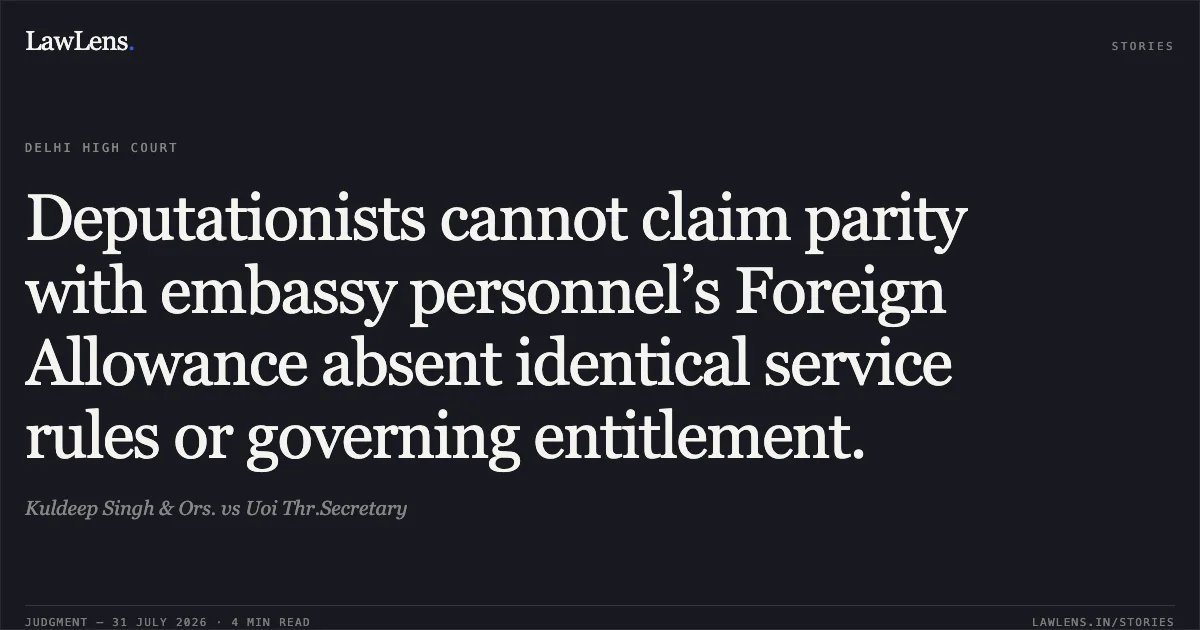
Whether the Petitioners, who were deputed to the Tala Hydro Electric Project in Bhutan and entitled to BCA under their deputation terms, were entitled to claim parity with the Foreign Allowance payable to Embassy personnel in Bhutan?
Source reference: pp. 10–13, paras. 34–42Whether the non-revision of BCA, despite periodic revisions of Foreign Allowance, was arbitrary or discriminatory and violated Article 14 of the Constitution?
Source reference: pp. 13–14, paras. 44–47Whether the Petitioners could rely on legitimate expectation or the earlier decision in Captain Gurdev Singh to claim the revised allowance?
Source reference: pp. 12–14, paras. 40–45Law Applied
Article 14 prohibits unequal treatment between persons similarly situated but permits reasonable classification founded on an intelligible differentia having a rational nexus with the object of the classification.
Source reference: pp. 10–12, paras. 34–38Service benefits are governed by the applicable service rules and terms of appointment; employees belonging to distinct services or categories, performing different functions and governed by different conditions, cannot claim parity merely because they work in the same place or receive allowances with similar purposes.
Source reference: pp. 10–12, paras. 34–38The Court relied on the Ministry of External Affairs’ letter dated 8 November 1977, which governed the Petitioners’ BCA, and distinguished the Foreign Allowance governed by the rules applicable to Embassy personnel.
Source reference: pp. 10–12, paras. 34–38It applied the Supreme Court’s decision in Union of India v. Captain Gurdev Singh, (2019) 14 SCC 289, which recognised that similarly purposed allowances need not be identical where the concerned categories have different service conditions and facilities.
Source reference: pp. 12–13, paras. 40–43The principle in Union of India v. Munshi Ram, 2022 SCC OnLine SC 1493—that similarly situated employees cannot be discriminated against in service benefits—was held applicable only where the employees belong to the same class.
Source reference: p. 14, para. 44Legitimate expectation must also be consistent with the governing rules and cannot override the accepted terms of appointment.
Source reference: p. 14, para. 45Reasoning
The Court held that the Petitioners’ entitlement arose from the specific deputation terms and the 1977 Ministry of External Affairs circular, which prescribed BCA, while Embassy personnel were governed by a separate service framework and received Foreign Allowance.
Source reference: pp. 10–12, paras. 34–38The two categories differed in their appointments, duties, service rules and available facilities; therefore, the fact that both allowances served broadly to compensate for conditions abroad did not establish legal parity.
Source reference: pp. 12–13, paras. 40–42The earlier similarity between the two allowances up to 1997 was regarded as incidental and did not create a vested right to identical future revisions.
Source reference: p. 14, para. 45The ad hoc increases granted to BCA in 2000 and 2005 further demonstrated that the Government had separately considered and revised the allowance applicable to deputationists.
Source reference: p. 13, para. 39Since the Petitioners and Embassy personnel were not similarly situated, the differential treatment had a reasonable basis and did not violate Article 14.
Source reference: pp. 14–15, paras. 44–47Holding
The Court answered the issues against the Petitioners.
It held that they had no enforceable legal right to BCA at par with the Foreign Allowance payable to Embassy personnel because the two categories were governed by different service conditions and rules.
Source reference: pp. 13–15, paras. 42–47The reliance on Captain Gurdev Singh was misplaced since that decision had been set aside by the Supreme Court, and the principles in Munshi Ram and legitimate expectation were inapplicable.
Source reference: pp. 13–14, paras. 43–45The writ petition was accordingly dismissed, with pending applications, if any, disposed of.
Source reference: p. 15, paras. 47–49Original Court PDF
Kuldeep Singh & Ors.vsUoi Thr.Secretary
Click to open original judgment
Original judgment, available to read, download and summarize on LawLens.in


