Facts
Sri Deviramma Temple was treated as a Muzarai temple, and the Deputy Commissioner’s order dated 5 September 2023 recognised hereditary Archakship in the branch of late Havale Gowda, with the Tahsildar thereafter arranging worship by rotation.
Source reference: para. 3–6Puttegouda’s turn was denied by a memorandum dated 11 January 2024, which referred to an adverse police report; he challenged that decision in W.P. No. 3388/2024.
Source reference: para. 3–6In W.P. No. 24820/2025, members of the Havale Gowda family challenged the Commissioner’s order dated 5 June 2025, which had set aside the Deputy Commissioner’s 2023 order and remanded the matter.
Source reference: para. 7–22The competing claims concerned, among other matters, the effect of a 1999 consent document and a 2001 order recognising Kari Gowda’s position.
Source reference: para. 7–22The Court found that deciding the family members’ respective succession rights required determination of disputed civil questions, including the genuineness and effect of the 1999 document.
Source reference: para. 28.35–28.43, 29.25–29.31Issues
1. Whether Section 25B(6)(iii) of the Karnataka Hindu Religious Institutions and Charitable Endowments Act, 1997 empowers the Deputy Commissioner to determine competing family members’ inter se succession and entitlement to hereditary Archakship.
Source reference: para. 26(i)2. Whether the Deputy Commissioner’s order dated 5 September 2023, which recognised and regulated the parties’ respective turns, was sustainable in law.
Source reference: para. 26(ii)3. Whether the Commissioner was justified in setting aside that order and remanding the matter, or whether the parties’ competing civil claims had to be determined by a Civil Court.
Source reference: para. 26(iii)4. Whether the Commissioner’s order dated 5 June 2025 called for interference, and what consequential relief should follow.
Source reference: para. 26(iv)Law Applied
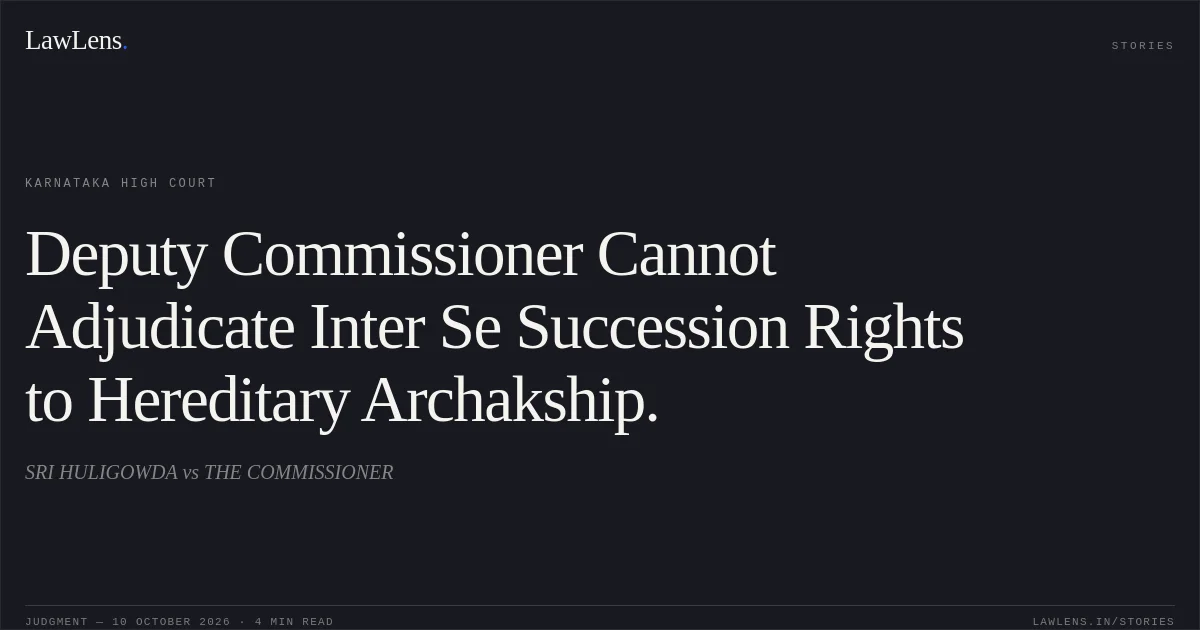
Section 25B(6)(iii) of the Act empowers the Deputy Commissioner to decide whether an Archak or temple servant holds or held office on the basis of hereditary right; it does not confer jurisdiction to determine rival family members’ succession, turns, relinquishment, or other inter se civil rights.
Source reference: para. 28.20–28.25, 28.42Sections 25B(7) and (8) permit an appeal to the Commissioner and empower the Commissioner to make an appropriate order in accordance with law.
Source reference: para. 30.19Section 9(1)’s first proviso provides for appointment of the next person in the line of succession to a hereditary post where there is no dispute among family members; it does not supply a mechanism for deciding a disputed succession claim.
Source reference: para. 28.24–28.25Sri C.L. Parashivamurthy v. State of Karnataka, WA No. 1687/2024, recognises the Deputy Commissioner’s jurisdiction over the hereditary character of an Archak’s office, but not over competing civil claims to succeed to it.
Source reference: para. 28.26–28.27, 30.33Ramachandra v. Shivaram, ILR 2008 Karnataka 4878, Ram Rattan v. Bajrang Lal, (1978) 3 SCC 236, and Narayanam Seshacharyulu v. Narayanam Venkatacharyulu, AIR 1957 AP 876, support the character of hereditary Archakship as a heritable and partible property right, but do not expand the Deputy Commissioner’s statutory jurisdiction.
Source reference: para. 28.28–28.33The genuineness, registration requirements, and legal effect of the disputed document, and the parties’ succession rights, were left for determination by a competent Civil Court.
Source reference: para. 29.25–29.31Reasoning
The Deputy Commissioner’s 2023 order went beyond deciding whether the Archak’s office was hereditary: by recognising particular family members’ entitlement and prescribing turns, it resolved contested succession and civil-rights questions outside Section 25B(6)(iii).
Source reference: para. 28.37–28.43The earlier 2001 order did not, on the material before the Court, establish Kari Gowda’s exclusive hereditary right, but the Court also declined to determine the other family members’ rights or the effect of the disputed 1999 document.
Source reference: para. 29.19–29.26, 29.40–29.42The Commissioner was therefore right to set aside the Deputy Commissioner’s order.
Source reference: para. 30.27–30.35Remand was nevertheless inappropriate because the Deputy Commissioner lacked jurisdiction to decide the inter se civil dispute; the parties must pursue those claims in the Civil Court.
Source reference: para. 30.27–30.35The rotational arrangement could not be restored on the basis of the invalidated order.
Source reference: para. 30.38–30.44The separate challenge to the Tahsildar’s 11 January 2024 memorandum was dismissed, without a distinct determination of the legality of its police-report condition.
Source reference: para. 31.10(i)Holding
The Court held that the Deputy Commissioner could determine the hereditary character of the office but could not adjudicate the family members’ competing succession rights or turns.
W.P. No. 3388/2024 was dismissed.
Source reference: para. 31.10(i)W.P. No. 24820/2025 was allowed in part: the Commissioner’s decision to set aside the Deputy Commissioner’s 5 September 2023 order was upheld, but the remand was set aside; the parties were left to seek adjudication of their respective civil rights before a competent Civil Court.
Source reference: para. 31.10(ii)–(iv)The request to restore the order or continue rotational Archakship was rejected, and the parties’ substantive rights were left open.
Source reference: para. 30.41–30.44, 31.10(i)–(iv)Acts & Sections Cited
5 provisions across 4 statutes referred to in this judgment. Each provision opens on LawLens.
Transfer of Property Act, 18821
Registration Act, 19081
General Clauses Act, 18971
HINDU RELIGIOUS INSTITUTIONS AND CHARITABLE ENDOWMENTS ACT, 19972
Original Court PDF
SRI HULIGOWDAvsTHE COMMISSIONER
Click to open original judgment
Original judgment, available to read, download and summarize on LawLens.in