Facts
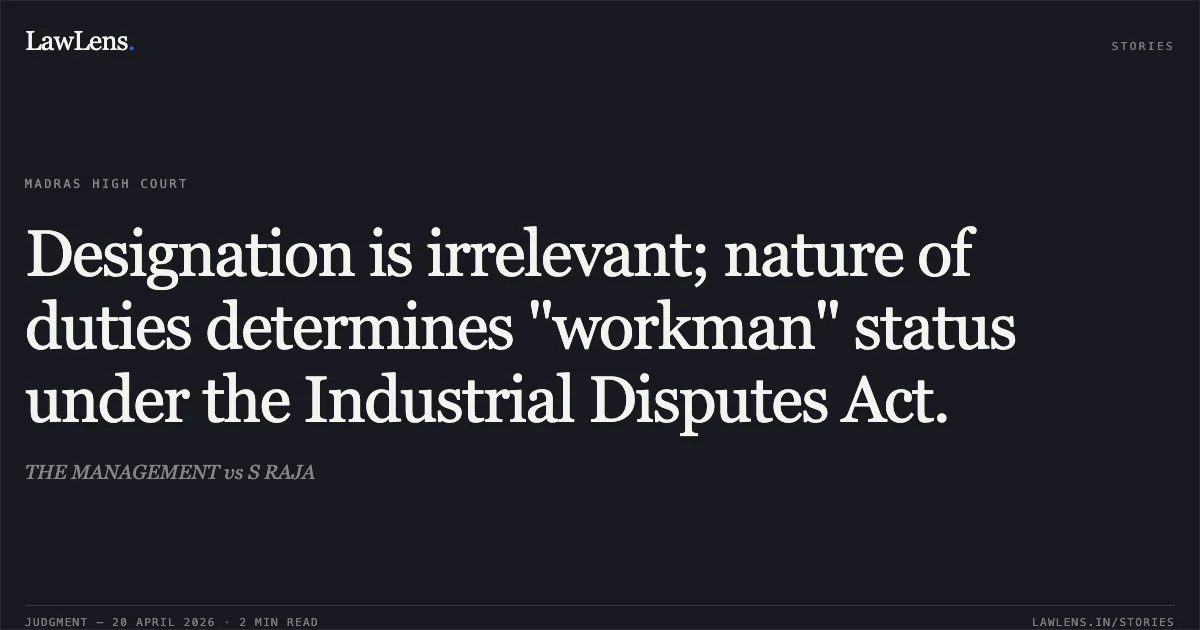
The respondent was employed by the appellant management as an "Area Business Manager" from September 9, 2014, until his termination on August 29, 2020.
Source reference: p. 2Following his termination, the respondent raised an industrial dispute under Section 2A(2) of the Industrial Disputes Act (“ID Act”).
Source reference: p. 2The Labour Court initially passed an award holding that the respondent did not qualify as a "workman" under Section 2(s) of the ID Act.
Source reference: p. 2The respondent challenged this award via W.P. No. 352 of 2024. The Writ Court (Single Judge) set aside the Labour Court's order, finding that despite his designation, the respondent's duties were those of a sales promotion employee. The Writ Court remanded the matter to the Labour Court for adjudication on merits.
Source reference: p. 2-3The Management preferred this Writ Appeal against the Single Judge’s order.
Source reference: p. 2Issues
1. Whether the respondent, holding the designation of "Area Business Manager," qualifies as a "workman" under Section 2(s) of the Industrial Disputes Act.
Source reference: p. 2, para 42. Whether the nature of duties performed prevails over the nomenclature of the post in determining "workman" status.
Source reference: p. 3, para 5Law Applied
Section 2(s) of the Industrial Disputes Act, 1947, which defines "workman," and the Sales Promotion Employees (Conditions of Service) Act, 1976, specifically Section 2(d) and Section 6(2), which extend the protections of the ID Act to sales promotion employees.
Source reference: p. 4, para 6Legal principles established by the Constitution Bench of the Supreme Court in H.R. Adayanthaya and Others v. Sandoz (India) Ltd. (1994) 5 SCC 737, regarding the classification of medical representatives.
Source reference: p. 3, para 6The court upheld the principle that the designation of an employee is irrelevant if the actual nature of the work is neither administrative nor supervisory.
Source reference: p. 4, para 6Reasoning
The Court analyzed the respondent's actual duties versus his "Manager" nomenclature. It noted that the respondent served as a medical representative whose primary responsibility was to promote institutional sales and meet targets.
Source reference: p. 3, 4Crucially, the Court observed from the "work flow chart" that the respondent had no subordinates, meaning he lacked the supervisory or managerial authority inherent in a managerial role.
Source reference: p. 4, para 6.11The Court reasoned that "managing" sales targets does not equate to "managerial" capacity in an industrial sense. By applying the Sales Promotion Employees (Conditions of Service) Act, the Court determined that the respondent's role was "pure and simple" sales promotion.
Source reference: p. 4, para 6.11Consequently, the Court found the Writ Court’s decision to pierce the corporate nomenclature and identify the respondent as a workman to be legally sound and consistent with judicial pronouncements.
Source reference: p. 5, para 7Holding
The High Court dismissed the Writ Appeal and upheld the Writ Court's order. The Court held that the respondent is to be treated as a "workman" for the purpose of the Industrial Disputes Act.
The matter remains remanded to the Labour Court, with the parties granted liberty to adjudicate the dispute on its merits based on existing evidence. No costs were awarded.
Source reference: p. 5, para 7 8Acts & Sections Cited
4 provisions across 2 statutes referred to in this judgment. Linked provisions open on LawLens.
Industrial Disputes Act, 19472
Sales Promotion Employees (Conditions Of Service) Act, 19762
Original Court PDF
THE MANAGEMENTvsS RAJA
Click to open original judgment
Original judgment, available to read, download and summarize on LawLens.in