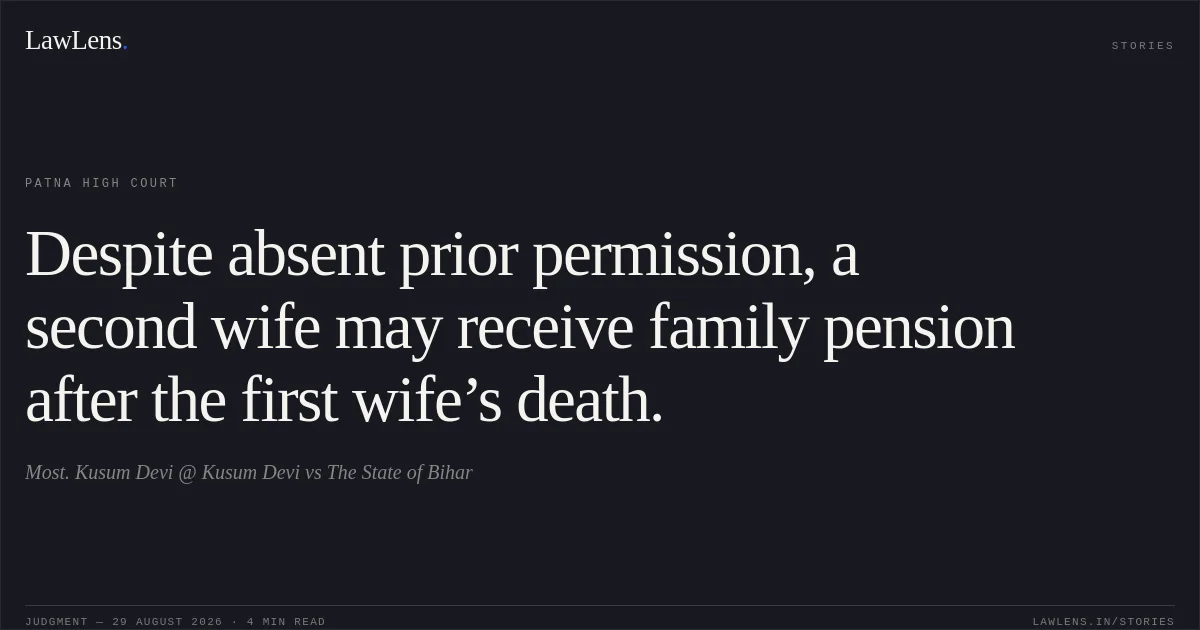
Facts
The petitioner claimed to be the second wife of Late Jay Lal Sah, a Grade-III Clerk in the Water Resources Department, who died in harness on 17 April 2009.
Source reference: para. 3His first wife, Kusum Devi-I, died subsequently in December 2009; the judgment records that the first wife was issueless and had not objected to the petitioner’s marriage with the deceased employee.
Source reference: paras. 4, 18–19The petitioner asserted that she and the deceased had six children and that the deceased had applied for permission to contract a second marriage on 28 February 1982, which was produced as Annexure-P/5.
Source reference: paras. 4, 9Her claim for family pension was rejected by the Chief Engineer through Memo No. 327 dated 5 February 2019, principally on the ground that the deceased employee had neither obtained prior permission nor informed the department about the second marriage.
Source reference: paras. 2–3The petitioner challenged the rejection and relied upon the Supreme Court’s decision in Radha Devi v. Chief General Manager.
Source reference: para. 5Issues
1. Whether the rejection of the petitioner’s claim for family pension solely on the ground that the deceased employee had not obtained prior permission for his second marriage was legally sustainable, despite the alleged application for permission and the surrounding family circumstances?
Source reference: paras. 9, 182. Whether the relief granted by the Supreme Court in Radha Devi under Article 142 of the Constitution could be considered while determining the petitioner’s entitlement to family pension?
Source reference: paras. 12–153. Whether the petitioner, claiming to be the second wife, could be recognised as a ‘spouse’ entitled to family pension after the death of the deceased employee’s first wife?
Source reference: para. 19Law Applied
The Court applied Rule 23(2) and its proviso of the Bihar Government Service Conduct Rules, 1976, which restrict a Government servant from contracting a second marriage during the lifetime of an existing spouse but permit the Government to authorise such marriage where it is permissible under the applicable personal law and other grounds exist.
Source reference: para. 10It also considered Finance Department Resolution No. 10059 dated 6 September 1996, under which a second wife of a deceased Government employee is generally not entitled to family pension, although children born from the second marriage may receive pension in accordance with the applicable rules.
Source reference: para. 17The Court relied on Rameshwari Devi v. State of Bihar, AIR 2000 SC 735, for the principle that the validity or status of a second marriage may be examined by departmental authorities for limited service-law purposes.
Source reference: para. 11It further relied on Indian Bank v. ABS Marine Products (P) Ltd., (2006) 5 SCC 72, for the distinction between binding declarations of law under Article 141 and fact-specific directions issued under Article 142.
Source reference: para. 14The Court treated Radha Devi as a fact-specific exercise of Article 142 power, but considered its reasoning relevant to doing complete justice in the present circumstances.
Source reference: paras. 13–15, 19Reasoning
The Court held that Rule 23(2) did not impose an absolute prohibition on a second marriage but contemplated Government permission in appropriate circumstances.
Source reference: para. 16The impugned order failed to consider the material fact that the deceased employee had allegedly applied for permission to contract the second marriage on 28 February 1982.
Source reference: paras. 9, 18It also failed to examine the petitioner’s long-standing relationship with the deceased, the existence of six children from the union, the first wife’s subsequent death, and the petitioner’s continued status and life with the deceased after that death.
Source reference: paras. 18–19Although the Court acknowledged that Radha Devi was not a general binding rule under Article 141 because it was decided under Article 142 on peculiar facts, it found the factual and humanitarian considerations in that case relevant.
Source reference: paras. 12–15In particular, denying the petitioner recognition as a spouse at an advanced age, after she had lived with and cared for the deceased and had to support their children, would defeat the object of substantial justice and financial dignity.
Source reference: para. 19Accordingly, the rejection based solely on absence of prior permission was held unsustainable for non-consideration of relevant material.
Source reference: para. 18Holding
The Court found the impugned Memo No. 327 dated 5 February 2019 unsustainable and directed the Chief Engineer to reconsider the petitioner’s claim on the correct factual basis, including the deceased employee’s application for permission for the second marriage and the petitioner’s claim to family pension after the first wife’s death.
The Court observed that the petitioner was entitled to family pension from the date of her husband’s death, 17 April 2009, until her death.
Source reference: para. 19The authority was directed to pass a reasoned order and ensure payment of family pension in accordance with law.
Source reference: para. 21The writ petition was accordingly disposed of.
Source reference: para. 22Original Court PDF
Most. Kusum Devi @ Kusum DevivsThe State of Bihar
Click to open original judgment
Original judgment, available to read, download and summarize on LawLens.in
![A police constable cannot be removed for unauthorized absence without a Rule 359-compliant inquiry.. Mohammad Sidiq Khan vs D/o Home Ut Of Jammu & Kashmir. CAT - ['Srinagar']. LawLens](/stories/thumbnails/a-police-constable-cannot-be-removed-for-unauthorized-absence-without-a-rule-359-compliant-7b43fc316bd94f22a62676153bbc9d54.webp)
![A Review DPC lacks authority to determine or alter inter se seniority.. SAURABH KUMAR vs REVENUE. CAT - ['Patna']. LawLens](/stories/thumbnails/a-review-dpc-lacks-authority-to-determine-or-alter-inter-se-seniority-4b21640f20af46fcabdfc8273d2ce959.webp)