01Facts
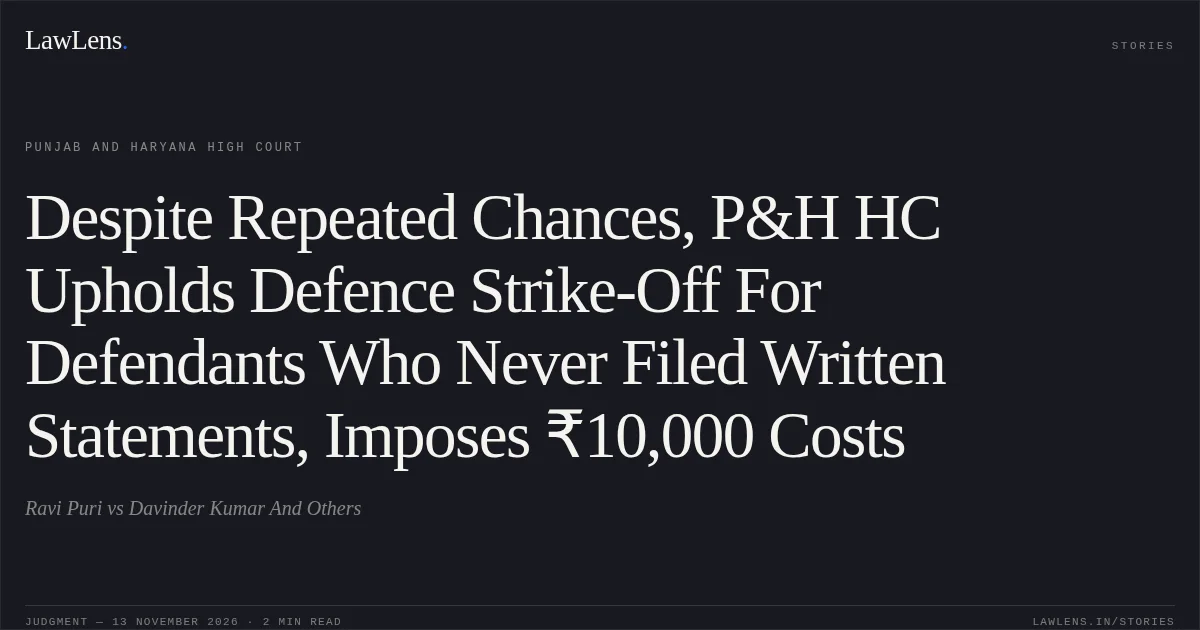
The plaintiffs brought a suit for permanent injunction. The petitioner-defendants entered appearance on 3 October 2024 but did not file a written statement despite repeated adjournments.
¶ 1On 18 July 2025, the Trial Court struck off their defence, noting that more than 90 days had elapsed and that previously ordered costs remained unpaid. The defendants’ review application was dismissed on 18 May 2026. They sought relief under Article 227, attributing the default to a communication lapse by their counsel’s clerk.
¶ 1–3, 402Issues
i.Whether the Trial Court’s orders striking off the defence and dismissing the review application disclosed an illegality or material infirmity warranting interference under Article 227
¶ 1, 4.4ii.Whether the alleged communication lapse by counsel’s clerk provided sufficient cause to permit the defendants to file a written statement after repeated opportunities and expiry of the prescribed period
¶ 3, 4.1–4.303Law Applied
Order VIII Rule 1 of the Code of Civil Procedure prescribes the timeline for filing a written statement; its time limit is directory, and a court may permit filing beyond 90 days in an appropriate case, but that discretion must be exercised judicially and supported by sufficient justification.
¶ 4.1In Kailash v. Nanhku and Others, 2005 (4) SCC 480, the Supreme Court held that filing beyond the prescribed period may be permitted in exceptional circumstances where sufficient justification is shown and the court gives reasons; the directory nature of the provision does not authorise indefinite delay.
¶ 4.2Article 227 supervisory intervention is not warranted absent illegality, perversity, or material infirmity in the impugned orders.
¶ 1, 4.404Reasoning
The Trial Court had granted repeated opportunities over approximately nine months, including a final adjournment, but the written statement remained unfiled and the costs were unpaid.
¶ 4, 4.3The petitioner did not provide a cogent explanation for the repeated defaults; the asserted clerk’s communication lapse was unsupported and did not account for the failure to file on the earlier dates or on 18 July 2025.
¶ 4.3Applying Kailash, the Court held that the directory nature of Order VIII Rule 1 did not justify further indulgence without a satisfactory explanation. It therefore found no basis for supervisory interference.
¶ 4.1–4.405Holding
The Court dismissed the revision petition, finding no merit or ground for interference with either impugned order.
¶ 4.4–4.5It imposed exemplary costs of ₹10,000, payable by the petitioner to the Poor Patients Fund, PGIMER, Chandigarh. Pending miscellaneous applications, if any, were also disposed of.
¶ 4.5, 6Original Court PDF
Ravi PurivsDavinder Kumar And Others
Click to open original judgment
Original judgment, available to read, download and summarize on LawLens.in