01Facts
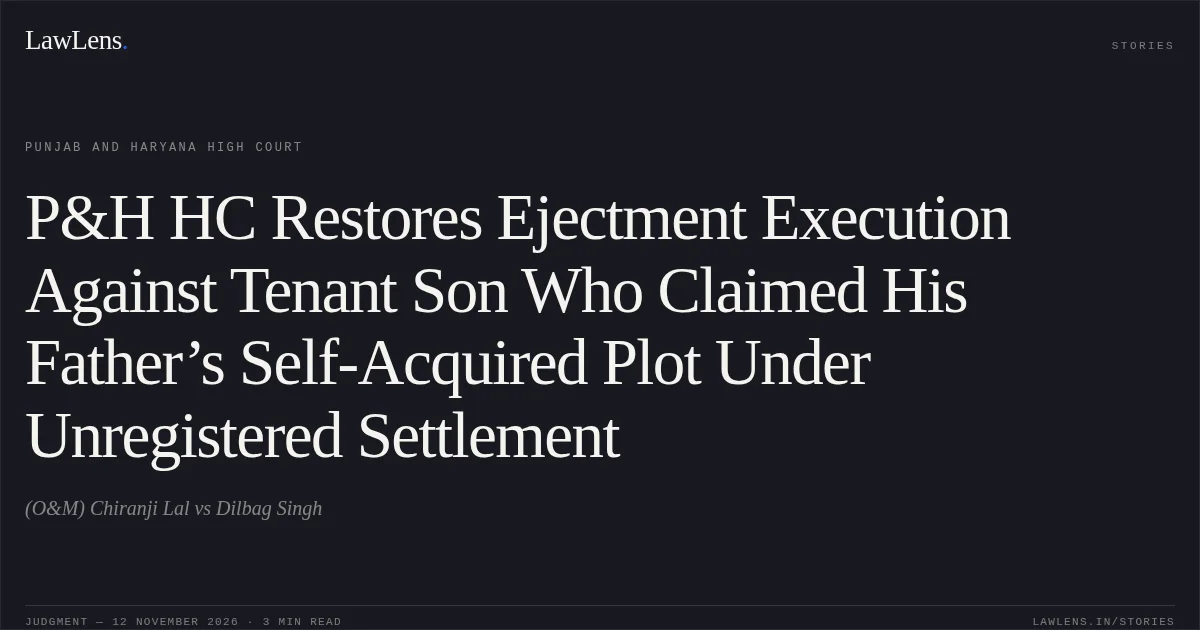
Chiranji Lal, owner of self-acquired property, obtained an ejectment order against his tenant-son, Dilbag Singh, on 12 March 1992.
¶ 3–10In execution, Dilbag objected that a family settlement dated 18 December 1992 had made him owner of the portion containing the demised room and had extinguished the decree.
¶ 3–10The Executing Court accepted the objections and dismissed the execution petition, relying on a photocopy of the settlement and finding waiver.
¶ 3–10Chiranji Lal’s revision challenged that order.
¶ 3–10During its pendency, he died, and Dilbag became one of his legal heirs.
¶ 4802Issues
i.1. Whether the alleged family settlement could confer ownership of the disputed portion and defeat the final ejectment order, despite being an unregistered document raised as an adjustment outside court
¶ 17–23, 26–33ii.2. Whether Chiranji Lal had waived or otherwise surrendered his right to enforce the ejectment order
¶ 38–44iii.3. Whether Dilbag’s subsequent inheritance of an undivided share in the property affected the enforceability of the ejectment order
¶ 48–5803Law Applied
Order XXI Rule 2 CPC requires an out-of-court payment or adjustment of a decree to be certified or recorded; an uncertified adjustment cannot ordinarily be recognised, and Article 125 of the Limitation Act, 1963 prescribes the period for seeking its recordal.
¶ 18–23The earlier remand order in the same proceedings bound the parties as to consideration of the objections, but did not determine the settlement’s validity
¶ 18–23Under Kale v. Deputy Director of Consolidation, (1976) 3 SCC 119, a memorandum recording a completed oral family arrangement need not be registered, but an instrument that itself creates or extinguishes rights in immovable property requires registration; its substance, not its label, governs
¶ 26–32Sections 17(1)(b) and 49 of the Registration Act, 1908 require registration for an instrument creating or declaring rights in immovable property and limit the effect of an unregistered instrument; Section 123 of the Transfer of Property Act, 1882 governs gifts of immovable property.
¶ 26–32Waiver requires intentional and unequivocal relinquishment of a known right
¶ 38–41Under Sections 8, 10 and 19 of the Hindu Succession Act, 1956, heirs may take as tenants-in-common; merger of tenancy under Section 111(d) of the Transfer of Property Act requires the entire interests of lessor and lessee to vest in the same person in the same right
¶ 49–51Provisions in the judgment · 9 · Linked ones open on LawLens
Limitation Act, 1963 Section 125Section 136
Transfer of Property Act, 1882 Section 123Section 111
Registration Act, 1908 Section 17Section 49
Hindu Succession Act, 1956 Section 8Section 10Section 19
04Reasoning
The settlement purported to make Dilbag absolute owner of a specified part of his father’s self-acquired property, although Dilbag had no established antecedent ownership interest.
¶ 28–33The Court therefore treated the writing, in substance, as creating ownership rights rather than merely recording a completed arrangement; as it was unregistered, it could not establish the asserted transfer
¶ 28–33Even if execution of the photocopy were proved, that would not establish its legal effect or extinguish the ejectment decree
¶ 34–37The settlement did not refer to the ejectment order or expressly release the right to execute it, and delay in seeking execution—within the limitation period—did not prove intentional waiver.
¶ 39–44Chiranji Lal’s subsequent opposition to the settlement further contradicted waiver
¶ 39–44Dilbag’s later inheritance could give him an undivided share, subject to proof of succession, but did not confer exclusive title to the demised room or retrospectively satisfy the decree; any inheritance rights remained available to be worked out through appropriate proceedings
¶ 49–5805Holding
The High Court allowed the revision, set aside the order accepting Dilbag’s objections, and dismissed those objections.
¶ 64–65It restored the execution petition and directed the Executing Court to proceed with enforcement of the ejectment order without reopening the issues of the alleged settlement or waiver
¶ 64–65Dilbag’s independent rights, if any, as a co-sharer were preserved, and execution was not to determine the heirs’ respective ownership shares
¶ 66The Executing Court was directed to deal with the deposited amount and security in accordance with law and to endeavour to conclude execution within three months, subject to any subsisting order of a competent court; no order as to costs was made
¶ 67–68Original Court PDF
(O&M) Chiranji LalvsDilbag Singh
Click to open original judgment
Original judgment, available to read, download and summarize on LawLens.in