01Facts
The plaintiff brought a suit for specific performance based on an agreement to sell dated 15 October 2019 and a related writing dated 26 May 2020 concerning 10 Bighas 7 Biswas of land.
¶ 1During the plaintiff’s evidence, the defendants sought to have both instruments impounded. The trial court directed the plaintiff to pay the deficient stamp duty and an equivalent amount as penalty. The plaintiff challenged that order in revision.
¶ 1–3The plaint stated that possession was handed over on 26 May 2020, and the writing made on that date, on the reverse of the agreement, recorded delivery of possession.
¶ 502Issues
i.1. Whether the agreement to sell and related writing were chargeable as an agreement to sell followed by or evidencing delivery of possession under Entry 5(cc) of Schedule 1-A to the Indian Stamp Act, 1899, as applicable in Punjab.
¶ 5ii.2. Whether the trial court’s direction to pay a penalty equal to the deficient stamp duty was justified.
¶ 6–7iii.3. Whether the deficient stamp duty was to be calculated on the entire sale consideration or on the amount paid or payable under the agreement.
¶ 803Law Applied
Section 35 of the Indian Stamp Act, 1899 bars admission in evidence of an instrument that is not duly stamped, but permits admission on payment of the deficient duty and penalty under its proviso (a).
¶ 6Under Entry 5(cc) of Schedule 1-A, as applicable in Punjab, an agreement to sell followed by or evidencing delivery of possession attracts the applicable stamp duty.
¶ 5The penalty is discretionary and must not be imposed mechanically; under Gurinder Singh Dhaliwal v. Pargat Singh (relying on Trustees of H.C. Dhanda Trust v. State of Madhya Pradesh), an extreme penalty requires exceptional circumstances such as fraud, deceit, or deliberate evasion, and a tenfold penalty is not mandatory.
¶ 6–7The deficient duty is computed under Entry 5(cc), read with Sub-column 2 of Column 2 of Entry 23 of Schedule 1-A, on the amount paid or payable under the agreement, subject to adjustment when the sale deed is executed.
¶ 8Provisions in the judgment · 1 · Linked ones open on LawLens
Indian Stamp Act, 1899 Section 35
04Reasoning
The Court rejected the plaintiff’s claim that he had possessed the land before the agreement, because the plaint contained no such specific averment and instead recorded delivery of possession on 26 May 2020. The writing on the reverse of the agreement corroborated that delivery. The Court therefore held that the instruments fell within Entry 5(cc); describing possession as being for cultivation rather than as owner did not displace the recorded delivery.
¶ 5As to penalty, the trial court imposed an amount equal to the deficient duty, not a tenfold penalty, and the record did not establish deliberate evasion or awareness of the Punjab amendment; the amount was therefore consistent with the governing principles.
¶ 6–7The Court clarified that the duty must be calculated on the amount paid or payable under the agreement, not the entire sale consideration.
¶ 805Holding
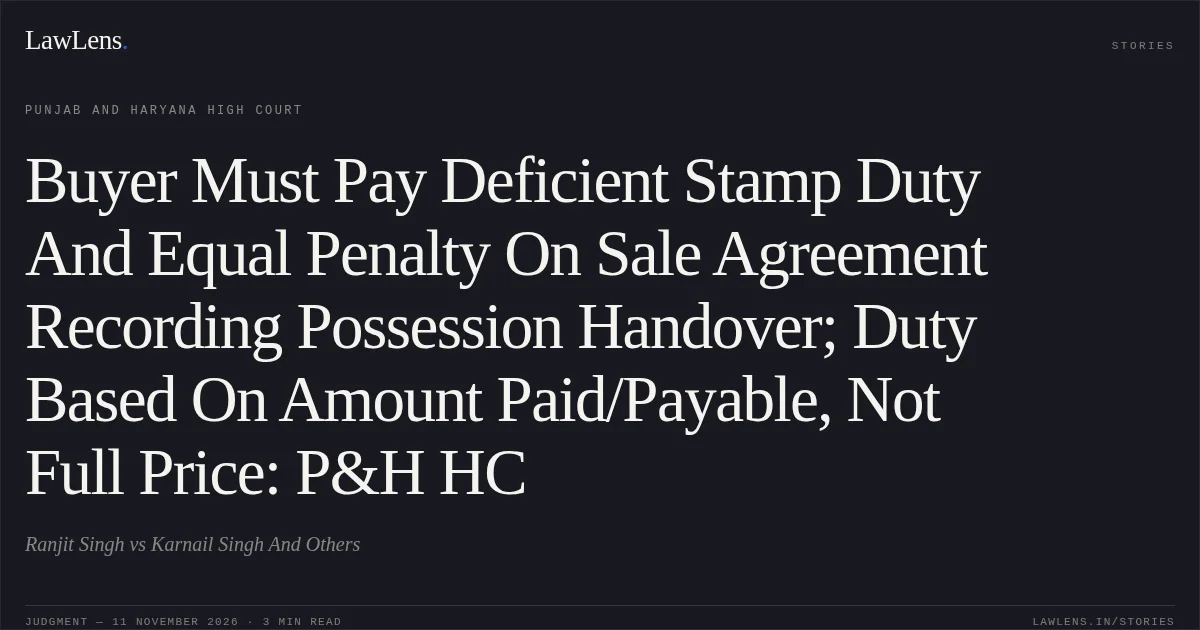
The High Court disposed of the revision petition in the above terms. The plaintiff was required to pay the deficient stamp duty, calculated on the amount paid or payable under the agreement and subject to adjustment at the time of execution of the sale deed, together with a penalty equal to the deficient duty. Payment was directed within four weeks before the trial court.
¶ 8All pending miscellaneous applications were also disposed of.
¶ 9Original Court PDF
Ranjit SinghvsKarnail Singh And Others
Click to open original judgment
Original judgment, available to read, download and summarize on LawLens.in