Facts
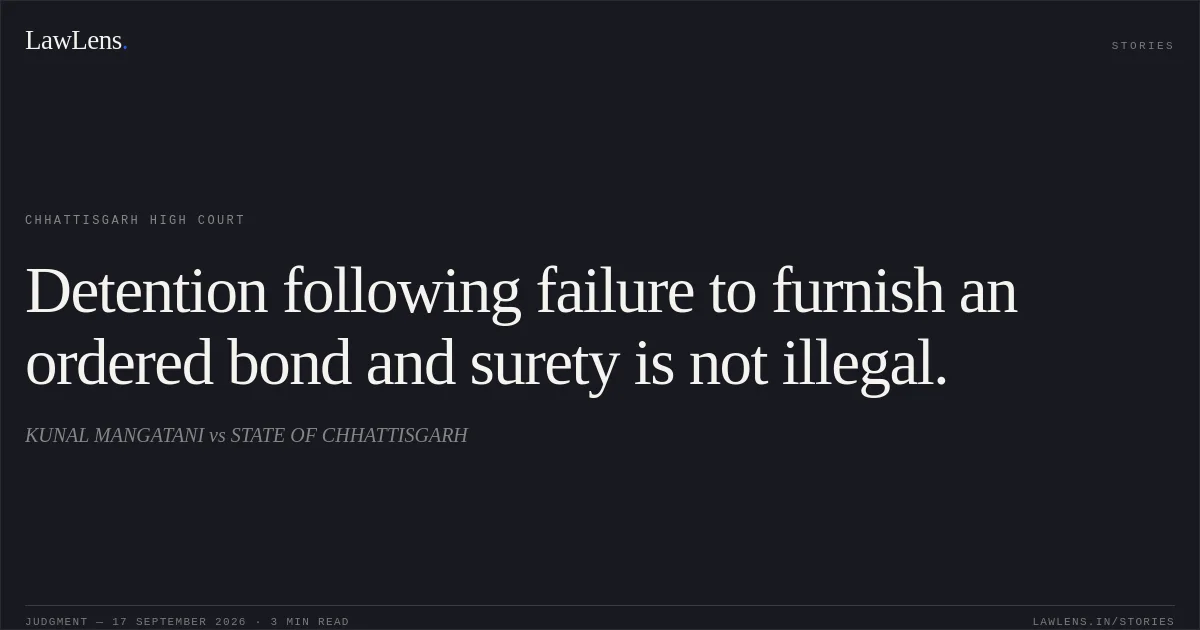
The petitioner challenged his detention from 11 December 2024 to 12 December 2024, alleging violation of his personal liberty and dignity under Article 21 of the Constitution and seeking compensation of ₹5,00,000.
Source reference: no citationAn Istagasha proceeding was initiated against him by Police Station New Rajendra Nagar under Sections 170, 126 and 135 of the Bharatiya Nagarik Suraksha Sanhita, 2023 (BNSS). Upon consideration, the Sub-Divisional Magistrate directed his arrest on 11 December 2024 at approximately 2:50 p.m. and ordered him to furnish a bond of ₹20,000 with a surety for the same amount for maintaining peace; his mother was informed of the arrest
Source reference: para. 2The petitioner claimed that he sought release on a personal bond on 11 December 2024 because he could not furnish the required surety, but that the application was considered only on 12 December 2024, when he was released.
Source reference: para. 3The State contended that the Magistrate’s order was lawful and that the imposed condition was neither excessive nor beyond jurisdiction.
Source reference: para. 4Issues
Whether the petitioner’s detention from 11 December 2024 to 12 December 2024 constituted illegal detention and violated Article 21 of the Constitution?
Source reference: paras. 1, 3, 8Whether the Sub-Divisional Magistrate was required to consider the petitioner’s application for release on a personal bond on the same day and whether failure to do so entitled the petitioner to compensation?
Source reference: para. 3Whether the conditions requiring a bond of ₹20,000 and a surety for the like amount, imposed under the preventive proceeding, were unlawful or excessive?
Source reference: paras. 2, 4, 6–7Law Applied
The Court considered the petitioner’s claim under Article 21 of the Constitution, which protects personal liberty and dignity, and exercised its constitutional jurisdiction under Articles 226 and 227.
Source reference: paras. 1–2, 3The preventive proceeding was initiated under Sections 170, 126 and 135 of the BNSS, and the Sub-Divisional Magistrate’s order requiring the petitioner to furnish a bond and surety was passed under Section 130 of the BNSS.
Source reference: paras. 1–2, 3The Court applied the principle that detention pursuant to a valid judicial or quasi-judicial order requiring compliance with specified bail or bond conditions cannot ordinarily be characterised as illegal merely because the person is unable or unwilling to satisfy those conditions.
Source reference: no citationIt further held that, after passing the order imposing the conditions, the Magistrate had no specific power to recall or modify it, although the subsequent alteration of the condition as a matter of leniency was not per se illegal.
Source reference: para. 7Reasoning
The Court found that the Sub-Divisional Magistrate had passed a peremptory order on 11 December 2024 requiring the petitioner to furnish a ₹20,000 bond with a surety of the same amount, and that release was conditional upon compliance with that order.
Source reference: para. 6Although the petitioner asserted that he had applied for release on a personal bond on the same day, the record contained no material establishing that such an application had in fact been filed on 11 December 2024; therefore, the Court rejected that assertion.
Source reference: para. 6The Court further held that the Magistrate was not required, in the absence of a specific statutory power, to recall or modify the original order, and that the later relaxation of the condition was a lenient measure rather than an admission that the initial detention was unlawful.
Source reference: para. 7Since the petitioner’s custody resulted from his failure to comply with the bond and surety conditions imposed by the competent authority, the detention could not be attributed to unlawful action by the respondents.
Source reference: para. 8Holding
The Court answered the issues against the petitioner. It held that the petitioner’s detention between 11 and 12 December 2024 was not shown to be illegal, that no violation of Article 21 was established, and that the bond and surety conditions were not demonstrated to be unlawful or excessive.
The claim for compensation was therefore rejected, and the writ petition was dismissed as devoid of merit.
Source reference: para. 9Acts & Sections Cited
4 provisions across 1 statute referred to in this judgment. Each provision opens on LawLens.
Bharatiya Nagarik Suraksha Sanhita, 20234
Original Court PDF
KUNAL MANGATANIvsSTATE OF CHHATTISGARH
Click to open original judgment
Original judgment, available to read, download and summarize on LawLens.in