Facts
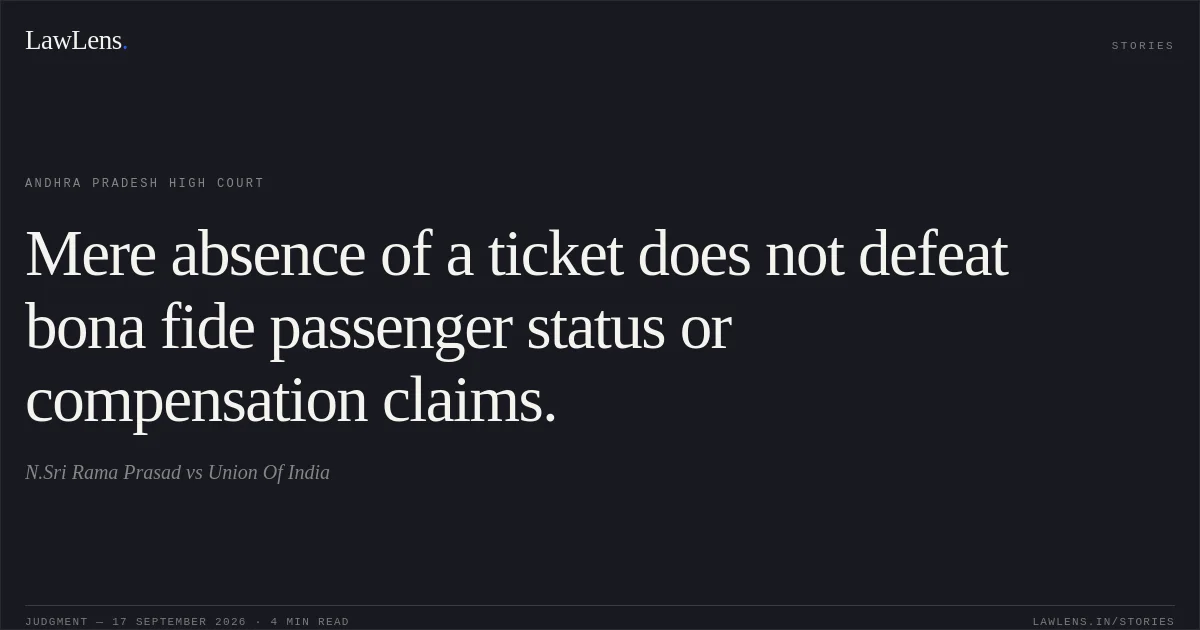
The deceased, a bachelor and resident of Tanuku, intended to visit his paternal uncle at Pinninty Village, Srikakulam District.
Source reference: para. 3His father purchased a passenger ticket from Tanuku to Visakhapatnam, and the deceased boarded Train No. 57229 on 29 March 2012 in his father’s presence.
Source reference: para. 3At Tuni Railway Station, the deceased allegedly fell from the train between Platform No. 2 and the train due to overcrowding and sudden jerks, suffered crush injuries, and died shortly thereafter at the Government Central Hospital, Tuni.
Source reference: para. 3His parents filed a claim before the Railway Claims Tribunal seeking compensation under the Railways Act, 1989.
Source reference: para. 4The Railway Administration denied that the deceased was a bona fide passenger and contended that he had fallen while attempting to board the moving train, making the injuries self-inflicted.
Source reference: para. 4The Tribunal accepted the absence of a journey ticket as proof that the deceased was not a bona fide passenger and dismissed the claim by judgment dated 27 November 2020.
Source reference: para. 8The parents challenged that decision under Section 23 of the Railway Claims Tribunal Act.
Source reference: p. 2Issues
Whether the deceased was a bona fide passenger despite the absence of a journey ticket being found on his person?
Source reference: paras. 8, 18–21Whether the deceased’s death resulted from an “untoward incident” attracting liability under Section 124-A of the Railways Act, 1989?
Source reference: paras. 3–5, 17–20Whether the appellants, being the deceased’s parents, were dependants entitled to claim compensation?
Source reference: para. 7Whether the appellants were entitled to compensation of ₹8,00,000?
Source reference: paras. 23, 25–28Law Applied
The Court applied Sections 123(b), 123(c) and 124-A of the Railways Act, 1989.
Source reference: no citationParents fall within the statutory definition of “dependants” under Section 123(b), while death or injury caused by falling from a train may constitute an “untoward incident” under Section 123(c), giving rise to strict/no-fault liability under Section 124-A, subject to the statutory exceptions.
Source reference: paras. 17–20Under Union of India v. Rina Devi, mere absence of a ticket does not disprove bona fide passenger status; the claimant’s initial burden may be discharged by an affidavit setting out the relevant facts, after which the burden shifts to the Railways.
Source reference: para. 18Rina Devi further holds that negligence in boarding or de-boarding does not amount to a “self-inflicted injury”; such injury requires an intention to cause the injury, not mere negligence.
Source reference: para. 19In Kalandi Charan Sahoo v. General Manager, South-East Central Railways, compensation was directed where the prescribed investigation had not been properly conducted after the incident.
Source reference: para. 17Doli Rani Saha v. Union of India reaffirmed that, once the claimant’s affidavit establishes the relevant circumstances and the Railway investigation indicates travel and death by falling from the train, the burden shifts to the Railways to rebut bona fide passenger status.
Source reference: para. 22The Court also relied on Rule 7 of the Railway Passengers (Manner of Investigation of Untoward Incidents) Rules, 2007, requiring investigation, collection of inquest and related records, and submission of a report within the prescribed period.
Source reference: paras. 14–16The Court also relied on Lata v. Union of India, concerning the Railways’ responsibility to maintain effective ticket-checking and crowd-control mechanisms.
Source reference: para. 24Reasoning
The Court held that the appellants had discharged their initial burden by pleading and supporting the material facts that the deceased’s father had purchased the ticket and that the deceased had boarded the specified train.
Source reference: paras. 12, 21The fact that no ticket was found on the deceased did not, by itself, negate his status as a bona fide passenger, particularly since the ticket could have been lost during the accident, removal from the site, or transportation to the hospital.
Source reference: paras. 12–13, 18The Railway Administration failed to rebut the appellants’ account with reliable evidence.
Source reference: no citationIts reliance on the Divisional Railway Manager’s report was insufficient, especially in light of the alleged failure to conduct the investigation contemplated by Rule 7 of the 2007 Rules.
Source reference: paras. 14–17The Court further found that the deceased’s fall from the train, whether caused by overcrowding, sudden jerks, or negligence while boarding, was not shown to be intentional.
Source reference: paras. 19–20Applying Rina Devi, mere negligence could not be treated as a self-inflicted injury or as a statutory exception to no-fault liability.
Source reference: paras. 19–20Since the deceased’s parents were established as dependants and the Railway failed to disprove either bona fide passenger status or the occurrence of an untoward incident, the claim was maintainable.
Source reference: paras. 7, 21, 25–26Holding
The High Court allowed the appeal and set aside the Railway Claims Tribunal’s judgment dated 27 November 2020.
It held that the deceased was to be treated as a bona fide passenger notwithstanding the non-recovery of the ticket, and that his death resulted from an untoward incident attracting compensation under Section 124-A of the Railways Act, 1989.
Source reference: paras. 25–28The Union of India was directed to pay ₹8,00,000 to the appellants within two months, with the amount to be apportioned equally between them.
Source reference: para. 28No order as to costs was made.
Source reference: para. 28Acts & Sections Cited
3 provisions across 3 statutes referred to in this judgment. Each provision opens on LawLens.
Railway Claims Tribunal Act, 19871
Railways Act, 19891
Motor Vehicles Act, 19881
Original Court PDF
N.Sri Rama PrasadvsUnion Of India
Click to open original judgment
Original judgment, available to read, download and summarize on LawLens.in