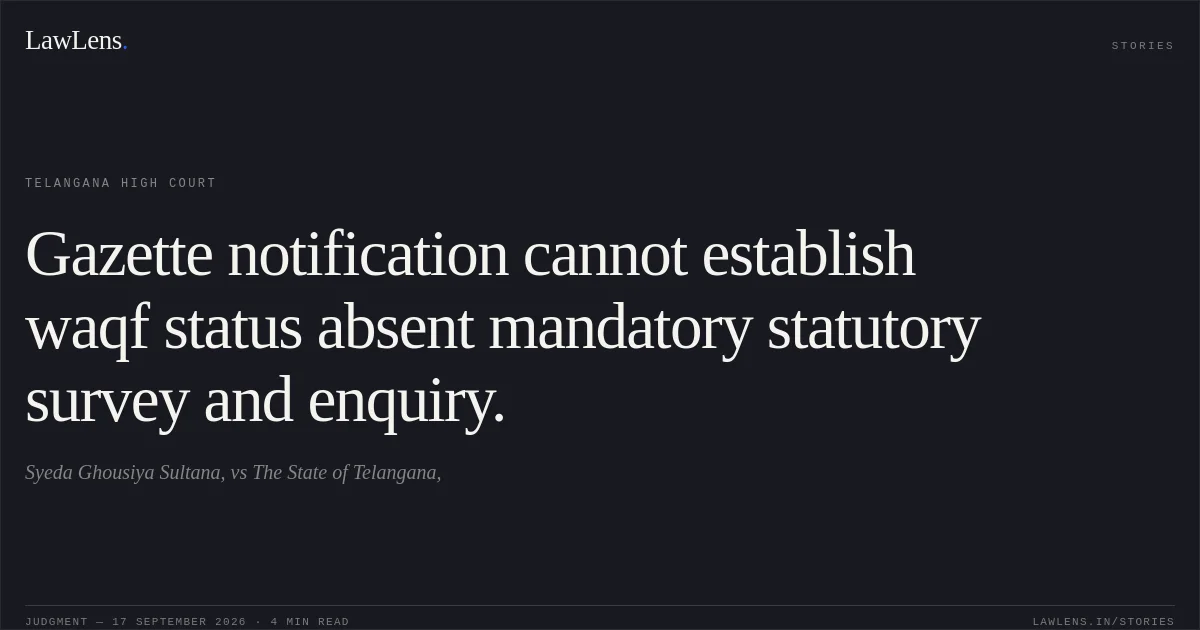
Facts
The petitioners claimed ownership and possession over various parcels of land situated at Toopran Village and Mandal, Medak District, relying on Occupancy Rights Certificates dated 05.06.1990, pattadar passbooks, title deeds and revenue records standing in their names.
Source reference: paras. 3–3.6They discovered, when seeking registration of sale deeds, that their lands had been included in Gazette Notification No.46-A dated 20.12.2001 as waqf properties and consequently placed on the prohibited-properties list.
Source reference: paras. 3.1–3.2The petitioners contended that they had received no individual notice, that no enquiry or opportunity of hearing had been afforded, and that no lawful dedication of the lands as waqf had been established.
Source reference: paras. 3.3–3.7The Telangana State Waqf Board asserted that the properties had been surveyed in the 1960s under Section 4 of the Waqf Act, 1954, following public proclamation by tom-tom, and that the Gazette notification had attained finality.
Source reference: paras. 5–5.5The petitioners therefore sought quashing of the Gazette notification insofar as it concerned their lands and deletion of the properties from the prohibited-properties list.
Source reference: para. 1Issues
1. Whether the petitioners had locus standi to maintain the writ petition as persons aggrieved by the inclusion of their lands in the list of waqf properties.
Source reference: paras. 7–152. Whether the writ petition was liable to be dismissed on the ground of delay and laches.
Source reference: paras. 7, 16–173. Whether the writ petition was maintainable despite the alternative remedy of approaching the Waqf Tribunal under Section 83 of the Waqf Act, 1995.
Source reference: paras. 7, 18–244. Whether the mandatory procedure under Sections 4 and 5 of the Waqf Act, 1954, including survey, enquiry, preparation and consideration of the survey report, and opportunity to affected persons, had been followed before publication of the impugned Gazette notification.
Source reference: paras. 7, 25–575. What relief the petitioners were entitled to.
Source reference: para. 7Law Applied
The Court applied Article 226 of the Constitution, holding that writ jurisdiction may be exercised where an action is without jurisdiction or violates natural justice, notwithstanding an alternative remedy, as recognised in Whirlpool Corporation v. Registrar of Trade Marks, Harbanslal Sahnia v. Indian Oil Corporation Ltd., and Radha Krishan Industries v. State of Himachal Pradesh.
Source reference: paras. 18–20It applied Article 300-A, recognising that State action affecting proprietary rights must have lawful authority.
Source reference: paras. 8–13Under Sections 4 and 5 of the Waqf Act, 1954, a preliminary survey and substantive, quasi-judicial enquiry by the Survey Commissioner, followed by preparation and consideration of a report and lawful publication of the list of waqfs, were mandatory conditions precedent to Gazette notification.
Source reference: paras. 30, 35–37The Court relied particularly on Madanuri Sri Ramachandra Murthy v. Syed Jalal, Salem Muslim Burial Ground Protection Committee v. State of Tamil Nadu, and State of Andhra Pradesh v. A.P. State Waqf Board, which establish that mere Gazette publication does not prove waqf character where the foundational survey and enquiry are not shown to have occurred.
Source reference: paras. 29, 32–33A notification issued without compliance with mandatory statutory requirements cannot be validated retrospectively by the Waqf Act, 1995, subsequent amendments, or the availability of a statutory Tribunal remedy.
Source reference: paras. 43–52The Court also applied the principle that an order or action lacking jurisdiction may be challenged whenever it is sought to be enforced, as stated in Rafique Bibi v. Sayed Waliuddin and Kiran Singh v. Chaman Paswan.
Source reference: para. 21Reasoning
The petitioners established a prima facie legal interest through the ORCs, title deeds, pattadar passbooks and continuing revenue entries, and the respondents did not show that those documents had been cancelled or invalidated; consequently, the petitioners were directly aggrieved by the restraint on dealing with their lands and had locus standi.
Source reference: paras. 8–14The Court declined to reject the petition on delay because the petitioners pleaded that they discovered the inclusion only when they approached the registering authority and thereafter promptly sought deletion; in any event, the challenge concerned an allegedly void action affecting subsisting proprietary rights.
Source reference: paras. 16–17The alternative-remedy objection also failed because the petitioners challenged the jurisdictional and procedural foundation of the notification, alleging violation of natural justice, rather than merely disputing the correctness of a validly conducted survey.
Source reference: paras. 18–24, 45–49Although the Waqf Board asserted that a survey and tom-tom proclamation had occurred, it produced no survey report, Survey Commissioner’s proceedings, enquiry record, proof of notice or proclamation, objection record, forwarding of the report, or material showing independent consideration by the Board.
Source reference: paras. 38–40, 53Since survey and quasi-judicial enquiry were conditions precedent to publication under Sections 4 and 5 of the 1954 Act, the Gazette notification could not itself substitute for proof of those proceedings or conclusively establish the waqf character of the lands.
Source reference: paras. 34–42, 52–56Later statutory amendments and the Waqf Tribunal remedy could not cure this foundational defect in a notification issued under the 1954 Act.
Source reference: paras. 43–50Holding
The Court answered the issues in favour of the petitioners. It held that the petitioners had locus standi, that the delay objection did not defeat the challenge, and that the writ petition was maintainable despite the alternative remedy because the validity and jurisdictional foundation of the Gazette notification itself were under challenge.
The Waqf Board failed to establish compliance with the mandatory survey, enquiry and reporting requirements under Sections 4 and 5 of the Waqf Act, 1954.
Source reference: paras. 56–59Accordingly, the writ petition was allowed and Gazette Notification No.46-A dated 20.12.2001 was set aside insofar as it related to the petitioners’ subject properties.
Source reference: para. 60Pending miscellaneous petitions were closed and there was no order as to costs.
Source reference: para. 61Acts & Sections Cited
6 provisions across 1 statute referred to in this judgment. Each provision opens on LawLens.
Technology Development Board Act, 19956
Original Court PDF
Syeda Ghousiya Sultana,vsThe State of Telangana,
Click to open original judgment
Original judgment, available to read, download and summarize on LawLens.in

![Relief is made contingent on the Supreme Court’s eventual determination in the analogous pending case.. Ashok Tolani vs REVENUE. CAT - ['Jaipur']. LawLens](/stories/thumbnails/relief-is-made-contingent-on-the-supreme-courts-eventual-determination-in-the-analogous-pe-0a05b6600e0644cf9facfda571d15955.webp)